

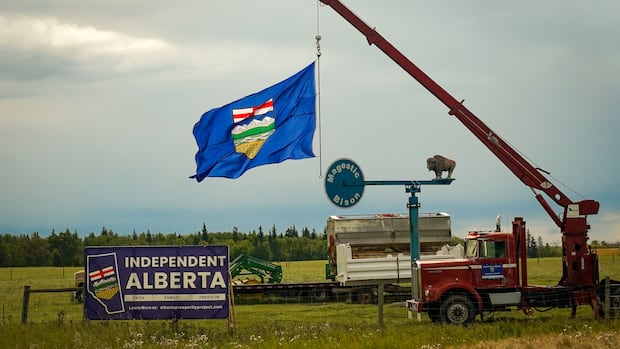
As Alberta prepares for its upcoming independence referendum, seasoned Quebec sovereigntists are making a clear distinction from the separatist sentiments in the western province.
The tenth question on Monday’s ballot asks if Alberta should stay part of Canada or begin the legal steps to hold a binding referendum on separation. Advance voting started Tuesday and will continue until Saturday.
For many in Quebec, this might feel familiar, reminiscent of the 1980 vote when René Lévesque’s Parti Québécois sought public opinion on whether the province should initiate talks to leave Confederation. At that time, nearly 60 percent of Quebec voters rejected Lévesque’s initiative.
Nearly 60 percent of Quebec voters were against sovereignty during the 1980 referendum, which took place when René Lévesque was premier. (Canadian Press)
A follow-up referendum occurred in 1995, which was narrowly won by those opposing separation. Yet committed sovereigntists view significant differences between the two movements.
Quebec Sovereigntists Set Clear Boundaries
Marie-Anne Alepin, president of the Société St-Jean-Baptiste de Montréal-a key Quebec nationalist organization-believes that Alberta is leveraging the idea of separatism as a bargaining tool with Ottawa. She interprets this referendum as an attempt at pressure rather than a true aspiration to form an independent nation.
“They want a bigger role within Canada and we want to leave,” she stated. “They want more control over their oil and gas … we don’t want pipelines.”
However, some leaders within Alberta’s separatist movement have voiced their solidarity.
After Quebec elected the PQ-who promised another independence referendum-to a minority government on October 5th, key figures in Alberta’s separatist movement expressed support for premier-designate Paul St-Pierre Plamondon, viewing him as a potential ally.
During a visit to Calgary last year, St-Pierre Plamondon said he would recognize an independent Alberta should the province vote to separate. (Christinne Muschi/The Canadian Press)
“Quebec rejected the status quo today,” posted ist Cory Morgan-a founding member of the Alberta Independence Party in 2001-on social media after PQ’s win. “Alberta can do the same in two weeks by choosing to send a message with Option 2 on Question 10.”
Alberta separatist Jeffrey Rath also took to social media following the provincial election stating that “for the first time in history, Alberta Independence will have support from an elected government in Quebec.” He congratulated St-Pierre Plamondon and “the country of Quebec.”
The duo lamented alongside lawyer Keith Wilson about how Quebec’s pursuit for independence seems legitimate while they feel Alberta separatists face ridicule.
St-Pierre Plamondon mentioned during his Calgary trip last year that he’d acknowledge an independent Alberta if it decided to separate. Rath noted he met with him then.
Despite supporting referendums democratically, many Quebec sovereigntists don’t align themselves with those pushing for separation in Alberta.
Former PQ leader Jean-François Lisée didn’t hold back when discussing Monday’s referendum.
“It’s mostly a waste because defeat is certain,” he said. “There’s really nothing much gained from watching the Alberta independence movement except maybe negative lessons.”
This sentiment is shared by other sovereigntists as well.
Louise Harel , who served as PQ minister during Quebec ‘ s 1995 sovereignty referendum and later became interim party leader , aligns with Lisée. Both argue that Québec and Albertan separatist movements differ fundamentally. p >
On th e eve o f th e 1995 re fe re ndum , pu blic opi nion w as split evenly in th e polls. ( R yan R emior z / The C anadian P ress ) p >
They believe that Queb ec ‘s so ve reign tis ts are driven by preserving cultural and linguistic identity , while Albe rta ‘s sep ara t ist s are motivated largely by economic interests and political libertarian views. They also note how some Albe rtans seem eager to align closer with America , whereas Que be cers fear assimilation threats. p >
A lberta P rem ier Danielle Smith has consistently stated her opposition towards secession , while PQ leadership openly advocates for sovereignty. p >
“In Q uebec , th e aim is giving unique historical nations in North America-which.. ha ve bravely resisted assimilation-the powers they need to thrive globally,” remarked Harel. “But there isn’t any identity or cultural issue present like there is in Alb erta.” p >
A lberta P rem ier Danielle Smith has repeatedly said she is against secession , whil e PQ leaders have openly called for sovereignty. ( James Maclennan / The C anadian P ress ) p >
Though sovereigni st Québeccers often feel economically disadvantaged within Canada , Lisée mentioned that this sentiment isn’t central to their movement. He emphasized how Québec’ s sovereign parties have historically leaned towards social democracy whereas movements emerging from Albe rta seem connected more closely wi th conservatism. p >
Daniel Tur pit , law professor at Université de Montréal who represented both Bloc Québécois and PQ sees differences regarding refer endum procedures too ; Québec ‘s two inde pendence referendums featured one single question regarding sovereignty. p >
Thus there were extensive mobilizations among federalist advo cates along w ith sov ere ign ti st factions leading upto them.
< h2 cl ass= "" h2-w T v8 Nine""html-heading=""A lb er ta sp lit le ss than Qu eb ec ""
Public sup port fo r independence vary considerably across both provinces.
Prior tothe1995referendum, pub lic opinionwas evenly divided according topolls; justthree days before voters headedto castingtheir ballots, Cana di ans traveledfrom all overthecountryto Montreal urgingthemto rejectindependence.
Poll aggregator338Canada reportsless than25percent supportfor Albertatoleave Canadaasof October11th.
“There hasn’t beenanymajor enthusiasmin Albertayet,”Turpsaid.“Perhapswe’renotasconcernedbecausepollsshowtheoptiontoremainwillprevail.”
WATCH | Here’s what’s behind separatist sentiment in central Alberta :<P Class =" Video-I Tem-Tit Le "" Why Separatist Sentiment Runs High In Central Albert A ""
< P Class ="Paragraph-B-G-x-d HTML-Paragr Aph ” Morethan90%ofregisteredvoterscastballotsduringthe1995referendum, federalistswonwith50.58%ofvotescast.”
The kind of voter turnout seen there resembles what you’d find where voting is mandatory,” remarked Harel.” I’d be really surprised if voter turnout were anywhere near similar for Albertan votes.”
The sovereigntists don’t completely dismiss Arizona’s move either; all four showed sympathy towards autonomy desires sparked amongst Alabertans wishing self-determination.” If A laberta decides yes, and Ottawa responds saying,’youcan’tleave’, we’llstandwith Alberta”said Lisée.”
If Alaberta stayswithin Canada, Turp believes itmay draw inspirationfrom Québec’s methodsinnegotiatingmoreautonomywith Ottawa.(The Canadian Press)’’
[add_link] askediftheyworriedthatano-voteon Mondaycouldimpact PQ-promisedreferenda-allfourrespondednoconcernswerepresent. Alepinfeelsbothmovementsaredifferentenoughthat Albertacouldn’texertinfluenceover Québecercertainlywillingnessto pursue sovereignty.”
Lisée anticipatesthat“thenegativeoutcomeforyes-voterson Mondaywilllikelyhavea minorimpactonthe(debatearound)Quebecreferendum.”
If A laberta remainspartofthecountry, Turpcautionsaboutpossibleinspirationcouldarrivefrom Québesattemptsatfosteringgreaterautonomyvia negotationswith Ottawa. “Thenagaintheycouldsetuptheirsecondvote, similar tous,” headded.
a href=”https://www. cbc. ca/news/canada/montreal/quebec-sovereigntists-alberta-separatists-9.7383106”>Source link