




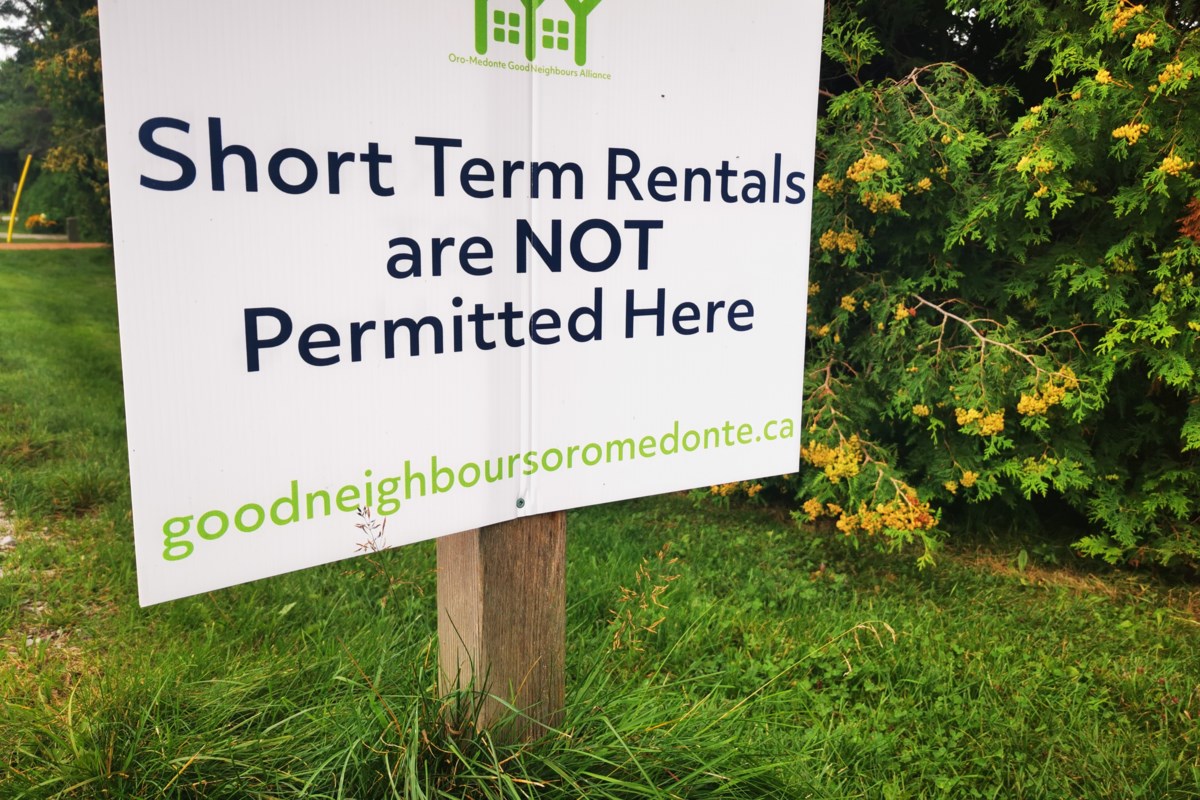
The township is also dealing with several appeals at the Ontario Land Tribunal and a judicial review regarding decisions about short-term rentals.
A notice of application has been submitted to the Ontario Superior Court of Justice, aiming to invalidate Oro-Medonte Township’s licensing bylaw for short-term rentals because it “is illegal, invalid and of no force or effect.”
This application was made by the Oro-Medonte Association for Responsible STRs (the association) along with three individuals on Oct. 2 and is set to be discussed through video conference on July 13, 2027 at 9 a. m.
Barry Sookman, president of the association, stated that eight appeals against the township’s decision in July to not rezone seven properties in residential zones were filed with the Ontario Land Tribunal (OLT) in August.
Furthermore, Sookman mentioned that an application for judicial review concerning the refusal to rezone these properties was also filed in August in Divisional Court.
The notice of application asserts that the township has “unlawfully made the eligibility for a licence under the bylaw conditional on a contrived requirement that short-term rental properties must have site specific zoning to be licensed or to advertise a property as a short-term rental.”
“However,” it further notes, “as already determined by the Ontario Land Tribunal and the Divisional Court, renting properties on a short-term rental basis is legal under the township’s zoning bylaw 97-95, whether the property is advertised or not.”
The application argues that “the licensing bylaw is illegal, ultra vires and cannot stand.”
It claims “the township knows short-term rentals are not illegal, whether they advertise or not.”
Additionally, it states “the township’s mayor, deputy mayor and planning staff know this because they were informed so by the Ontario Land Tribunal (OLT), which repealed Township Bylaw 2020-ZB-073 that incorrectly asserted that short-term rentals in Oro-Medonte were illegal if advertised online.”
“They were also told this,” according to the application, “by the Divisional Court which upheld OLT’s decision indicating that a short-term rental only becomes an illegal ‘commercial accommodation’ when operated similarly to hotels or motels and if such use predominates.”
The notice of application mentions that “the township has been informing residents that all short-term rentals (outside two resort zones) are illegal. Recently they claimed these are illegal if merely advertised as such without site-specific zoning.”
The application contends “the township enacted this licensing bylaw based on an assumption that short-term rentals are illegal which has been proven false.”
No claims from this case have been evaluated in court yet.
Sookman expressed his belief that this court action could have been avoided.
“In July, we provided council with legal advice addressing concerns about this proposed law alongside its potential impact based on earlier decisions,” he noted in his release.
“Council had also previously received guidance from its own planning team stating short-term rentals weren’t illegal while acknowledging risks linked to expected challenges against their licensing approach,” he added.
Officials from the township mentioned they couldn’t comment about these ongoing matters.
“Since this involves litigation matters, we’re unable to provide comments,” stated Jenny Legget, manager of communications and customer experience at Oro-Medonte Township.
Source link