




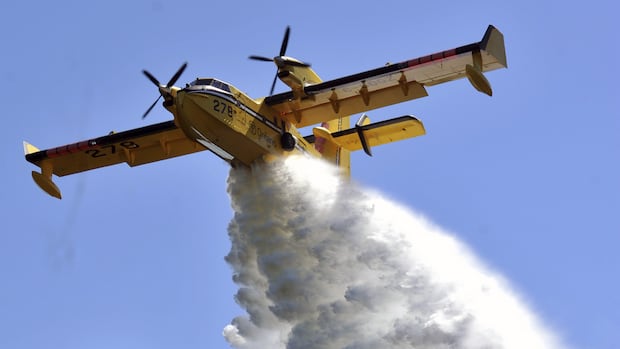
Currently, there are 84 active wildfires in northwestern Ontario, based on the most recent report released Sunday night by Ontario’s Aviation, Forest Fire and Emergency Services (AFFES).
Among these fires, seven are not contained, six are being managed, nine are under control, and the remaining fires are being monitored.
The province noted that as of Sunday evening, no new fires had started in the northwest area since the last update on Friday evening. Additionally, cooler temperatures and rain on Saturday were anticipated to aid efforts in lowering the intensity of some of the major fires in the region.
The forest fire risk is generally low to moderate across northwestern Ontario. However, there are areas of high risk in the southwest part of the region, particularly near Fort Frances. High hazard zones also exist north of Lake Nipigon and around Marten Falls First Nation.
Highlighted Fires in the Region
The Rinker Complex: Consisting of Thunder Bay 36, Dryden 34, and Dryden 35 – continues to be one of the largest firefighting efforts underway. Thunder Bay 36 spans 301,240 hectares; Dryden 34 covers 45,800 hectares; and Dryden 35 is at 30,201 hectares. All three remain uncontrolled. An evacuation order is still active for areas impacted by these fires. Fire activity has been low overall; AFFES mentioned that Fire Ranger teams have made “excellent progress” extinguishing hotspots.
Atikokan Cluster: Fort Frances Fires
Fort Frances 13 measures at 25,313 hectares; Fort Frances 14 at 51,768 hectares; and Fort Frances 15 at 42,273 hectares. Fort Frances 13 is now listed as being monitored while Fort Frances 14 and 15 remain uncontrolled. Travel restrictions have been lifted for Fort Frances 14 and 15 but those returning to these areas are advised to avoid active firefighting operations. The cooler weather from Saturday along with increased humidity and forecasted rain was expected to help lessen fire behavior; however, stronger winds could potentially carry smoke or trigger isolated flare-ups. The province reported that an additional group of twenty firefighters from Mexico joined those working on Fort Frances 14 Saturday and crews have been making headway extinguishing hotspots.
Approximately 829 People Remain Displaced
As reported on Friday, about 829 individuals continue to be displaced due to wildfires in Ontario according to the Ministry of Emergency Preparedness and Response.
Around 2,000 evacuees from various parts of northwestern Ontario have made their way back home.
The ministry has conducted over 110 coordination calls involving First Nation chiefs, community leaders, emergency management partners , municipalities , and federal officials said Jill Dunlop , Ontario’s Minister of Emergency Preparedness , during a news conference Tuesday.
Evacuation Alerts Issued
Two new evacuation alerts have been established for Fort Frances 39 and Minnesota’s “Thumb Fire.”
The Dryden Fort Frances Atikokan District has announced an evacuation alert due to “the evolving situation and increased fire activity regarding wildland Fire Fort Frances 39 and Minnesota’s ‘Thumb Fire.’”
Residents living or utilizing areas close to these fires on the Ontario side are “strongly encouraged to prepare for possible evacuations at short notice.”
This includes all locations accessible via Lagoon Road as well as those situated on:
Blue Lake. Cranberry Lake. Lac La Croix. Lilac Lake. Loon Lake. Queer Rock Lake. Spring Lake. Thompson Lake. Trout Lake.
Evacuation orders or alerts persist for regions neighboring these specific fires:
If you’re under evacuation orders you must leave immediately while those receiving alerts should get ready for potential evacuations.
“My ministry is also carrying out assessment flights aimed at documenting property damage,” stated Mike Harris , Minister of Natural Resources , during Tuesday’s press briefing. “Impacted property owners can reach out through 211 for guidance from our ministry staff regarding next steps.”
He mentioned that they’re actively collaborating with Namaygoosisagagun First Nation to restore access roads leading into communities near lakes while engineers work quickly on its primary bridge construction.
The ministry is also partnering with camps , tourist operators , and other stakeholders to facilitate assessments concerning damages,” Harris added. p >
Northwestern Ontario alongside a small section of northeastern Ontario remains classified as a restricted fire zone prohibiting any outdoor burning including campfires. p >
Notice To Air Missions (NOTAMs) have also been issued covering Thunder Bay 36 and Fort Francis 14. p >
However updates were implemented Friday regarding restrictions previously affecting Thunder Bay ¬ ¬ ¬ ¬ ¬ ¬ ¬
Source link