




A heat wave along with wildfire smoke is leading to potentially hazardous conditions in parts of southwestern Ontario on Wednesday.
Environment Canada issued its first air quality warnings of the year on Wednesday morning as a prolonged heat warning continued across the area.
Environment Canada meteorologist Kate Leclerc mentioned that smoke from wildfires in northwestern Ontario is moving into much of southern Ontario and will probably keep affecting air quality into the evening.
“As smoke levels increase, health risks increase,” Leclerc said. “People should limit their time outdoors and consider reducing or rescheduling outdoor sports, activities and events.”
Forecasters predict that air quality will worsen throughout the day in many parts of southwestern Ontario, including Sarnia, Windsor, London, and extending through Kitchener and Toronto.
![]() A live map from Fire Smoke Canada shows the expected smoke coverage over southwestern Ontario at 3 p. m., on Wednesday, with darker tones indicating denser smoke. (Firesmoke. ca)
Air quality warnings for Windsor, Sarnia, and London were upgraded from yellow to orange on Wednesday morning. Orange warnings were also put out for Kitchener-Waterloo and Toronto.
In London, the Air Quality Health Index is projected to hit 8 on Wednesday before rising to over 10 overnight. It’s expected to stay at 10 on Thursday and go above 10 again Thursday night. Index readings between 7 and 10 signify a high health risk.
Leclerc noted that the combination of extreme heat along with wildfire smoke creates extra challenges for people trying to stay safe.
“One of the ways people try to keep cool is by opening windows at night if they don’t have air conditioning,” she said. “But if the air quality is bad, you have to choose your battles. They definitely have a worsening effect when combined together.”
Wildfire smoke can cause irritation in eyes, nose, and throat as well as headaches and coughing. More serious symptoms may include wheezing, chest pain, and severe coughing.
When both warnings are active, Leclerc advised that people should focus on protecting themselves from heat-related issues.
“If you really have to choose one or the other, we do recommend prioritizing the heat effects on your body,” she said. “If you need to open up a window to cool down, go ahead. Apply that to your situation.”
Officials also suggest limiting intense outdoor activity; if being outside can’t be avoided, wearing a well-fitting N95 respirator or something similar can help reduce exposure to fine particles in smoke.
The Middlesex London Health Unit (MLHU) encourages residents to check in on those who might be more vulnerable due to poor air quality such as seniors, pregnant women, young children, or individuals living outdoors.
“During these extreme heat events and when the air quality is really bad, it’s really important to keep in mind folks who are outdoors for extended periods of time and just try to ensure they have the necessary supports and hydration,” said David Pavletic, program manager of environmental health at MLHU.
A list of cooling centres and resources can be found on the city’s website.
Environment Canada’s air quality warning does not specify an expected end time.
A live map from Fire Smoke Canada shows the expected smoke coverage over southwestern Ontario at 3 p. m., on Wednesday, with darker tones indicating denser smoke. (Firesmoke. ca)
Air quality warnings for Windsor, Sarnia, and London were upgraded from yellow to orange on Wednesday morning. Orange warnings were also put out for Kitchener-Waterloo and Toronto.
In London, the Air Quality Health Index is projected to hit 8 on Wednesday before rising to over 10 overnight. It’s expected to stay at 10 on Thursday and go above 10 again Thursday night. Index readings between 7 and 10 signify a high health risk.
Leclerc noted that the combination of extreme heat along with wildfire smoke creates extra challenges for people trying to stay safe.
“One of the ways people try to keep cool is by opening windows at night if they don’t have air conditioning,” she said. “But if the air quality is bad, you have to choose your battles. They definitely have a worsening effect when combined together.”
Wildfire smoke can cause irritation in eyes, nose, and throat as well as headaches and coughing. More serious symptoms may include wheezing, chest pain, and severe coughing.
When both warnings are active, Leclerc advised that people should focus on protecting themselves from heat-related issues.
“If you really have to choose one or the other, we do recommend prioritizing the heat effects on your body,” she said. “If you need to open up a window to cool down, go ahead. Apply that to your situation.”
Officials also suggest limiting intense outdoor activity; if being outside can’t be avoided, wearing a well-fitting N95 respirator or something similar can help reduce exposure to fine particles in smoke.
The Middlesex London Health Unit (MLHU) encourages residents to check in on those who might be more vulnerable due to poor air quality such as seniors, pregnant women, young children, or individuals living outdoors.
“During these extreme heat events and when the air quality is really bad, it’s really important to keep in mind folks who are outdoors for extended periods of time and just try to ensure they have the necessary supports and hydration,” said David Pavletic, program manager of environmental health at MLHU.
A list of cooling centres and resources can be found on the city’s website.
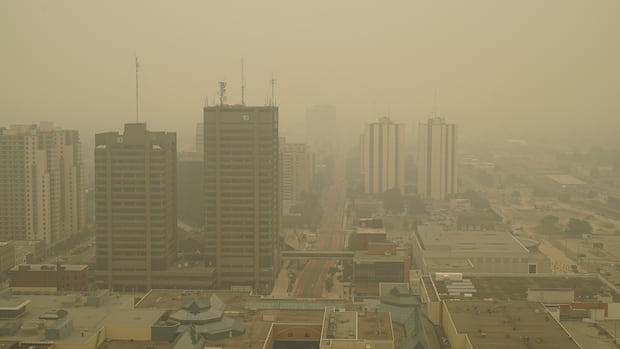
Environment Canada’s air quality warning does not specify an expected end time.![]() Wildfire smoke hanging in the skies above London, Ont., creates a yellow hue on Wednesday Jul. 15th ,2026.(Alessio Donnini/)
Wildfire smoke hanging in the skies above London, Ont., creates a yellow hue on Wednesday Jul. 15th ,2026.(Alessio Donnini/)
Source link
Heat warning continues
The air quality warning comes as southwestern Ontario stays under a heat warning. London’s expected high temperature for Wednesday is around 33 C with a humidex reaching up to 42 degrees Celsius. The heat warning might lift later Wednesday evening for London but areas near Lakes Erie & Ontario could remain under it until Thursday or Friday. “The smoke is going to continue through at least Friday,” Leclerc stated. “Keep updated with current warnings , monitor forecasts , and check available advice online.” Environment Canada explains that hot , humid conditions can make air quality worse while increasing risks associated with heat-related illnesses. Civic officials urge residents not only drink water often but also avoid strenuous activities during peak heating hours , check up on vulnerable neighbors & family members , and never leave pets & children inside parked cars. If you’d like more information about how locals are dealing with this heat wave-and tips for staying safe-you can read CBC London’s story regarding this issue here.Source link