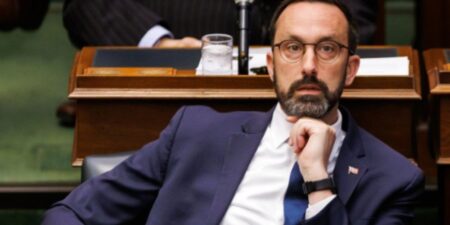





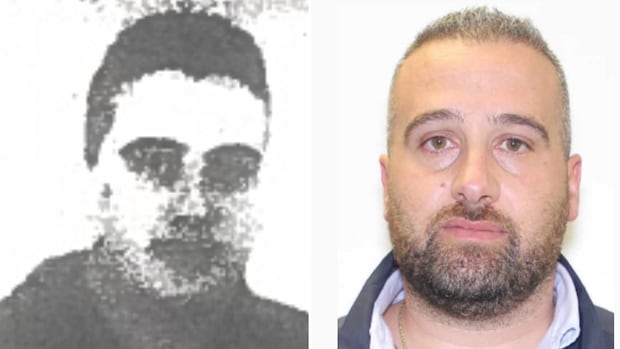
Living comfortably north of Toronto in a spacious five-bedroom, six-bathroom house on an expansive property with a movie theatre and garage space for nine cars, Carlo Bruzzese doesn’t seem like someone who’s on the run.
A married father of four, public records indicate he shares his address with his mother and runs a construction business.
However, in Italy, prosecutors view Bruzzese as a significant criminal figure – a fugitive they’ve sought for 16 years – linked to the Calabrian ‘ndrangheta, a powerful crime syndicate involved in drug trafficking, bid-rigging, and extortion.
The 41-year-old is both the son and son-in-law of alleged mob leaders who have been removed from Canada. He was convicted over ten years ago due to his supposed connections to the mafia.
Now, has discovered that Italian officials are pushing to extradite Bruzzese to enforce the six-year prison sentence he was given but has yet to serve.
Carlo Bruzzese’s bail conditions state he must return every night to his home in the Woodbridge district of Vaughan, Ont. (CBC)
An Ontario court filing reveals that evidence from the Italian government includes several wiretaps and a secretly recorded conversation from 2008 inside a Range Rover where two senior mafiosos talk about “Franco” holding a “high” position in Carmelo Bruzzese’s ‘ndrangheta unit.
Italian authorities claim “Franco” refers to Carmelo’s son, Carlo.
Nadine Ramadan, spokesperson for Toronto police, stated that Carlo Bruzzese was arrested on April 22 in Vaughan “on the strength of an arrest warrant issued under the Canadian Extradition Act as he is wanted by Italian authorities.”
Court documents show Carlo, who holds dual citizenship in Italy and Canada, received bail nine days later.
Three family members pledged $4 million for Bruzzese’s release. He agreed to wear a GPS tracker and return each night to his security camera-equipped home valued at $3.3 million in Vaughan, which is registered under his mother and older brother’s names.
The first arrest warrant for Bruzzese came from Italy back in 2010 after an extensive mafia investigation. Two years later, he was convicted in absentia for mafia association – an Italian charge that Bruzzese’s legal team argues has no equivalent here in Canada.
An expired Italian driver’s licence shows Carlo Bruzzese was born in Locri, Italy, in 1984. (Ontario Superior Court of Justice)
It’s unclear why Rome is now attempting to carry out this six-year sentence.
“The government of Italy has not sought extradition in this matter since 2014,” said Bruzzese’s lawyer Marco Sciarra during court proceedings earlier this month.
“Suddenly [the federal Crown is] really urging us to move things along quickly; however we truly need time to prepare our response.”
Canadian government attorney Marin Nati told the Ontario court that “I don’t think it should be up to the Attorney General of Canada to control or demand when Italy seeks extradition.”
“They decide when they want it; we just respond accordingly,” he added.
Bruzzese’s lead attorney Michael Lacy declined CBC’s request for comment but noted in court filings that his client intends to contest extradition.
Carlo Bruzzese was granted bail at the Superior Court of Justice after a hearing on May 1. (Evan Mitsui/CBC)
Father Identified as Mafia ‘Capo’
Carlos’ father Carmelo once told Canada’s Immigration and Refugee Board (IRB) that Italian authorities were targeting his youngest son “just to frustrate and harass the family,” according to IRB records reviewed by .
The IRB determined back in 2015 that Carmelo-who had ties with late Montreal mafia boss Vito Rizutto-was inadmissible into Canada due to being part of an organized crime group.
“The evidence does not depict a depthless or superficial affiliation with the ‘ndrangheta,” wrote IRB adjudicator Ama Beecham. p >
Instead , Beecham indicated Carmelo seemed more like a leader or “capo” within this specific unit (“locale”) belonging to the Calabrian criminal organization based out of Grotteria. p >
Under oath , Carmelo admitted using his children regularly as couriers for large sums between Italy and Canada instead of opting for bank transfers. An Italian judge also reportedly described “a sophisticated hiding place” within Carmelo’s home back in Italy. p >
Carmelo asserted before IRB officials that he had no real knowledge about mafia activities beyond what he’d read online or seen depicted within The Godfather film series released back around 1972. p >
As far as Carlo goes , courts found him having facilitated communications amongst members , participated actively during meetings , while also carrying out directions given by prominent figures within Grotteria locale along with its entire association ; testified Toronto Police Det.-Const. Charlene Smith through sworn affidavit. p >
Car lon o B ru zz es e ’s fa th er- i n- l aw Gi use pp e Co lu cc io wa s de sc rib ed i n un da te d ph ot os pr ov id ed b y It alian gove rn ment ba ck i n 2008. (It alian In terior M ini stry / Re u ters )
‘Mafia Association’ Not Recognized As Crime In Canada
Lacy pointed out via court filings regarding whether Canadians can be extradited based on charges related specifically towards mafia association originating from Italy remains unresolved.
According t o Can adian law , an indiv idual may only face extradition if their purported crime stands recognized throughout both countries involved.
Federal lawyers argue th at t he It alian charge aligns closely wit h Can adian laws regarding participation within cr iminal organizations. However Lacy contends these two offenses diverge because t he one present doesn’t require individuals accused thereof necessarily needing awareness surrounding aiding any criminal group whatsoever.
A F ed eral Cou rt ju dge previously reached similar conclusions concerning Ca rm elo B ru zz ese ten years ago saying: “Since there exists no direct Canadian equivalent f or char ges associating w ith any maf ia-like entity thus rendering extradi tion impractical.” T hen Judge Yves de Montigny affirmed rulings made against him intially stating ; F ederal Cou rt Justice Yves de Monti gny wrote down ways pertaining toward additional deportation measures being utilized instead sending C arm elo Ba ck directly towards I tal y w ithout waiting f urther necessitating such agreement between states al r eady established prior actions taken afterwards resulting ultimately leading him facing inadmissibility determinations made regarding entry across borders into Can ada otherwise infringing upon international relations altogether without proper adjustments following necessary protocol laid down previously agreed upon earlier cycles outlined before being directed any further resources diverted elsewhere effectively causing delays unnecessarily prolonging trials going forth indefinitely until resolved amicably enough once suitable arrangements could finally yield some cooperation agreed upon beforehand establishing better clarity overall moving forward successfully
Source link