





Ontario education workers and parents are sounding the alarm about a significant shortage of educational assistants (EAs) as contract negotiations approach for the upcoming school year.
With schools facing staffing shortages, advocates claim that support is being “rationed” across various classrooms, leaving at-risk students without consistent help.
Pamela Boniferro, President of the Dufferin-Peel Education Resource Workers’ Association, shared with CBC Toronto that current funding models overlook the necessity of human support compared to physical resources.
“You could put an educator in front of a student with no paper, no pencil, no nothing, and the student will learn,” she said. “But you can put pencil and paper in front of a student with no EA, and nothing is going to take place.”
In a statement, Emma Testani, press secretary for the Minister of Education, mentioned that annual education funding has been raised to a record $30.6 billion. She pointed out that the province has facilitated the hiring of over 4,500 additional EAs; however, local school boards ultimately decide on staffing matters.
WATCH | Ontario’s education workers say teachers want change:
Ontario education unions say teachers want change. Here’s what they’re asking for
Ontario’s five major education unions representing teachers and educational staff in public, Catholic, and French schools submitted a notice to bargain on Wednesday as their contracts near expiration in August. As CBC’s Lorenda Reddekopp reports, all parties expect challenging negotiations ahead.
However, for Boniferro and others in this field, merely increasing funding isn’t enough without a plan to attract and keep employees. She noted an alarming number of daily “fail-to-fills,” which means absences go unfilled due to a lack of available supply staff-evidence that falling college enrollments have led boards into a recruitment crisis.
This situation comes as various education unions band together to negotiate new collective agreements before an August 31 deadline. Unions are advocating for mandatory staffing ratios and job security instead of just wage increases.
Lisa Weiler Haskins, president of the Educational Assistants Association, told CBC Toronto that it’s crucial for the government to recognize how this affects all students; she referenced one specific EA who divides her time among four classrooms.
“For that hour a day that she’s in there with this grade three student, it is magnificent,” she said. “And everybody’s learning-him and the other children. But when she leaves, that student isn’t getting the support. And so he’s acting out.. and the teachers can’t teach.”
Lack of support often leads to ‘classroom evacuations’: union president
When high-needs students don’t receive adequate assistance, it often results in distress that forces “classroom evacuations,” Weiler Haskins explained-a chaotic disruption where entire classes must exit while staff handle situations involving an upset child who may damage property.
This environment can also lead EAs to experience injuries while on duty, she added.
The pressure has caused widespread burnout among staff members; Boniferro remarked how frequently they report crying in their cars before shifts begin.
This leaves parents grappling with consequences at home. Cataldo Brugnano described his experience with his son on the autism spectrum who recently left public schooling; he told CBC Toronto navigating through this system felt like an endless struggle where necessary accommodations were seldom provided.
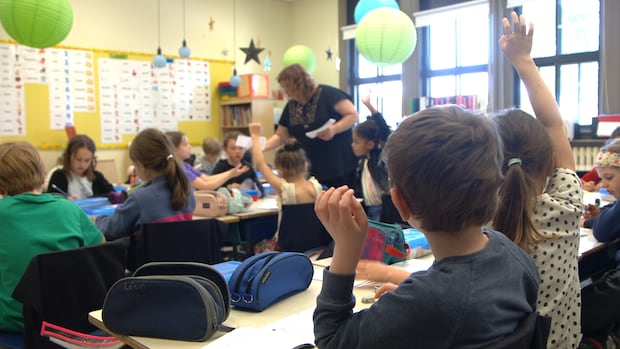
Education workers note that when high-needs students are left unsupported without a present EA, the resulting distress frequently forces ‘classroom evacuations.’ (Halyna Mihalik/CBC)
“People want to help out.. but they had no resources because my son is one of many,” he said. “We would actually often have to badger and badger and badger for something to happen.”
Brugnano believes low pay contributes to turnover rates that negatively impact vulnerable students needing consistency.
“My son’s gone through 15 counselors in five years. It’s ridiculous,” he stated. “It becomes very frustrating for both parents and child.”
Boniferro emphasized once again that addressing this crisis needs provincial efforts aimed at encouraging people into these roles by citing past healthcare recruitment strategies as examples.
“You put the 911 call out for PSWs; you put it out for nurses; you offered premiums on education; you offered all that,” she said. “Where’s the incentive to get these people in [EA] programs?”
Source link