



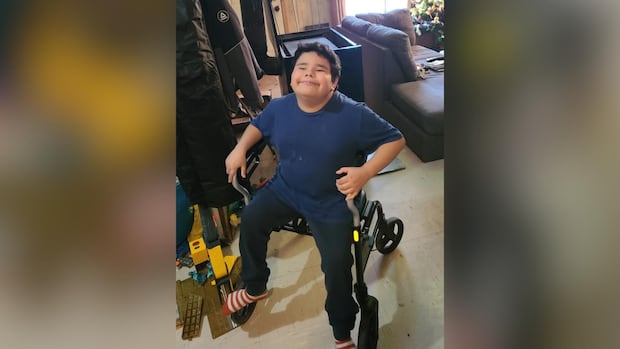
The household of a seven-year-old boy from Deer Lake First Nation who was denied medical transportation protection as a result of he did not but have an Indian standing card is looking for modifications to Ottawa’s Non-Insured Well being Advantages (NIHB) program.
Jordan Harper was significantly injured, and his grandmother died, in January in a head-on collision with one other car on the winter highway close to the northwestern Ontario group. The Grade 2 pupil was airlifted to the Hamilton Well being Sciences Centre, the place two metallic rods have been put in his leg.
Final month, Jordan was alleged to have the rods eliminated, however his household was ready for NIHB employees to e-book a scheduled medical evacuation from Deer Lake to Thunder Bay.
“His leg was all swollen from the rods,” mentioned Aretta Meekis, who described her stepson as sensible and outgoing.
The household mentioned they have been informed Jordan wasn’t lined beneath NIHB as a result of he did not have an Indian standing card, one thing his late grandmother — who was his major caregiver — had been making an attempt to get him.
“I used to be simply crying that at some point as a result of they refused — they nonetheless refused the medevac and he was simply in ache,” his stepmom mentioned. “He simply turned seven, like, how are you going to refuse a baby?”
About 1,100 individuals dwell in Deer Lake, a distant group that may solely be accessed by airplane or winter highway.
After ready greater than every week to get him out of the group, the Oji-Cree First Nation’s tribal council, Keewaytinook Okimakanak, paid to ship him to Thunder Bay for the rod-removal surgical procedure.
“We’re listening to tales like that throughout — group chiefs paying for issues, well being administrators paying for issues,” mentioned Monica Hemeon, vice-president of regional companies for the Sioux Lookout First Nations Well being Authority (SLFNHA).
SLFNHA gives well being companies to 33 First Nations — 28 of them are distant.
We’re listening to tales like that throughout — group chiefs paying for issues, well being administrators paying for issues.- Monica Hemeon, SLFNHA
The NIHB program gives protection to First Nations and Inuit individuals throughout Canada for a variety of well being advantages that are not already lined beneath social packages, non-public insurance coverage, or provincial or territorial medical health insurance.
This consists of medical transportation to entry companies that are not out there of their communities.
With the intention to qualify, shoppers should dwell in Canada and be at the least one of many following:
A First Nations particular person registered beneath the Indian Act — often known as a standing Indian. An Inuk acknowledged by an Inuit land declare group. A baby beneath two years previous whose father or mother is eligible beneath the NIHB.
Jordan’s stepmom questions why, contemplating the urgency of the care Jordan wanted, an exception could not be made whereas his household completed finishing his standing Indian card software. The method continues to be within the works — the household’s efforts to get him the cardboard have been delayed as they handled the accident.
A spokesperson for Indigenous Companies Canada (ISC) informed CBC in an e-mail that it “is working diligently to enhance NIHB medical transportation companies within the Sioux Lookout space.”
Jordan’s household, nonetheless, mentioned the change cannot come rapidly sufficient.
Miscommunications, missed appointments
Brad Meekis is a band councillor for Deer Lake First Nation who oversees the well being portfolio in his group. He mentioned miscommunications between NIHB employees and Deer Lake’s nursing station repeatedly lead to journey not being booked and appointments being cancelled.
“As soon as the referrals are made to NIHB, they are saying that they do not obtain the referrals from our nursing station.
“A few of our individuals miss vital appointments like this. Generally they wait quite a few years earlier than they’re seen once more.”
Amanda Meekis, seen exterior Deer Lake First Nation’s nursing station, manages medical journey requests for group members. She says sending referrals to employees with the Non-Insured Well being Advantages (NIHB) program entails numerous paperwork and advocacy for group members. (Submitted by Donna Potter-Roberts)
Amanda Meekis, who works at Deer Lake’s nursing station, is answerable for managing medical journey requests and sending referrals to NIHB employees, which entails numerous paperwork and advocacy for group members. She mentioned she usually spends hours on maintain with NIHB staff and generally has damaging interactions with them.
“Generally, they simply dangle up on me.”
She mentioned NIHB employees usually ask her detailed questions in regards to the causes shoppers want medical transportation, however she will’t disclose that info resulting from affected person confidentiality.
A few of our individuals miss vital appointments like this. Generally they wait quite a few years earlier than they’re seen once more.- Brad Meekis, Deer Lake First Nation band councillor
When individuals from distant communities miss appointments, “the influence probably is catastrophic,” mentioned Hemeon.
“If somebody’s meant to exit to see a specialist, and so they’re getting recognized with one thing at that appointment and so they miss that appointment, that analysis now’s pushed.”
ISC boosts staffing to extend capability
Jennifer Cooper, a spokesperson for ISC, mentioned in an e-mail that an preliminary assembly was held between the division and SLFNHA in July “to debate their considerations in regards to the NIHB program.”
Since then, a variety of conferences have taken place, and ISC mentioned a number of steps have been taken “to resolve the challenges raised and improve capability on the Sioux Lookout workplace.” These embrace:
Boosting staffing numbers, for a complete of 20 staff on the Sioux Lookout NIHB workplace, to supply extra telephone help to cut back wait occasions. The creation of a brand new senior supervisor place to guide the workforce and handle capability.
“ISC can be adjusting inner processes and governance constructions, and streamlining kinds and documentation to enhance our capability to answer medical transportation requests,” Cooper mentioned.
A bilateral desk was additionally established with SLFNHA “to help common dialogue of gaps and challenges, and actions that may be taken to enhance NIHB operations within the Sioux Lookout area.”
Want for extra help in city centres
When shoppers do not present as much as appointments, health-care suppliers turn into extra reluctant in scheduling followups, mentioned Hemeon, even when the scenario was past their management — like journey not being booked or a airplane being cancelled resulting from inclement climate.
Past getting individuals out of their communities for care, Hemeon mentioned, there is a want for extra help as soon as they arrive.
SLFNHA operates three hostels in Sioux Lookout to accommodate individuals who’ve travelled there for medical appointments. The group additionally provides transportation, translators, affected person navigators and different help.
 Monica Hemeon, vice-president of regional companies on the Sioux Lookout First Nations Well being Authority, says that when group members miss medical appointments, it could actually have a catastrophic influence on their well being. (Sarah Legislation/CBC)
“It is after they have to go away Sioux Lookout that the consumer tends to have a bit bit extra bother navigating the health-care system, particularly in greater city centres like Thunder Bay, Winnipeg and Toronto,” mentioned Hemeon.
Oftentimes, NIHB employees do not reserve lodging prematurely, and sufferers who do not have bank cards have issues reserving taxis and resort rooms, she mentioned.
SLFNHA is taking a look at increasing its presence in these city centres; it is already launched a transportation program in Thunder Bay.
Nonetheless, “we’ve acquired a really damaging response from Indigenous Companies Canada and NIHB particularly concerning our want to maneuver out and into these city metropolis centres to help our shoppers extra,” Hemeon mentioned.
 Jordan, together with his stepmother Aretta Meekis, are again in Deer Lake First Nation, gearing up for the vacations. He is feeling higher following surgical procedure in Thunder Bay to take away the rods from his leg. (Submitted by Donna Potter-Roberts)
Again in Deer Lake, Jordan is feeling lots higher, mentioned Aretta Meekis.
“He is so comfortable he can transfer round freely,” she mentioned. “They did such an excellent job on his leg. He is so pleased with the nurses and the medical doctors.”
Jordan has a followup appointment developing in Thunder Bay. When CBC spoke with Aretta Meekis, she wasn’t positive how that journey could be lined.
Her hope is Jordan’s story informs others in regards to the challenges individuals in distant communities face in getting care and that different households do not undergo related conditions.


