

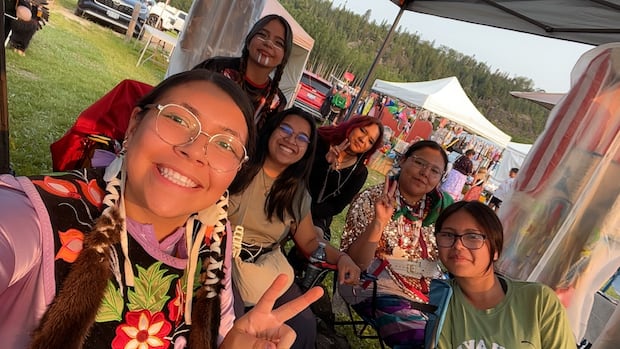
Powwow regalia are beautiful creations – some are crafted by the people who wear them, while others are custom-made for their use.
But what about those who can’t afford to have regalia made, don’t know how to create a piece, or simply aren’t able to own their own regalia?
This is where Tisha Duncan and the Wabinoong Regalia Collective step in: They provide free regalia rentals at powwows, supporting First Nations communities in northwestern Ontario.
Duncan was just 19 when she began traveling to various powwows with other Indigenous youth from Thunder Bay and offering this rental service, now in its second year. She got inspired after discovering a similar program in Oregon, right as she was starting her journey into dancing and creating her own regalia.
The Wabinoong Regalia Collective travels to powwows across northwestern Ontario, lending regalia to those who need them. (Submitted by Tisha Duncan)
“For me, there were a lot of barriers, I guess in accessing that financially, culturally, knowing elders in my area,” said Duncan.
“Specifically in northwestern Ontario, we really needed something like that up here. I think a lot of the Indigenous youth were struggling and I could see this helping, and I had no idea how I was going to make it happen, but I.. guess I made it happen.”
Importance of Regalia in First Nation Culture
Traditional regalia are also worn during cultural ceremonies, community celebrations, graduations and other special events. For example, on Jan. 4th-National Ribbon Skirt Day-Indigenous women are encouraged to wear traditional regalia as a way to honor their culture and strength as women.
Duncan and her team travel around different communities during powwow season, which usually runs from June through September.
She remembers getting lots of support when she shared her vision for the collective online; community members contributed regalia that their children had outgrown or extra pieces they could share.
The first year Duncan ran the collective saw 200 rentals take place.
“So far, it’s been really good. It’s been really well received,” she noted, adding that the collective receives invitations from various communities.
“I think many families here have noticed the impact it can make and the positivity it brings to Indigenous youth. So whenever they return their regalia, they’ll share how it’s helped them today.”
Tisha Duncan created the Wabinoong Regalia Collective two years ago (Submitted by Tisha Duncan)
Duncan also aims to bring this initiative along the powwow trail as part of efforts for suicide prevention among First Nation youth-a region known for having one of Canada’s highest suicide rates.
According to Nishnawbe Aski Police Service (NAPS), which is Canada’s largest First Nations police force, suicide rates among First Nations youth are estimated at six times higher than those of non-Indigenous youth in Canada.
“Almost everyone I’ve talked to has faced some sort of mental health challenge or struggles with poverty.. For me personally, dancing has been incredibly healing,” said Duncan. “It’s helped me through tough times and without it I don’t think I’d be where I am today. I wanted other youth to experience that same opportunity.”
<
Pushing people toward joining the powwow circle is another goal for the collective-as well as empowering young individuals like Misty Atlookan. p >
Atlookan was invited by Duncan to assist with the collective’s work; she says it’s been eye-opening visiting different communities while learning more about her culture.
It’s also helped her come out of her shell.
“I love talking to people,” she mentioned. “I wasn’t like that before-I used to be quite shy. But now I’m very outgoing! This is something I’m passionate about; traveling and attending powwows.” p >
Plans for Continuing the Collective
Atlookan enjoys helping others too; she’s planning on participating again next summer with hopes of making her family proud.
“Being around good energy… learning about my culture and language has truly benefited me-just being immersed in that environment.”
Tisha Duncan came up with the idea for Wabinoong Regalia Collective from a similar initiative in Oregon and wanted it brought over here into northwestern Ontario. (Submitted by Tisha Duncan)
Understanding how essential regalia is for individuals involved; Duncan sought advice from elders at Fort William First Nation regarding proper care techniques for these sacred garments. For instance: She ensures each piece gets smudged after being returned before passing it on again.
As powwow season wraps up; Duncan mentions she’ll be seeking grants or alternative funding sources so they can keep this initiative running next summer.
Source link