




Automaker Volkswagen has begun building North America’s largest EV battery plant in St Thomas, Ont., as the Canadian automotive industry grapples with Stellantis and GM’s plans to either shift or halt production of important vehicle models in the region.
When it opens in 2027, the three large factories within the $7 billion manufacturing complex, developed by VW-subsidiary Power Co, will produce enough batteries annually for approximately one million electric vehicles.
“Electric vehicles are the future of the global automotive sector,” Frank Blome, CEO of Power Co, said in a statement. “Spearheading such a significant investment positions Canada at the forefront of innovative EV battery production.”
This massive gigafactory will be VW’s first lithium-ion battery cell manufacturing facility in North America and will be located at Power Co’s 350-acre St Thomas industrial park. The Canadian construction firm Magil has already laid 500,000 square feet of cement foundations at the site, while another local company, Steelcon, is set to begin constructing the facilities’ steel framework “in the coming weeks.”
Melanie Joly, Canada’s minister of innovation, science and industry, stated that this new facility would enhance domestic EV battery production while also benefiting Ontario and Canada’s manufacturing sectors like steel and aluminum… and creating well-paying jobs.
“We are taking an important step in making Canada a world leader in the EV and battery industry. We are working towards a cleaner, more sustainable and resilient economy,” she added.
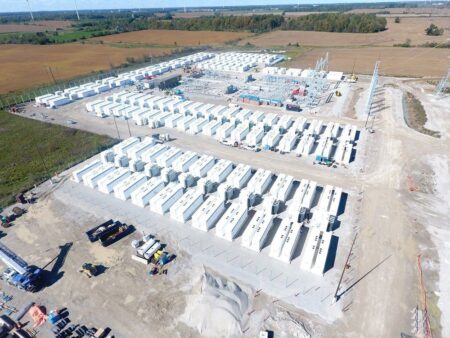
In operation, the St Thomas battery gigafactory, seen here with foundations poured, will produce 1 million batteries a year. Photo courtesy: Power Co
In April, the US imposed a 25 per cent tariff on all Canadian-made auto parts and vehicles that fell outside of the trade agreement known as the Canada-US-Mexico Agreement. Ottawa responded with a matching tariff on US imports.
Even before GM and Stellantis made their latest confidence-shaking announcements, other major car manufacturers planning to establish EV and battery plants in Ontario under the government’s $100 billion industrial strategy had already slowed down their efforts.
‘Long-term trend is clear’
Japan’s Honda Motors reduced its pace on its EV supply chain construction plans in Ontario back in May due to “changing conditions,” leading to a delay of a $15 billion investment. This came after similar slow-downs from Ford and Toyota regarding their facility developments.
Then last month, federal Liberals halted Canada’s Electric Vehicle Availability Standard which aimed for EVs to account for 20 per cent of all car sales by 2026. This uncertainty has impacted electrification goals within an industry that “is under extreme pressure because of the massive change in US policy,” as Prime Minister Mark Carney pointed out at that time.
Jeff Turner, an automotive sector analyst at Dunsky Energy & Climate told Canada’s National Observer that news about Power Co should lift spirits within the sector as he sees reasons for “long-term optimism” regarding Ontario’s EV ecosystem.
“This is a helpful reminder that while any single country’s EV market can experience some ups and downs, the long-term trend in Canada is clear – our latest analysis suggests demand will see a three- to five-fold increase” through 2030,” said Turner.
More than 270,000 electric vehicles were sold across Canada last year which accounted for 13.9 per cent of all car sales compared to just 9.4 per cent in 2023 according to data compiled by Electric Mobility Canada-an industry advocacy group alongside Dunsky. Progressions in EV technology are expected to boost electric cars’ market share up to an impressive 82 per cent among new sales by 2040 “even under low-growth scenarios.”
‘Anchor investment’
Matthew Fortier, CEO of Accelerate-a Canadian zero-emission vehicle supply chain alliance-remarked that Power Co’s advancement showcases “what‘s possible in Canada when long-term thinking meets political will at all levels of government.”
“While the US increases our anxiety levels over trade issues let’s leverage this anchor investment along with others throughout our value chain to ensure Canada remains essential and irreplaceable within this new automotive supply chain,” he shared with Canada’s National Observer.
From October 2021 through April 2024 automakers have announced investments totaling $46.1 billion across Canada’s EV supply chain including companies like Honda, Volkswagen , GM , and Ford-with an additional $52.5 billion backed by federal and provincial governments according to Canada’s Parliamentary Budget Officer who provides economic insights for Ottawa.
During his campaign for prime minister Liberal leader Mark Carney committed to creating a $2-billion fund aimed at developing an “all-in-Canada” auto supply chain. In addition during this year alone Canada imported $2.3 billion worth of electric vehicles and plug-in hybrids from China.
Worldwide sales figures show fully electric cars along with plug-in hybrids surged by twenty-six percent last month compared to last year hitting record highs with two point one million units sold driven mainly by high demand from China paired with late tax incentives from US markets according Rho Motion-a research organization dedicated tracking these trends.
Source link