





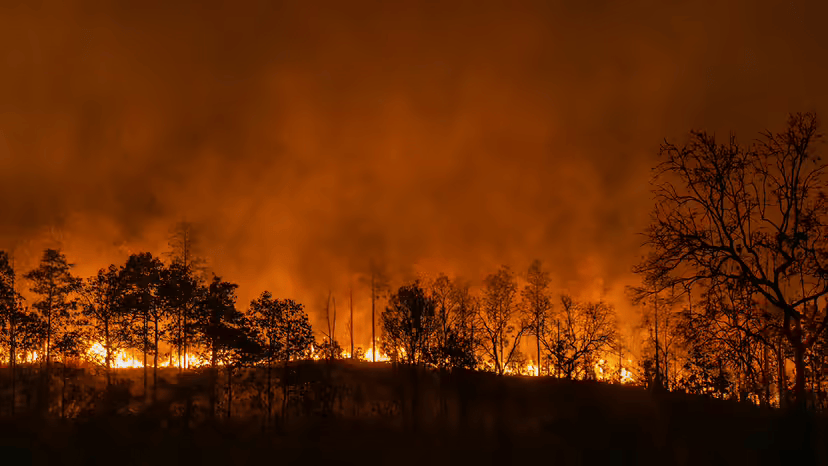
Ontario was at the center of the problem. The province reported 565 wildfires that burned over 728,000 hectares, which is about three and a half times higher than its ten-year average. While annual rainfall across Ontario was near normal, the southwest region experienced more than two standard deviations less rain than usual in the past two months, and temperatures were over 2°C above average. The forests dried out quickly.
“Climate change has not only increased the frequency of wildfires, especially in the mesic vegetation types, but also made them more intense,” said Dr. Mojtaba Sadegh, Climate and Wildfire Analytics Lead at UNU-INWEH. “When these dense forests burn, they release a huge amount of smoke that impacts millions of people far away from the burn perimeters. There is no easy solution to this problem; it requires a collective commitment to curbing climate change, and even if we act today, the problem will not disappear overnight, but we can make sure it does not get worse.”
Smoke from the fires in Ontario traveled hundreds of kilometers. It pushed Toronto’s air quality into unhealthy territory and spread throughout southern Ontario and parts of Quebec before heading south into the United States, degrading air quality in cities like Detroit, Minneapolis, Milwaukee, Chicago, New York City and Washington, D. C. Officials in various states urged residents to stay indoors and limit outdoor activities-especially for children, older adults and those with respiratory or cardiovascular issues. Some cities canceled public events or moved them inside.
The transboundary smoke also sparked political tensions between Canada and the United States-two countries that usually cooperate well during emergencies like this one. The report emphasizes that worsening climate-related wildfire and smoke hazards can strain even close international partnerships while highlighting how coordinated firefighting efforts and public health planning are becoming increasingly vital as these risks grow.
In areas closer to the fires, Indigenous communities faced significant challenges with evacuations. By mid-July, over 3,500 First Nations residents had been displaced nationwide due to wildfires affecting as many as 11 Ontario First Nations. Around 1,800 residents evacuated from remote northwestern communities. Ontario sought federal help-including support from Canadian Armed Forces-to reach areas accessible only by air or water. In Namaygoosisagagun First Nation, residents fled by boat as flames approached their community. Whitewater Lake First Nation also felt the impact of the fires. Transportation routes were disrupted too; operations for Canadian National Railway were halted temporarily.
The report urges national and provincial authorities to enhance evacuation preparedness and shelter options in remote and Indigenous communities. It calls for clean-air shelters along with clearer public health advice during smoke incidents while advocating for investment in early detection systems as well as infrastructure able to withstand fire threats in high-risk areas. Looking ahead long-term ties these risks to rising global temperatures-particularly affecting boreal regions where carbon-rich ecosystems play an essential role beyond just Canada.
“Smoke does not check passports,” said Professor Kaveh Madani, Director of UNU-INWEH. “What burns in a forest in northern Ontario is breathed in a schoolyard in Chicago a day later. It is a shared problem and it has shared solutions. The communities that are evacuated first and hit hardest need investment. And cities need to plan for smoke the way they have learned to plan for heat.”
Read the Incident Brief
Teymoor, S., Abatzoglou, J., Agha Kouchak, A., Madani, K., Matin, M., and Sadegh, M.(2026). The July 2026 Wildfires in Canada and Their Transboundary Smoke Problem. United Nations University Institute for Water , Environment , and Health (UNU-INWEH), Richmond Hill , Ontario , Canada. doi:10.53328/INI26IMS001
Available for Interview
Interview requests should be submitted to media. inweh@unu. edu
Media Contacts
Marjan Asadullah , Communications Assistant , UNU-INWEH , marjan. asadullah@unu. edu
About UNU-INWEH
This year marks its 30th anniversary since starting operations back in 1996-the United Nations University Institute for Water , Environment, and Health (UNU-INWEH) consists among thirteen institutions within UN University (UNU)-the academic arm representing UN interests globally. Known widely as ‘The UN’s Think Tank on Water’, it tackles pressing environmental matters tied closely with human health across diverse geographies worldwide through focused research initiatives along capacity building efforts while ensuring knowledge dissemination channels remain open among stakeholders. Headquartered centrally located at Richmond Hill within Ontario province; supported generously through Government funding initiatives spanning decades-operates under extensive partnerships formed collaboratively between different entities including various global organizations alongside local governmental bodies too!
Source link