
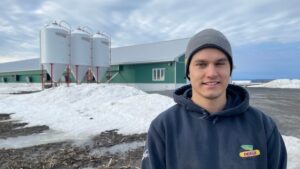



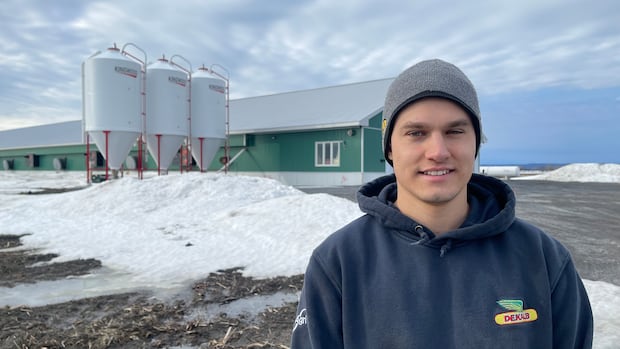
For more than three decades, Marcus Haefele’s family has operated Agri-Caledonia Inc., a broiler chicken and cash crop farm located between Alfred and Vankleek Hill, Ont., east of Ottawa.
They cultivate about 1,090 hectares of land and have two broiler barns, one of which they constructed two years ago with an investment of $7 million.
Haefele worries that the Alto high-speed rail project, which will pass through this area of eastern Ontario, could disrupt their land and threaten their livelihood.
The exact path for the high-speed rail project, intended to connect Quebec City and Toronto, hasn’t been finalized. Alto has stated it plans to make a decision by the end of 2026.
In the meantime, Alto has been conducting field studies on fish and wildlife habitats, soil conditions, and waterways along a wide corridor that includes the United Counties of Prescott-Russell as well as communities like Alfred, Bourget, Hawkesbury, and Vankleek Hill.
This area also encompasses Haefele’s family farm.
Haefele fears that the rail development could sever access to their newly built barn and their water source. (Mélina Lévesque/CBC )
Source link
‘No idea what my future has in store’
This week, Alto announced it would begin reaching out to selected property owners within the study corridor to request permission to enter their properties. This development has left Haefele concerned about his family’s farming future. “They would cut us off from roughly [405] hectares of farmland and would very likely cut us off from access to the newly built chicken barn as well as our water source for both barns we have on the farm,” he said. Haefele mentioned he attended a public consultation regarding the high-speed rail project in Vankleek Hill back in January but ended up with more questions than answers. No matter what, this is going to affect us.- Andrea Glenn, Gibbs Honey “Everyone at the consultation from Alto wasn’t able to address any of our pressing questions,” he said while adding that his family hasn’t yet received any request from Alto regarding access to their farm. “I have no idea what my future holds. Will I be able to continue for another 30 years like my parents did before me? I just simply don’t know,” Haefele said. Gibbs Honey is a third-generation apiary managed by Andrea Glenn alongside her husband in Vankleek Hill; it’s also within the study corridor. “No matter what, this is going to affect us,” Glenn shared with CBC’s Ottawa Morning. “What we’ve established here isn’t something you can easily replicate. We’re located in one of the least expensive areas in eastern Ontario; if we were expropriated we wouldn’t be able to afford anything similar nearby.” Glenn also attended the January session in Vankleek Hill and similarly felt she walked away with more questions than clarity concerning her 45-hectare heritage farm.Alto pledges ‘no-surprise environment’
Marc-Olivier Ranger, who serves as Alto’s chief of strategic policy, environment and partnerships, says they are looking for such feedback from residents. “They’re actually telling us ‘Don’t go close to fragile ecosystems or habitats; don’t split our farmlands in two,'” he explained Tuesday during a public meeting held in Gatineau, Que. Marc-Olivier Ranger speaks at a public consultation session in Gatineau on Tuesday (Mélina Lévesque/CBC) Ranger emphasized that Alto aims to establish a “no-surprise environment” where residents feel informed and heard throughout this process. “The goal here is to listen closely to those concerns then relay them back [to] our designers so eventually we’ll return with additional details along with a refined corridor,” he stated. He noted that most feedback from locals has been positive while enthusiasm for the project continues growing. “People are starting to believe that it will transform how they live work together along this corridor,” he added. Glenn doesn’t share this sentiment. “There are plenty of other opportunities we should explore before committing fully or taking people’s lands away,” she argued. Haefele concurred. “Rural Canada shouldn’t have its resources sacrificed just so city dwellers can enjoy easier transportation,” he insisted. The final face-to-face public consultation is scheduled for March 25 in Stirling Ont., but people can submit feedback until April 24.Source link