


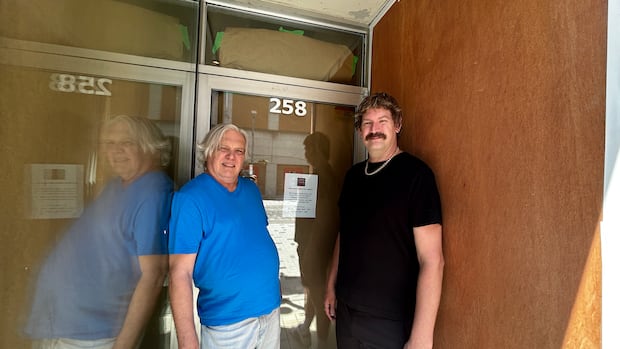
At first glance, it might seem like the ceramic art gallery at 258 Dundas St. in downtown London has closed its doors for good. The front windows are blocked off with brown paper, featuring notice signs taped up front.
But that’s not the situation at all.
The gallery’s windows were covered as a form of protest, according to Brian Cooke, manager of Jonathon Bancroft-Snell Gallery.
“If you don’t use the downtown, this is going to be the future of all the businesses down here,” Cooke said.
“It’s not just us,” he continued. “All the long-term downtown businesses are suffering.”
The sign in the window is actually an invitation for people to come inside and support local businesses.
A sign hangs in the window of the Jonathon Bancroft-Snell Gallery welcoming people to come inside. (Michelle Both/CBC)
Cooke hopes this political act will motivate Londoners to visit the downtown area more often, emphasizing that increased foot traffic could lead to more businesses opening and staying open.
“We need your help,” Cooke said. “Downtown needs your help.”
While downtown London deals with challenges like open-air drug use and homelessness, Cooke pointed out that many cities such as Toronto face similar issues yet still have vibrant downtowns.
On the Brink of Closing
Jonathon Bancroft-Snell opened his gallery in 2000 and mentioned it’s one of North America’s largest galleries dedicated to ceramics at 4,500 square feet, showcasing a collection of colorful paintings and ceramics from contemporary Canadian artists across Canada.
If conditions don’t change soon, everything is at stake.
“The reality is we are within a hair’s breadth of actually closing,” said Bancroft-Snell. “As an independent business owner, it is really, really hard. I have struggled to keep the shop open.”
Jonathon Bancroft-Snell is the owner of the ceramic gallery on London’s Dundas Street near Wellington Street. (Michelle Both/CBC)
He shared that despite having international recognition, sales have drastically dropped over the past year. Last week there were only two sales made-both from visitors who traveled from outside town; one customer was from Picton and another from Thunder Bay.
Bancroft-Snell noted that while events and markets can attract crowds to their area, it’s not sufficient for survival.
“We can’t survive on just a weekend event sporadically,” he said. “We’re here 52 weeks of the year. We’re open six days a week.” p >
He believes if more locals visited regularly, it would benefit everyone involved.
“The only way that a downtown retains vitality is when people use it,” he stated.
More Visitors Needed for Survival
Councillor David Ferreira from Ward 13 agrees with what those brown-papered windows convey to Londoners. p >
“It definitely got people’s attention,” Ferreira said. “I think he’s calling out something that is true.” p >
Ferreira mentioned hearing from other business owners that their main issue stems from not enough customers coming into their shops to keep afloat.
“Londoners need to come downtown. Whatever reason someone might give for avoiding downtown doesn’t change.. it’s meant for everyone in London.” p >
“Some folks might mention homelessness or addiction or empty storefronts as reasons; however, I believe what isn’t discussed enough is how negative perceptions impact our downtown,” he expressed.
“There are plenty of positive things happening around here-resilient people live here along with resilient business owners running shops here-all contributing positively,” he added.
Ferreira encourages residents citywide to put down their phones and get out into what downtown has to offer.
Bancroft-Snell warned if attitudes about downtown don’t shift soon, many small businesses may not survive.
Source link