



Farmers in southwestern Ontario believe it’s crucial now more than ever to support an increasing number of people facing hunger and food insecurity around the globe.
During a meeting with the international aid organization Canadian Foodgrains Bank in St. Thomas, Ont. on Wednesday, participating farmers learned about how their crops, seeds, and donations are making a difference for people in nations affected by geopolitical conflicts and climate issues.
“We’ve been given lots, and we want to be able to help others,” said Jack Koetsier, a farmer from Wyoming, Ont., near Sarnia, who is part of a growing project. “Our family feels this is a very good vehicle to help people in other parts of the world who are less fortunate.”
Growing projects consist of farming groups across Canada that either cultivate crops or donate profits from sales to the Foodgrains Bank so it can provide emergency food assistance in crisis areas. These projects also assist small-scale farmers in those countries as they work towards long-term food security.
Currently, there are 95 growing projects in Ontario involving hundreds of farmers and volunteers. The organization supports initiatives in 70 countries worldwide including Afghanistan, Sudan, Cuba, Uganda, Lebanon, and Haiti.
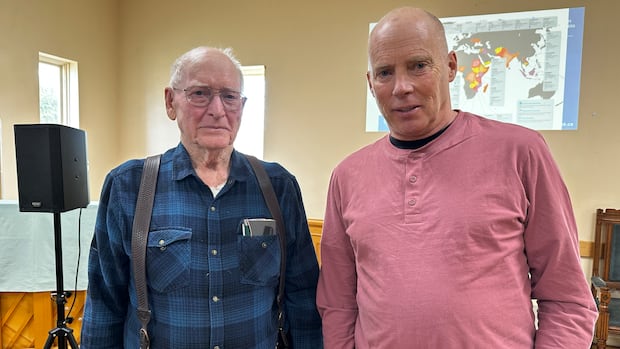
![]() Andy Harrington is executive director of the Canadian Foodgrains Bank, an international aid organization which aims to curb world hunger. The agency partners with Canadian farmers to raise crops and money to provide food assistance to other countries. (Isha Bhargava/CBC)
The challenges mentioned are also making it harder for local farmers wanting to contribute further. The ongoing war in the Middle East has caused prices for diesel fuel and fertilizer to soar while access issues at Iran’s Strait of Hormuz limit availability for one-third of global fertilizer supply.
“The part that bothers me right now is not only the price but also the availability of some inputs for fertilizers that can’t get through right now,” said Richard Bolton whose son and daughter-in-law manage a growing project on their farm located in Kerwood, Ont., within Middlesex County.
While they have secured their fertilizer for this year already, Bolton warns if access issues at the Strait persist into next year it could lead to serious consequences down the line.
“Our own farmers are having economic difficulties so they have to work even harder just getting donations together for funding these projects,” said Rob Hawkin treasurer for Melville United Church located northwest of London which collaborates with Foodgrains Bank on various initiatives.
Despite these obstacles though farmers remain committed because they know their efforts provide vital support for many individuals worldwide. Last year Bolton’s farm teamed up with neighbors raising $24,000 from their crop contributions going directly towards helping others through this organization.
“I don’t think people realize how much difference we make as a group,” he shared.
Koeitsier’s project contributed $180K which could potentially be matched by Ottawa according him adding he hopes future policies will enable Canadian farmers greater self-sufficiency without depending too heavily on foreign resources. Meanwhile he’ll keep pushing forward fighting against global hunger.
Andy Harrington is executive director of the Canadian Foodgrains Bank, an international aid organization which aims to curb world hunger. The agency partners with Canadian farmers to raise crops and money to provide food assistance to other countries. (Isha Bhargava/CBC)
The challenges mentioned are also making it harder for local farmers wanting to contribute further. The ongoing war in the Middle East has caused prices for diesel fuel and fertilizer to soar while access issues at Iran’s Strait of Hormuz limit availability for one-third of global fertilizer supply.
“The part that bothers me right now is not only the price but also the availability of some inputs for fertilizers that can’t get through right now,” said Richard Bolton whose son and daughter-in-law manage a growing project on their farm located in Kerwood, Ont., within Middlesex County.
While they have secured their fertilizer for this year already, Bolton warns if access issues at the Strait persist into next year it could lead to serious consequences down the line.
“Our own farmers are having economic difficulties so they have to work even harder just getting donations together for funding these projects,” said Rob Hawkin treasurer for Melville United Church located northwest of London which collaborates with Foodgrains Bank on various initiatives.
Despite these obstacles though farmers remain committed because they know their efforts provide vital support for many individuals worldwide. Last year Bolton’s farm teamed up with neighbors raising $24,000 from their crop contributions going directly towards helping others through this organization.
“I don’t think people realize how much difference we make as a group,” he shared.
Koeitsier’s project contributed $180K which could potentially be matched by Ottawa according him adding he hopes future policies will enable Canadian farmers greater self-sufficiency without depending too heavily on foreign resources. Meanwhile he’ll keep pushing forward fighting against global hunger.
Source link
Wars and Climate Change Complicate Efforts
Last year alone, the agency fed 1.2 million individuals, according to executive director Andy Harrington. However, global hunger has surged dramatically lately; the World Food Programme reports that the need has nearly tripled from 105 million to 295 million people between 2016 and 2024. He mentioned that cuts to foreign aid from countries like Canada-who reduced $2.7 billion in their fall budget-will heighten this demand. This rise is largely driven by war, inflation, economic instability, and climate change, Harrington explained. “We are seeing more people displaced as a result of conflict and climate change. We’re working in countries that have seen five to six rainy seasons just fail one after the other and we haven’t seen that before,” he stated. “We’re seeing more protracted climate crises happening and that is causing people who’ve grown food in traditional ways all around the world to really struggle to grow; especially those smallholder farmers that really feed a lot of the world-especially in Africa.”Source link