




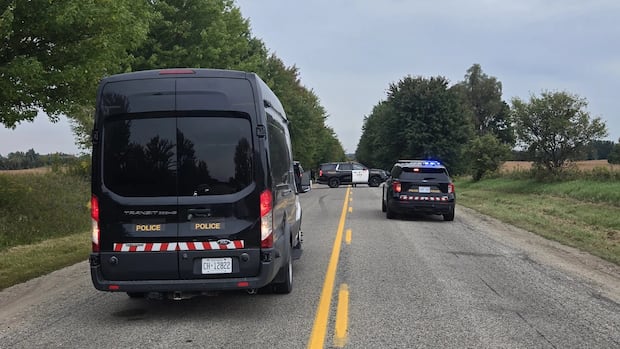
As police look into a crash east of London that claimed the life of a cyclist, others who frequently ride in the area say the incident has shaken them and highlights the need for improved safety measures.
The collision took place around noon on Wednesday along Richmond Street, just north of Dorchester, according to Ontario Provincial Police.
The cause is still under investigation, but authorities stated that the cyclist, a 34-year-old resident of Thames Centre, suffered serious injuries and later passed away in hospital.
The section of Richmond where the accident occurred, between Gore Road and Marion Street, resembles other rural roads near London – it’s a municipal road with two lanes, no paved shoulder, and a speed limit of 80 km/h.
However, among the few routes connecting Dorchester to Gore Road and beyond, many cyclists feel it’s safer than nearby Elgin and Shaw roads, which are busier and have more truck traffic.
Londoner Ivan Cernigoy mentioned that he often bikes east out of the city through Dorchester and had been on Richmond Street about an hour before the crash.
“I was dumbstruck because I just didn’t see how it could happen. The visibility was great that day; there was hardly any traffic,” he said.
“Short of a medical emergency, the only other way I could see it happening is not looking at the road.” Police had no update on Friday regarding the case, and Cernigoy did not know the victim.
The roadway isn’t usually busy around noon when the accident occurred at 12:20 p. m., Cernigoy noted. He pointed out that there’s a paved shoulder on Richmond used by cyclists that ends abruptly at Marion Street, forcing them to ride in traffic to reach Gore Road.
“There’s always guys that are going to come too close to you. Usually, I try to take a good metre of road, but nothing really stands out to me about that road … and that’s why that accident surprised me.” He avoids riding on Richmond after 3 p. m. due to increased traffic.
The crash won’t change how or where he rides; he does everything possible to stay safe including wearing a helmet, using lights, and having a radar camera with him.
“But you know what? You can never account for some things right?”
Location of Sept. 30, 2026 collision in Thames Centre:
Richmond Street is often used by cyclists traveling back and forth from Dorchester; this incident has left their community heartbroken said Evan Jones from London.
“I can see myself in this situation.. The idea of not coming back is really heartbreaking. It’s unfortunately something that I think about while I’m riding,” he shared.
Like Cernigoy, Evans pointed out he does all he can do stand out like using lights and bright clothing; however almost every ride outside London presents at least one scary moment with passing vehicles.
“I don’t know if drivers are always familiar with what it feels like being passed on a road like that,” he said. “Country roads are usually straight with great visibility. You’d think it’s not an issue.. but passing at high speed with very little space is really terrifying.”
A wider paved shoulder would ease pressure off cyclists needing to ride in traffic while providing them an area they feel belongs solely to them , he added.
An existing plan for trails along cycling paths in Thames Centre indicates paved shoulders may be considered accessible for bicycles if they “offer sufficient operating space , clear pavement markings.. and smooth surface free from snow or debris.”
Cyclist Bill Dowhaniuk who lives west of Dorchester believes construction work along Catherine Street plus nearby subdivisions has led more vehicle activity as well as near misses.
“I’ve had more close calls this year than previous years,” he stated. One instance occurred within two weeks when turning south onto County Road 74 from Catherine street. “A gentleman was turning left onto River Road , and didn’t see me at all.”
Dawhaniuk didn’t know who died during incident ; however even though shaken up by news , he likely continues using Richmond since both Elgin & Shaw roads prove too congested. He wishes extensions made towards paving shoulders northwards from Marion street reaching toward gore road. br > br >
Cernigoy doesn’t believe every road should have paved shoulders ; yet feels strongly if there were one installed where happened tragedy-this young man might still be alive today. br > br >
“I don’t think cyclists need each single route catered specifically towards them-there oughta be some paths which allow folks getting same destinations without conflicting against automobiles ,”Cernigoy mentioned.
Reached out attempts made towards contacting Thames Centre Coun. Tom Heeman whose ward includes location surrounding crash site-but response received prior publication lacked comment.
Source link