




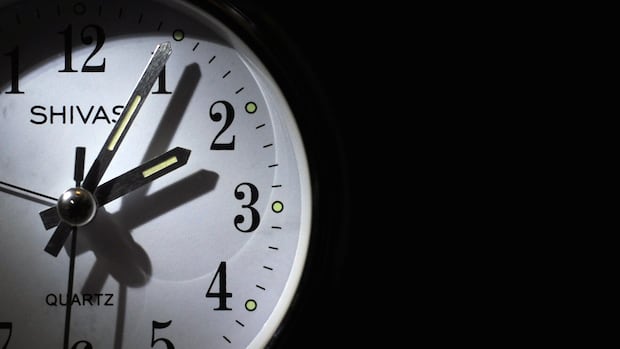
Just days after British Columbians found out they’ll be setting their clocks forward for the last time this Sunday, some folks in Ontario are saying it’s time to follow suit.
B. C. Premier David Eby announced Monday that the province will stick with daylight time permanently, meaning clocks won’t “fall back” in November anymore. The new time zone will be referred to as Pacific time, according to the province.
“We should follow B. C. and just scrap it all together,” said London, Ont., resident Leanne Lebeau. “I don’t like the forward, backward, forward, backward. It’s too hard on my body.”
Londoner Scott Creamer mentioned that he works in a downtown office building and has noticed how dark it gets during winter.
“B. C. did the right thing,” he said. “Sitting in that building at four or five o’clock in December, and it’s already pitch black outside, just sucks.
“Time is a construct. We can set our own time. If we can have more time and more daylight, then let’s do it.”
![]() Scott Creamer says he wants Ontario to follow in British Columbia’s footsteps of permanently adopting daylight time. He says he would prefer more light when he leaves work. (Kendra Seguin/)
Canadian scientists have supported getting rid of time changes for decades, said York University biology professor Patricia Lakin-Thomas, but that doesn’t mean they all agree with B. C.’s approach.
“I’m 50 per cent yes, 50 per cent no,” said Lakin-Thomas, who studies circadian rhythm and biological clocks.
“We should get rid of time changes because we have plenty of evidence showing that it’s bad for us, especially during the spring changeover. We know there are acute effects from this like [vehicle] accidents, heart attacks and strokes,” she explained.
“But then the question is which direction do we go?”
Scott Creamer says he wants Ontario to follow in British Columbia’s footsteps of permanently adopting daylight time. He says he would prefer more light when he leaves work. (Kendra Seguin/)
Canadian scientists have supported getting rid of time changes for decades, said York University biology professor Patricia Lakin-Thomas, but that doesn’t mean they all agree with B. C.’s approach.
“I’m 50 per cent yes, 50 per cent no,” said Lakin-Thomas, who studies circadian rhythm and biological clocks.
“We should get rid of time changes because we have plenty of evidence showing that it’s bad for us, especially during the spring changeover. We know there are acute effects from this like [vehicle] accidents, heart attacks and strokes,” she explained.
“But then the question is which direction do we go?”
![]() Patricia Lakin-Thomas is a biology professor at York University who studies circadian rhythm and biological clocks. (Submitted by Patricia Lakin-Thomas)
Patricia Lakin-Thomas is a biology professor at York University who studies circadian rhythm and biological clocks. (Submitted by Patricia Lakin-Thomas)
![]() (Kendra Seguin/)
(Kendra Seguin/)![]() Even if a province switches to permanent daylight time, Lakin-Thomas noted it could still be tough for people’s bodies to adjust.
You’ll end up trying to eat breakfast when your body isn’t ready for it … You’ll struggle to feel awake when your normal stress hormones haven’t kicked in yet at dawn,” she explained.
Even if a province switches to permanent daylight time, Lakin-Thomas noted it could still be tough for people’s bodies to adjust.
You’ll end up trying to eat breakfast when your body isn’t ready for it … You’ll struggle to feel awake when your normal stress hormones haven’t kicked in yet at dawn,” she explained.