




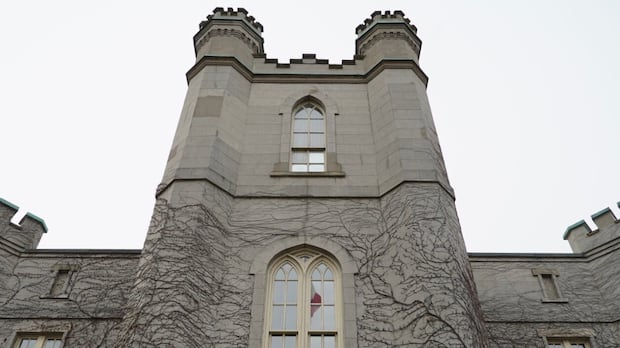
The Middlesex County Courthouse, a rather stern-looking structure inspired by medieval castles, is located at the site where historians claim London, Ont., first developed almost two hundred years ago.
“If you say ‘the old courthouse,’ everybody knows what you mean,” said Steve Liggett, a volunteer with the London-Middlesex Historical Society who has been leading tours of the building since 1988.
“It’s the most recognizable building in the city of London. It’s very much a symbol of the city.”
Over generations, trials and executions have taken place within its walls, including infamous events like the Donnelly murders, the 1935 kidnapping of beer mogul John Labatt, and the execution of Phoebe Campbell in 1872, who was the first woman hanged in post-Confederation Canada. Thin
WATCH | The courthouse that built London, Ont.:
‘London exists because this courthouse exists’
Historian and tour guide Steve Liggett explains why the Middlesex County Courthouse is regarded as the symbolic heart of London, Ont.
The County of Middlesex sold both this building and the adjacent former Middlesex County Health Building to York Developments for $30 million in 2019.
The company has revealed plans for a 54-storey residential tower with 800 units next to this nearly two-century-old structure – literally casting a shadow over where the city began while highlighting what some heritage advocates see as gaps in federal law.
The courthouse continues to host county council meetings and community group gatherings as well as weddings – an unusual fate for a place once filled with trials and sentences.
Liggett mentioned that once the county vacates near late 2026, its future will depend on private ownership.
“I would like to believe that nobody is crazy enough to tear it down,” he said. “Everybody and their grandmother would be opposed to that. The problem is what do you do with it?”
![]() The Middlesex County Courthouse sits next door to a pit at 50 King St., where there’s a plan for a proposed 54-storey tower with 800 units. (Colin Butler/CBC)
This courthouse was originally designed after Malahide Castle from Ireland which dates back to 1475 and was home to Thomas Talbot, an Irish-born colonial administrator whose influence helped establish early settlements in southwestern Ontario.
Renovations during both the 1890s and again in 1911 significantly changed how it faced, turning its main entrance away from Thames River toward Talbot Street as London expanded around it.
The courthouse holds designation as a National Historic Site of Canada – an honor granted by Ottawa due to its significant role in Canadian history and culture – yet this title offers limited legal protection.
“The designation doesn’t say you cannot tear it down,” Liggett stated. “There’s only so much protection because private ownership is paramount. How would you like it if someone said you couldn’t tear your house down or sell it?”
The Middlesex County Courthouse sits next door to a pit at 50 King St., where there’s a plan for a proposed 54-storey tower with 800 units. (Colin Butler/CBC)
This courthouse was originally designed after Malahide Castle from Ireland which dates back to 1475 and was home to Thomas Talbot, an Irish-born colonial administrator whose influence helped establish early settlements in southwestern Ontario.
Renovations during both the 1890s and again in 1911 significantly changed how it faced, turning its main entrance away from Thames River toward Talbot Street as London expanded around it.
The courthouse holds designation as a National Historic Site of Canada – an honor granted by Ottawa due to its significant role in Canadian history and culture – yet this title offers limited legal protection.
“The designation doesn’t say you cannot tear it down,” Liggett stated. “There’s only so much protection because private ownership is paramount. How would you like it if someone said you couldn’t tear your house down or sell it?”
![]() A drawing from 2022 shows a cross-section view comparing east side structures-the courthouse on one side and development on another side-highlighted by red arrows indicating distance between proposed garage and historic structure. (Zedd Architecture)
Engineering documents related to this project note potential “moderate impact” stemming from excavating near courthouse property.
“There is concern that digging down four storeys deep-and any extra shoring needed-could affect this protected heritage building due proximity,” Rachel Redshaw noted in her March 10, 2023 heritage impact assessment prepared for York Developments by MHBC Planning Limited based out of Kitchener, Ont.
These documents also mention “vibration monitoring” along with other protective measures aimed at preventing damage to this historic building such as needing “certification by structural engineer ensuring development won’t harm courthouse.”
The City of London indicated these recommendations arose during planning approval processes through required assessments for heritage impact expect being addressed through site plan reviews accordingly.
Ontario Heritage Trust confirmed via email they haven’t yet received engineer’s certification or risk management plan linked with project associated York Developments.
That company didn’t respond when asked for comments.
A drawing from 2022 shows a cross-section view comparing east side structures-the courthouse on one side and development on another side-highlighted by red arrows indicating distance between proposed garage and historic structure. (Zedd Architecture)
Engineering documents related to this project note potential “moderate impact” stemming from excavating near courthouse property.
“There is concern that digging down four storeys deep-and any extra shoring needed-could affect this protected heritage building due proximity,” Rachel Redshaw noted in her March 10, 2023 heritage impact assessment prepared for York Developments by MHBC Planning Limited based out of Kitchener, Ont.
These documents also mention “vibration monitoring” along with other protective measures aimed at preventing damage to this historic building such as needing “certification by structural engineer ensuring development won’t harm courthouse.”
The City of London indicated these recommendations arose during planning approval processes through required assessments for heritage impact expect being addressed through site plan reviews accordingly.
Ontario Heritage Trust confirmed via email they haven’t yet received engineer’s certification or risk management plan linked with project associated York Developments.
That company didn’t respond when asked for comments.
![]() An inside look at old Middlesex County Gaol shows one cell block preserved since ’60s; remaining sections converted into offices plus wedding venue. (Colin Butler/CBC)
Only historic properties owned federally receive government protections while privately held locations like Middlesex County Courthouse mainly rely upon patchwork provincial municipal legislation securing their integrity over time.
“What doesn’t happen when site becomes designated nationally historical is no actual safeguarding occurs,” Patricia Kell remarked-the CEO representing National Trust Canada-a charity focused preserving protecting sites across nation.
“Federal laws don’t obligate anyone protect care avoid causing harm these places,” she continued.
“Canada stands alone amongst G7 countries lacking such legislation safeguard heritage sites.”
Kell mentioned absence federal support increasingly apparent amid rising developmental pressures today’s society faces.
An inside look at old Middlesex County Gaol shows one cell block preserved since ’60s; remaining sections converted into offices plus wedding venue. (Colin Butler/CBC)
Only historic properties owned federally receive government protections while privately held locations like Middlesex County Courthouse mainly rely upon patchwork provincial municipal legislation securing their integrity over time.
“What doesn’t happen when site becomes designated nationally historical is no actual safeguarding occurs,” Patricia Kell remarked-the CEO representing National Trust Canada-a charity focused preserving protecting sites across nation.
“Federal laws don’t obligate anyone protect care avoid causing harm these places,” she continued.
“Canada stands alone amongst G7 countries lacking such legislation safeguard heritage sites.”
Kell mentioned absence federal support increasingly apparent amid rising developmental pressures today’s society faces.
![]() Steve Liggett poses inside council chamber once courtroom hosting famous trials throughout nineteenth early twentieth century Canada history.(Colin Butler/CBC)
Some heritage consultants argue current arrangements aren’t necessarily flaws per se.
Rebecca Sciarra-a consultant working ASI which calls itself largest firm specializing archaeology Ontario-explained how original intent behind designation never intended operate regulatory capacity.
She elaborated saying it’s better viewed recognition commemoration without establishing protective framework regulations themselves.
Instead , she explained preservation historical buildings often comes via provincial laws municipal bylaws easements conservation routes available those needing assistance keeping legacy intact.
For instance concerning case involving Middlesex County Courthouse , Sciarra stated existing easement enacted back ’81 serves primary protector property itself.
Steve Liggett poses inside council chamber once courtroom hosting famous trials throughout nineteenth early twentieth century Canada history.(Colin Butler/CBC)
Some heritage consultants argue current arrangements aren’t necessarily flaws per se.
Rebecca Sciarra-a consultant working ASI which calls itself largest firm specializing archaeology Ontario-explained how original intent behind designation never intended operate regulatory capacity.
She elaborated saying it’s better viewed recognition commemoration without establishing protective framework regulations themselves.
Instead , she explained preservation historical buildings often comes via provincial laws municipal bylaws easements conservation routes available those needing assistance keeping legacy intact.
For instance concerning case involving Middlesex County Courthouse , Sciarra stated existing easement enacted back ’81 serves primary protector property itself.
![]() History surrounds everywhere within confines Middlesex County Courthouse , among vintage photographs displayed walls includes portrait Canada’s first Prime Minister Sir John A. Macdonald.(Colin Butler/CBC)
“When owner seeks propose alterations-which can cover anything ranging changing windows sizable additions demolitions-subsequent proposal travels concurrently tracks,” she outlined moving alongside municipal planning Ontario Heritage Trust procedures put place respectively
Next steps entail reviewing detailed engineering construction schemes focusing vibration monitoring structural safeguards aiming ensure protection courtside legacy endured further time ahead.
History surrounds everywhere within confines Middlesex County Courthouse , among vintage photographs displayed walls includes portrait Canada’s first Prime Minister Sir John A. Macdonald.(Colin Butler/CBC)
“When owner seeks propose alterations-which can cover anything ranging changing windows sizable additions demolitions-subsequent proposal travels concurrently tracks,” she outlined moving alongside municipal planning Ontario Heritage Trust procedures put place respectively
Next steps entail reviewing detailed engineering construction schemes focusing vibration monitoring structural safeguards aiming ensure protection courtside legacy endured further time ahead.
Source link
Excavation risks raised
Plans from York Developments obtained through a freedom of information request indicate that constructing this new tower would necessitate four levels of underground parking garage coming within about sixteen meters of the courthouse building.Should federal protection carry more power?
This situation illustrates wider discussions among heritage advocates regarding whether federal designations such national historic sites should come equipped stronger legal safeguards.Source link