






Winter isn’t over yet, but Ontario is already dealing with a shortage of road salt, which is pushing some cities to rethink their strategies or limit supplies.
Cities are quickly using up their salt supplies for de-icing roads and sidewalks because winter started early and brought more severe weather events than usual.
Doug Godfrey, general manager of city operations, mentioned that Guelph typically sees around 40 millimeters of rain and 10 centimeters of snow in November and December.
However, “Guelph has experienced above-average levels of precipitation, with November and December receiving 104 millimeters of rain and 30 centimeters of snow,” Godfrey stated in a press release.
To make the salt last longer, cities are incorporating more sand or a mix of sand and road salt.
We’re running at full capacity and we’ve got crews running seven days a week.- Syed Kazmi, Goderich Salt Mine, VP of operations
Perth County is also encountering difficulties with getting salt delivered to its storage facilities, which has led plow operators to adjust their methods when treating the roads.
“Currently, county storage facilities are being replenished with road salt, but supply is still slow,” Sarah Franklin, a Perth County spokesperson said.
The City of Kitchener also reported “lower-than-expected salt supply” this winter and noted that crews are adopting best practices to conserve what they have left.
“This includes providing salt management training for our roads team, weather monitoring and substantial plowing efforts prior to salting or sanding,” the city added in its statement.
Despite the shortage, they assured that there’s enough salt available for future needs.
WATCH | Ontario is dealing with a road salt shortage with weeks left in winter: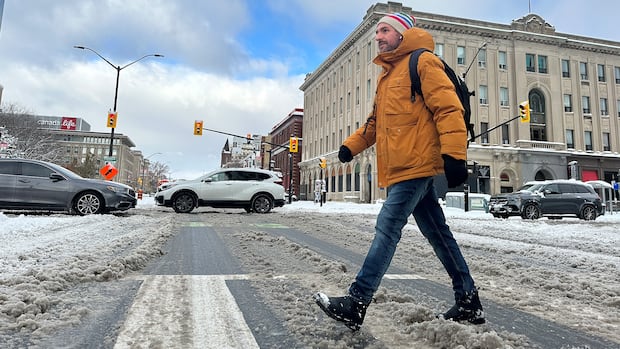 Ontario faces road salt shortage – and it’s only January
Ontario’s road salt supply is already under pressure due to higher-than-normal levels of precipitation and snowfall across the province. The Goderich mine says it’s operating at full capacity but demand remains so high that some municipalities must ration their supply.
Ontario faces road salt shortage – and it’s only January
Ontario’s road salt supply is already under pressure due to higher-than-normal levels of precipitation and snowfall across the province. The Goderich mine says it’s operating at full capacity but demand remains so high that some municipalities must ration their supply.
![]() On Nov. 9, Kitchener saw a record-breaking amount of snowfall at 14 centimeters surpassing the previous record set in 1921 at 10.2 centimeters. (Kate Bueckert/CBC)
On Nov. 9, Kitchener saw a record-breaking amount of snowfall at 14 centimeters surpassing the previous record set in 1921 at 10.2 centimeters. (Kate Bueckert/CBC)
“With climate change we have warmer atmosphere which can hold more moisture,” Kidd explained.
“When you have more moisture in atmosphere it can increase chances for impactful precipitation events.”
Source link
 Ontario faces road salt shortage – and it’s only January
Ontario’s road salt supply is already under pressure due to higher-than-normal levels of precipitation and snowfall across the province. The Goderich mine says it’s operating at full capacity but demand remains so high that some municipalities must ration their supply.
Ontario faces road salt shortage – and it’s only January
Ontario’s road salt supply is already under pressure due to higher-than-normal levels of precipitation and snowfall across the province. The Goderich mine says it’s operating at full capacity but demand remains so high that some municipalities must ration their supply.
Goderich mine crews work around the clock
The need for road salt has become so intense that one of the largest underground salt mines in the world located in Goderich beneath Lake Huron claims it can’t keep up even while working full shifts round-the-clock during holidays. “It’s the high demand that’s causing a lot more noise around than really what the capabilities are at Goderich mine.. because we’re running at full capacity and we’ve got crews running seven days a week,” Syed Kazmi, vice-president of operations at Goderich Salt Mine owned by Compass Minerals said. “So when you get high demand within weeks instead of spread out over a couple months that’s what we’re seeing now.” This situation means suppliers throughout Ontario are prioritizing municipalities first; thus anyone working with private contractors has had to seek supplies from other provinces like Quebec. “We’re just doing everything we can to try to get as much supply as possible,” Christopher Arnts from Arnts the Landscape Supplier Inc. in Whitby shared. “There’s just been a huge increase in need for salt.” Arnts mentioned that sourcing salt from out-of-province costs thousands more which ends up being passed on to customers.Soggy conditions across most southern Ontario
The Environment and Climate Change Canada reports that much of Ontario has faced wetter conditions this year.
Meteorologist Trudy Kidd told us that southwestern Ontario has seen above-normal amounts snow this winter.“With climate change we have warmer atmosphere which can hold more moisture,” Kidd explained.
“When you have more moisture in atmosphere it can increase chances for impactful precipitation events.”
Meteorologist Rob Kuhn from Environment Canada tweeted about Kitchener experiencing record-breaking snowfall on Nov. 9 reaching 14 centimeters.
Kuhn confirmed it broke previous records set back in 1921 (10.2 cm) equaled again later in 1933.
Kidd noted temperatures were below average throughout December too.
This past December was definitely colder than normal across Ontario,” she stated.”Seeing colder-than-normal Decembers isn’t typical concerning precipitation.”
Source link


