




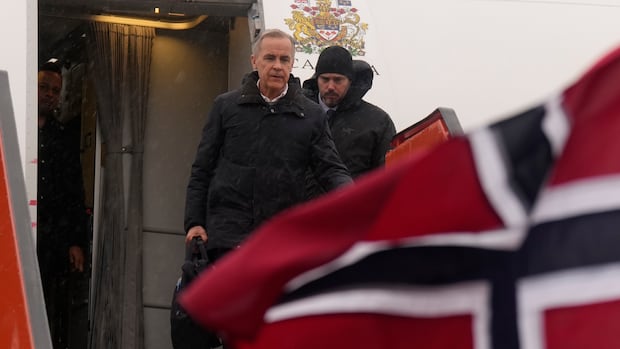
Prime Minister Mark Carney arrived in Norway early Friday for crucial discussions with the country’s leader and the German chancellor before observing a significant NATO wargaming exercise that features Canadian troops.
Both nations are supporting a proposal from German submarine manufacturer TKMS to provide Canada with 12 new submarines – a multi-billion dollar initiative that has been expedited by the Liberal government.
Even with such high stakes – militarily, economically, and diplomatically – Carney mentioned he doesn’t anticipate discussing the submarine proposal among the three leaders.
“The short answer’s no,” he stated when asked about it in Yellowknife prior to his flight to Europe, “because we’re at a phase in that process where the final bids have been submitted.”
TKMS and their competitor, South Korea’s Hanwha Ocean, submitted their proposals to Canada’s defence investment agency on March 2. In the upcoming month, federal officials will be able to pose clarifying questions before closing bids in early April.
Both companies have been informed to expect a prompt decision – potentially as early as late June.
![]() Carney inspects a Type 212A submarine under maintenance during his visit to a TKMS facility in Kiel, Germany, on Aug. 26, 2025. TKMS is one of two firms vying to build 12 new subs for Canada. (Christinne Muschi/The Canadian Press)
The joint pitch from Germany and Norway emphasizes North Atlantic unity and longstanding collaboration as NATO allies while also highlighting economies of scale since all three nations would operate similar submarines. TKMS is presenting the Type 212CD, an upgraded version of the Type 212 boat currently used by several navies.
Micheal Byers, an expert on politics and defense at the University of British Columbia, indicated that even if they don’t talk specifically about the submarine bid, discussions around allied cooperation are always relevant.
“I’m sure the Germans and Norwegians are very glad that they’ll get to speak with him. Whether the prime minister is susceptible to that kind of friendly cajoling, I don’t know,” said Byers, who added that he believes Carney approaches matters with clarity and professionalism.
“My sense is that he’s a pretty hard-headed guy and if he sees an advantage in going with the South Korean company, he’ll go with the South Korean company. This is not about sentimentality; this is a rational decision that needs to be made.”
Later Friday, all three leaders will head north to Bardufoss above the Arctic Circle where over 25,000 NATO personnel including soldiers, sailors, and aircrew are taking part in Cold Response – NATO’s biannual exercise.
This major drill began on March 9 and runs until March 19 involving operations on land, sea, and air across 14 countries.
Carney inspects a Type 212A submarine under maintenance during his visit to a TKMS facility in Kiel, Germany, on Aug. 26, 2025. TKMS is one of two firms vying to build 12 new subs for Canada. (Christinne Muschi/The Canadian Press)
The joint pitch from Germany and Norway emphasizes North Atlantic unity and longstanding collaboration as NATO allies while also highlighting economies of scale since all three nations would operate similar submarines. TKMS is presenting the Type 212CD, an upgraded version of the Type 212 boat currently used by several navies.
Micheal Byers, an expert on politics and defense at the University of British Columbia, indicated that even if they don’t talk specifically about the submarine bid, discussions around allied cooperation are always relevant.
“I’m sure the Germans and Norwegians are very glad that they’ll get to speak with him. Whether the prime minister is susceptible to that kind of friendly cajoling, I don’t know,” said Byers, who added that he believes Carney approaches matters with clarity and professionalism.
“My sense is that he’s a pretty hard-headed guy and if he sees an advantage in going with the South Korean company, he’ll go with the South Korean company. This is not about sentimentality; this is a rational decision that needs to be made.”
Later Friday, all three leaders will head north to Bardufoss above the Arctic Circle where over 25,000 NATO personnel including soldiers, sailors, and aircrew are taking part in Cold Response – NATO’s biannual exercise.
This major drill began on March 9 and runs until March 19 involving operations on land, sea, and air across 14 countries.
![]() Norwegian and British troops participate in NATO’s Cold Response exercise near Evenes air base in Norway on Wednesday. (Bernadett Szabo/Reuters)
Keir Giles from Chatham House emphasized Canada’s troop involvement goes beyond just showing solidarity.
“Troops from Canada will be used to operating in these kinds of conditions” in Arctic environments,” said Giles. “And there’s valuable experience they can share with forces coming from further south who may find this entirely new.”
Norwegian defense officials have highlighted how this edition of their long-standing war game includes several hundred civilians acting out various roles.
“It’s an important addition,” said Giles.
“War happens among people and has to be considered when realistically assessing how conflict might unfold,” he noted.
“In Ukraine it’s been clear what impact conflicts have had on civilian populations which must be modeled by any country wishing to safeguard its citizens against war.”
NATO member states face challenges rallying their populations together; Giles stated there are significant lessons expected over these next few days.
“It’s not only about keeping them alive but also ensuring they contribute resilience,” he explained. “It’s vital for maintaining societal functions while facing adversaries aiming for disruption.”
Norwegian and British troops participate in NATO’s Cold Response exercise near Evenes air base in Norway on Wednesday. (Bernadett Szabo/Reuters)
Keir Giles from Chatham House emphasized Canada’s troop involvement goes beyond just showing solidarity.
“Troops from Canada will be used to operating in these kinds of conditions” in Arctic environments,” said Giles. “And there’s valuable experience they can share with forces coming from further south who may find this entirely new.”
Norwegian defense officials have highlighted how this edition of their long-standing war game includes several hundred civilians acting out various roles.
“It’s an important addition,” said Giles.
“War happens among people and has to be considered when realistically assessing how conflict might unfold,” he noted.
“In Ukraine it’s been clear what impact conflicts have had on civilian populations which must be modeled by any country wishing to safeguard its citizens against war.”
NATO member states face challenges rallying their populations together; Giles stated there are significant lessons expected over these next few days.
“It’s not only about keeping them alive but also ensuring they contribute resilience,” he explained. “It’s vital for maintaining societal functions while facing adversaries aiming for disruption.”
Source link
Source link