




By Daniel Béland
January 3, 2026
Since Donald Trump took office again nearly a year ago, his trade policies and comments about Canada becoming the “51st state” have sparked a stronger sense of unity here. This was evident in polling data that showed an increase in national pride across the nation.
At the same time, 2025 saw continued conversations about potential independence referendums in two provinces: Alberta and Quebec.
The implications of these referendums could lead to more economic and political uncertainty, as well as create chances for foreign meddling. This is particularly concerning given Trump’s recent National Security Strategy and his ongoing regime change efforts in Venezuela.
In Alberta, Danielle Smith’s government lowered the required number of signatures needed to initiate an independence referendum from 20% to 10% of eligible voters, making it much easier for proponents of independence to start the separation process.
Currently, there are two citizen initiative petitions being circulated: Alberta Forever Canada, which is supported by former anti-independence MLA Thomas Lukaszuk, and A Referendum Relating to Alberta Independence, led by pro-independence Alberta Prosperity Project CEO Mitch Sylvestre.
The first petition has already gathered more than enough signatures needed, while the second one was approved by Elections Alberta on December 22 and has four months total to meet its signature goal.
A significant difference between these petitions is how they phrase their referendum questions: “Do you agree that Alberta should remain in Canada?” (Alberta Forever Canada) versus “Do you agree that the province of Alberta should cease to be a part of Canada to become an independent state?” (A Referendum Relating to Alberta Independence).
In Quebec, the Parti Québécois (PQ) consistently led polls throughout 2025. During this time, Premier François Legault’s Coalition Avenir Québec (CAQ) faced various public relations setbacks like backlash against Bill 2 concerning medical access and physician pay. Despite this turmoil, Premier Legault maintained he would not resign, denying the CAQ a leadership contest that might help regain its footing against the PQ.
The divisiveness surrounding any upcoming independence referendum in a Canadian province could leave the country appearing more vulnerable-regardless of how such a vote turns out.
The Liberal Party of Quebec (LPQ) elected Pablo Rodriguez as their new leader in June; however, he stepped down in December amid a criminal investigation over alleged financial misconduct during the LPQ leadership race. While they’ll have another leader by March 15, they now face significant challenges against the PQ ahead of elections scheduled for October 5th.
As it stands now, with less than nine months until those elections, PQ leads comfortably in polls-a troubling scenario for federalists since PQ leader Paul St-Pierre Plamondon continues promising that if he wins come fall, his government will hold a referendum on Quebec’s independence by 2030.
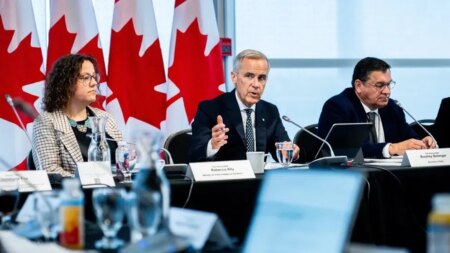
This situation should give Prime Minister Mark Carney some pause at a moment when his government wants to concentrate on economic matters alongside trade relations with America as they prepare for an evaluation of the Canada-United States-Mexico Agreement (CUSMA).
An optimistic viewpoint regarding potentially disruptive or even existential referendums in both Alberta and Quebec suggests that current geopolitical instability caused by Trump may actually favor national unity. After all, pursuing independence can seem particularly risky during uncertain times.
This perspective comes from David Coletto-the CEO and founder of Abacus-who notes through public opinion research that people are currently adopting a “precarity mindset,” making them more cautious and therefore less inclined toward supporting independence. Drawing from political psychology insights he argues support for separation initiatives in both regions is limited due mainly to heightened perceptions around economic risks influenced by Trump’s rhetoric and policies.
In this context according to Coletto: “The question is no longer simply Ottawa versus the provinces. It is Canada versus an increasingly unstable North American environment. In that context, Canada looks less like a constraint and more like a shield.” He believes there’s a strong chance that if organized quickly enough an independence vote either way would result ultimately preserving national unity through widespread “no” votes.
Additively regarding Quebec we must note without any strong political triggers akin to events surrounding Meech Lake Accord-which preceded voting during earlier referendums-it becomes tougher for those advocating separation options among francophone voters emotionally appeal effectively towards them alike previous campaigns did successfully back then.
Nevertheless it’s vital we remember even outcomes leading towards sustaining our unified status quo still carry ramifications-such as legitimizing calls toward future separations further down roads ahead altogether altogether too significantly!
The divisive nature surrounding impending discussions across various provinces implies Canadians appear evermore exposed regardless whatever results yield forth itself..
Source link
Source link