





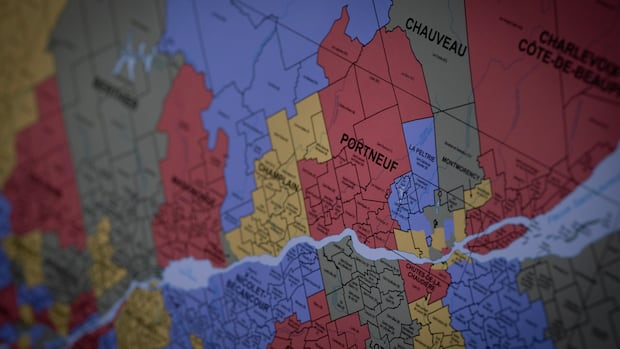
Quebec’s updated electoral map will be implemented as scheduled after Canada’s highest court backed a lower court decision regarding the changes.
The Supreme Court of Canada announced its ruling on Wednesday following several hours of private discussions. The details behind the ruling were not disclosed immediately.
With the new map, both the Gaspésie region and Montreal island will each lose one riding, while the rapidly growing Laurentians and Centre-du-Québec areas will gain a seat apiece. Overall, the new map alters 51 of Quebec’s 125 ridings.
The independent commission in charge of the map, known as the Commission de la représentation électorale (CRÉ), made these changes to account for shifts in population.
The revised map faced opposition from the Coalition Avenir Québec (CAQ) government along with other political groups. Last year, they came together to pass a law stopping the redistricting process, claiming it negatively impacted regional representation.
However, the Quebec Court of Appeal ruled that this law was unconstitutional, stating that it undermined effective representation by allowing large differences in voter weight to continue.
The CAQ government applied for permission to appeal to the Supreme Court of Canada late last year, hoping to maintain the current map for the upcoming provincial election set for fall.
A coalition of municipal officials from Laurentians led a legal challenge against the government’s attempt to freeze the map, supported by leaders from Laval, Outaouais, Eastern Townships, and Centre-du-Québec regions who argued their constituents were underrepresented.
After Wednesday’s ruling, Quebec Premier Christine Fréchette stated her government would propose a bill alongside opposition parties aimed at ensuring fair representation and safeguarding ridings like Anjou-Louis-Riel and Bonaventure that are being lost with this new map.
“For me, it is absolutely essential that all regions of Quebec are well represented in the National Assembly,” Fréchette said on social media.
Source link
Source link