




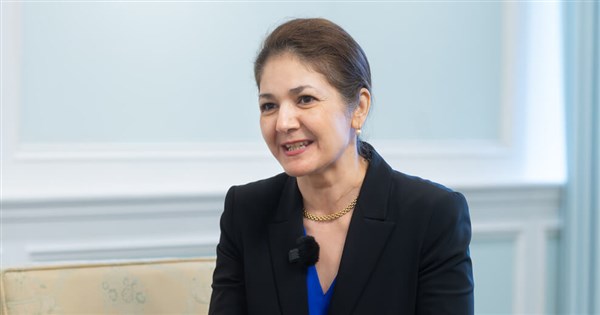
Taipei, March 20 (CNA) Canada is looking to broaden its partnerships as the global situation changes quickly and does not plan to take sides between China and Taiwan, according to Asia Pacific Foundation of Canada Vice President Vina Nadjibulla.
In a conversation with CNA in Taipei on Thursday, Nadjibulla mentioned that even though progress on a proposed trade cooperation deal between Taiwan and Canada has stalled, both nations should keep working on strengthening their relationship in practical ways.
“I think whether that happens or not, that’s a political decision and we’ll wait to see what happens between the two governments,” Nadjibulla said.
Taiwan and Canada wrapped up discussions on a trade cooperation framework agreement in the first half of 2025, but Ottawa has reportedly postponed signing it due to concerns about its relationship with Beijing.
Regarding this issue, Nadjibulla stated that collaboration could still be enhanced in areas like energy security, critical minerals, and emerging technologies, pointing out that “there’s already so much that can be happening” even without a formal agreement.
She added that businesses and civil society groups “can continue to do more together and that will actually create the enabling environment for that political decision to be made.”
Source link
Expanding Partnerships
On broader strategic positioning, Nadjibulla noted that Canada is trying to boost its independence by diversifying partnerships instead of aligning with just one power. “I think that is exactly what Prime Minister [Mark] Carney was saying, that countries that are not hegemonic, that are not [the United States] or China, need to work together to be able to have as much agency, as much choice, as much autonomy as possible.” When asked about relationships with the U. S., Nadjibulla mentioned that Canada aims to keep positive ties while enhancing its own capabilities and connections with other nations. This strategy involves investing in domestic strength and broadening global partnerships rather than reacting hastily to every policy change from Washington, she explained. “So it’s staying calm. It’s focusing on what we can control, on deepening relationships and friendships around the world,” she said. At the same time, she continued by saying Canada remains “clear-eyed” regarding its approach toward China after facing economic pressure and diplomatic strains in recent years. She pointed out that only 5 percent of Canadian exports go to China; this figure is much lower compared to Australia or Japan. Ottawa is working towards stabilizing relations with Beijing while keeping “clear guardrails,” she mentioned which include avoiding collaboration in sensitive fields like AI and defense.Economic Synergy
Additionally, she emphasized the economic compatibility between Taiwan and Canada. She noted Taiwan can gain from Canada’s strengths in energy resources and research while Canada can benefit from Taiwan’s manufacturing abilities. Nadjibulla also suggested diversifying energy supply sources could help Taiwan build resilience amid geopolitical uncertainties. “With everything that’s happening in the Middle East right now, you’re also vulnerable because you’re getting so much of your energy from a part of the world that’s actually much more volatile,” she said. (By Chao Yen-hsiang and Charlotte Yang) Enditem/ASGSource link