




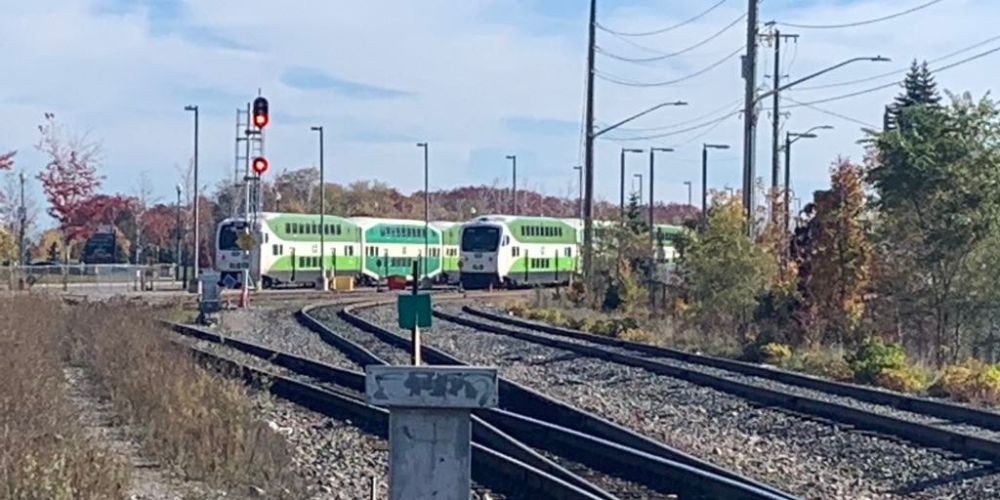
Trains parked in the yard at the Allandale Waterfront GO station. (Oct. 30, 2022 – Image – Barrie 360)
Ontario is looking to significantly raise fines for fare evasion on GO Transit, allow rideshare services in certain northern areas, and prevent municipalities from mandating EV charging stations and other outdoor features as part of development standards.
The proposals were shared on Monday by the housing and transportation ministers as they introduced a new bill aimed at simplifying transit construction and improving access while accelerating home building.
This announcement coincided with Prime Minister Mark Carney and Premier Doug Ford revealing their commitment to invest $4.4 billion each into housing-related infrastructure in Ontario municipalities that lower development fees.
Barrie’s News Delivered To Your Inbox
Stay informed about what’s happening in Barrie. Get the latest local news sent directly to your inbox every day. Don’t miss out on important updates..
Consent Info
By submitting this form, you are consenting to receive marketing emails from: Central Ontario Broadcasting, 431 Huronia Rd, Barrie, Ontario, CA, https://www. cobroadcasting. com. You can withdraw your consent to receive emails anytime by using the Safe Unsubscribe® link found at the bottom of every email. Emails are serviced by Constant Contact
The pace of new home construction in Ontario has slowed considerably due to high inflation rates, increasing building costs, labor shortages, and economic uncertainty linked to tariffs; the province anticipates only 64,800 housing starts this year.
Cabinet ministers have been playing down the importance of their goal to construct 1.5 million homes by 2031 as that target seems increasingly difficult to achieve.
Municipal Affairs and Housing Minister Rob Flack expressed confidence that this new legislation will make a difference and noted he’s content as long as construction trends upward.
“Every little bit helps,” he said. “It all adds up.”
The new measures designed to boost home construction include standardizing official plans for municipalities, reviewing building codes, promoting public water and wastewater corporations to help municipalities spread out infrastructure costs, and establishing a minimum lot standard statewide exempting non-profit retirement homes from development fees.
The Ontario Real Estate Association stated that the combined effects of these changes will be “transformative.”
“This is the kind of bold action we need to drive economic growth, support jobs, and keep the dream of home ownership alive,” president Kim Fairley wrote in a statement.
However, one aspect of the bill is likely to upset environmental groups; it builds on earlier legislation preventing municipalities from enforcing their own mandatory climate-friendly standards for builders.
This new measure would also stop cities from requiring green outdoor features like landscaping or electric vehicle chargers at street level. Officials argue that having varying standards across different municipalities complicates the building process.
Lana Goldberg from environmental group Stand. earth stated that these standards were put in place by municipalities when there was a lack of strong provincial regulations for buildings.
“These common sense rules would have simply encouraged new homes to be resilient to extreme weather and more affordable to heat and cool,” Goldberg wrote in a statement.
“Eliminating these initiatives passes down costs to residents who will be on the hook for higher monthly energy bills, expensive energy retrofits, and possibly costly repairs after extreme weather events like floods.”
On transit matters within this legislation, there’s an effort underway to increase fines for fare evasion on GO Transit from $35 up to $200 for first-time offenders; subsequent offences could lead up to $500 fines. The government noted that fare evasion leads Metrolinx-a provincial transit agency-to lose about $21 million annually due to lost revenue.
The government also aims to enhance its One Fare program which prevents riders from paying an extra fare when transferring between different transit systems within Greater Toronto Area by mandating uniform fare levels among transit agencies including Hamilton and Halton systems.
This bill alongside other measures includes previously announced initiatives such as opening high-occupancy vehicle lanes for all drivers during off-peak hours and setting up a rideshare framework along future routes for Northlander train service.
– With files from Jordan Omstead
This report by The Canadian Press was first March 30, 2026.
What do you think of this article?
Source link
Source link