


Politicians were informed that this ‘really robust species’ could pose a threat to the lake before a request was made for financial assistance to ‘achieve functional eradication.’
The Innisfil council is being urged to take action against the invasion of water soldier in Lake Simcoe.
During its May 6 meeting, council heard from a representative of the Invasive Species Centre on behalf of the Lake Simcoe Water Soldier Working Group. Colin Cassin, executive director of the centre, emphasized that immediate action on water soldier is necessary.
“There is a high probability of subsequent spread – without further action – into the lake, proper, outside of Cook’s Bay,” he stated.
The presence of water soldier was first noted in North America in 2008 at Trent Hills within the Trent-Severn Waterway. Two years ago, about 40 floating plants were discovered near Young’s Harbour in Keswick, which led to more surveys being conducted across Lake Simcoe.
Currently, the infestation remains limited to Cook’s Bay, which spans six kilometers between Holland River and Keswick and covers roughly 450 hectares of vegetation.
No one suggests that winter soldier expanded from 40 plants to 450 hectares within just one year; however, Cassin explained that researchers believe even a single storm or a fragment detached from an existing area can lead to new infestations.
This could negatively affect various uses of the lake, as informed by the council.
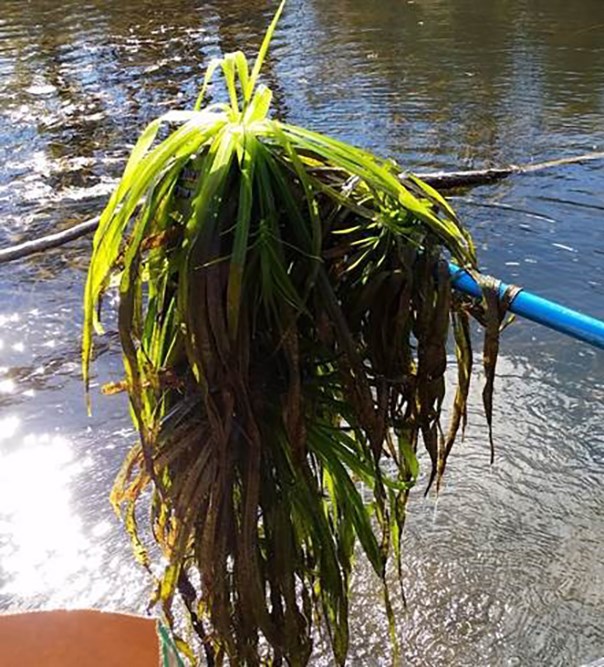
Water soldier is an invasive aquatic plant that grows submerged and becomes buoyant during summer peak growth. It creates large rosettes with serrated leaves sticking out above the water surface, posing risks for swimmers and obstructing boat navigation.
Cassin acknowledged that complete eradication will be difficult when questioned by Coun. Robert Saunders and mentioned that implementing their management plan would be expensive.
The center estimates they will need up to $5 million over five years to combat water soldier effectively. According to Cassin, this funding would “achieve functional eradication or significantly reduce its population down to very low levels.”
Cassin also mentioned various methods available for tackling water soldier in response to questions from Coun. Linda Zanella; these include herbicides, mechanical removal techniques, and hand pulling when possible.
Cassin pointed out that municipalities around Lake Simcoe aren’t solely responsible for this effort. The federal and provincial governments have already supported monitoring efforts regarding water soldier, and additional resources may become available as their management plan progresses. He also highlighted how crucial data collection and technical support have been provided by the Lake Simcoe Conservation Authority.
A key way municipalities can assist is by communicating with residents along their shorelines about how water soldier spreads and what preventative actions all lake users should take. Being part of the working group and backing the management plan are also vital steps for local councils according to Cassin.
“It really takes a collaborative effort to try and address a challenge of this size,” Cassin said. “It’s a really robust species.”
No further resolution or direction was given by council after receiving this delegation.
Source link