A doctor from Guelph, Ont., is sharing his experience after being stopped by an Israeli border guard while attempting to enter Gaza for humanitarian work and ultimately being denied entry.
Dr. Hassan Kapasi told that he tried to drive to Gaza from Jordan twice last year, following a truce deal between Israel and Hamas aimed at ending the long-standing conflict.
His first attempt was on Nov. 25, when he boarded a bus organized by the United Nations (UN). The bus was primarily filled with medical personnel from various non-profit organizations and NGOs, including Doctors Without Borders, the United Nations World Food Programme, and Catholic Relief Services.
Kapasi was representing Humanity Auxilium, a Texas-based NGO, to assist surgeons facing increasing medical demands at the Shuhada al-Aqsa Hospital in Gaza.
The bus was halted at the Allenby Bridge, also called the King Hussein Bridge, where an Israeli border guard conducted a random baggage inspection. They discovered general medical supplies like a stethoscope and temperature probe, Band-Aids, and blood pressure cuffs.
According to Kapasi, the guard informed him that he couldn’t enter because they suspected he would distribute those items in Gaza.
“It’s kind of arbitrary because everyone on the convoy who’s medical has stuff like this.”
On Dec. 4, Kapasi made another attempt to cross – this time he said the same border guard recognized him and stated that he was banned from entering Israel again.
This is the first page of the notice that Kapasi says an Israeli border guard handed him in December. CBC has blacked out some of the doctor’s personal information. (Hassan Kapasi)
“I was singled out during my second attempt without any explanation,” Kapasi mentioned, noting that he wasn’t carrying any medical equipment then.
“They gave me a piece of paper saying that I’m a security threat or a threat to public safety, and I can never enter Israel again in the future.”
The document specifically cites “public security or public safety or public order considerations” as reasons for denying his entry.
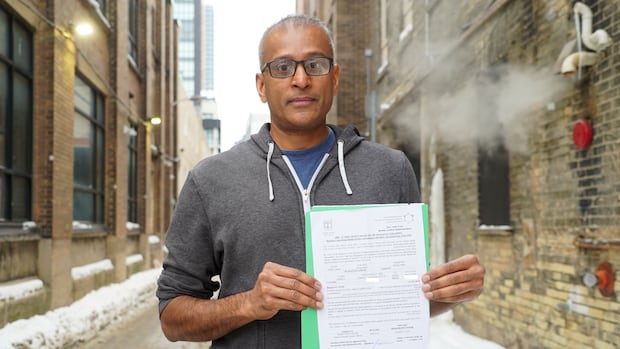
![]() Kapasi holds up the letter from Israel’s Border Control Administration saying he was denied entry into Israel. (Carmen Groleau/CBC)
“There’s been consistent denials occurring without any process for appeal; we’ve had numerous surgeons turned away by COGAT right before deployment without justification.”
The organization pointed out that medical personnel face significant challenges crossing borders-with “the highest denial rate among all groups entering Gaza: over 45 percent according to data shared by UN Accessory Support Unit back in Nov 2025.” There’s often no clear reasoning behind why medics are deployed into Gaza.”
A social media post included a video of Kapasi detailing his situation; beneath it read: “Imagine being told that your stethoscope makes you a threat to public safety.”
“When even Bandaids (sic) are weaponized against Palestinians-is it really still considered a ceasefire? End the siege! Open borders! Allow aid through!”
Kapasi holds up the letter from Israel’s Border Control Administration saying he was denied entry into Israel. (Carmen Groleau/CBC)
“There’s been consistent denials occurring without any process for appeal; we’ve had numerous surgeons turned away by COGAT right before deployment without justification.”
The organization pointed out that medical personnel face significant challenges crossing borders-with “the highest denial rate among all groups entering Gaza: over 45 percent according to data shared by UN Accessory Support Unit back in Nov 2025.” There’s often no clear reasoning behind why medics are deployed into Gaza.”
A social media post included a video of Kapasi detailing his situation; beneath it read: “Imagine being told that your stethoscope makes you a threat to public safety.”
“When even Bandaids (sic) are weaponized against Palestinians-is it really still considered a ceasefire? End the siege! Open borders! Allow aid through!”
![]() Kapasi’s intended route was set: take a bus from Amman Jordan towards King Hussein-Allenby Bridge at Israeli borders leading into Gaza.
Kapasi’s intended route was set: take a bus from Amman Jordan towards King Hussein-Allenby Bridge at Israeli borders leading into Gaza.
(Google Maps) reached out seeking comments from officials at Israeli Consulate regarding this matter but were informed more details such as passport number would be needed which Kapasi chose not share leading them subsequently declining further comment.Your story on access needed acknowledged globally”.
‘We followed all protocols,’ colleague states
Kapasi noted that his colleague Dr. Muhammed Farooq from Britain and another Italian doctor affiliated with Catholic Relief Services were also turned away on Nov. 25 while around 30 others were permitted passage. “We followed all protocols,” Farooq expressed. “We thought they’d let us through.. confiscate our items and allow us through but then they didn’t.” Farooq has successfully crossed into Israel three times before facing denial last November for the first time; he’s hoping to try again in six months to a year. The efforts by Kapasi, Farooq, and others come amid ongoing deadly attacks in Gaza despite attempts at establishing peace following hostilities beginning Oct. 7, 2023 due to an attack led by Hamas against Israel. Israeli figures indicate approximately 1,200 individuals have died in their country due to this conflict. On Tuesday, Gaza’s Health Ministry reported that since the ceasefire began 586 Palestinians have been killed; overall casualties are now estimated at 72,037 since Israel’s offensive commenced. The ministry claims its casualty data is generally reliable according to UN agencies and independent experts but does not separate civilians from militants.NGO highlights ‘continuous supply shortages’
A statement given to by Humanity Auxilium indicated that Kapasi had received prior approval from the Israel Defence Forces (IDF) for entry into Gaza on Nov. 25 with plans to exit by Dec. 23; this authorization came via COGAT-the Coordination of Government Activities in the Territories under IDF administration. “There’s an ongoing shortage of supplies at hospitals; what they carried was minimal even if packed neatly-certainly not enough for their entire rotation period” – two weeks for Farooq and four weeks for Kapasi as explained in their statement.Doctor expresses lifelong commitment
Kapasi has previously worked alongside organizations such as Canadian Red Cross providing medical assistance in regions like South Sudan and Bangladesh; this marked his first effort trying to get into Gaza. “I’ve always been drawn towards humanitarian work-observing conditions firsthand often leaves one feeling powerless yet eager to contribute however possible,” he stated.(Google Maps) reached out seeking comments from officials at Israeli Consulate regarding this matter but were informed more details such as passport number would be needed which Kapasi chose not share leading them subsequently declining further comment.