



A recent report from Canada’s Parliamentary Budget Office indicates that meeting NATO’s new defense spending targets might be more challenging for Canada than anticipated – potentially creating a significant gap in the federal budget.
The analysis released on Thursday suggests that between now and 2035, an extra $33.5 billion will be needed each year to reach the benchmark of 3.5 percent direct military spending, which was agreed upon by allies during NATO’s last leaders’ meeting in the Netherlands.
In total, NATO countries have committed to allocate five percent of their gross domestic product towards defense – 3.5 percent for their militaries and another 1.5 percent for defense infrastructure.
The PBO estimates that this influx of funding into defense could cause the budget deficit to rise by $63 billion (equivalent to 1.4 percentage points of GDP) in the years 2035-36 and push up the federal debt-to-GDP ratio.
However, there is a significant caveat regarding these estimates due to extensive budget secrecy enforced by the federal government.
Prime Minister Mark Carney promised last June that Canada would meet NATO’s previous target of two percent of GDP by March 2026. To achieve this goal, he allocated an additional $9 billion toward military spending.
WATCH | How can the Canadian navy be more efficient in the Arctic?: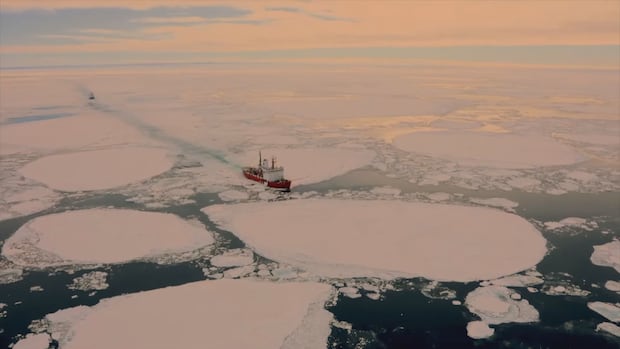 Canadian navy exploring amphibious landing ship concepts
Description: Canada is increasing its defense spending, and the Royal Canadian Navy is looking at ways to effectively transport equipment and personnel through the Arctic. The CBC’s Murray Brewster provides more details on these plans.
In making its estimate, the PBO had to assume that this target would be achieved.
The federal budget last fall did not include a detailed breakdown of future defense spending year-by-year.
This marks a notable shift from prior budgets and recalls a time when fiscal secrecy surrounded government finances under former Prime Minister Stephen Harper’s Conservative government.
Canadian navy exploring amphibious landing ship concepts
Description: Canada is increasing its defense spending, and the Royal Canadian Navy is looking at ways to effectively transport equipment and personnel through the Arctic. The CBC’s Murray Brewster provides more details on these plans.
In making its estimate, the PBO had to assume that this target would be achieved.
The federal budget last fall did not include a detailed breakdown of future defense spending year-by-year.
This marks a notable shift from prior budgets and recalls a time when fiscal secrecy surrounded government finances under former Prime Minister Stephen Harper’s Conservative government.
Source link
 Canadian navy exploring amphibious landing ship concepts
Description: Canada is increasing its defense spending, and the Royal Canadian Navy is looking at ways to effectively transport equipment and personnel through the Arctic. The CBC’s Murray Brewster provides more details on these plans.
In making its estimate, the PBO had to assume that this target would be achieved.
The federal budget last fall did not include a detailed breakdown of future defense spending year-by-year.
This marks a notable shift from prior budgets and recalls a time when fiscal secrecy surrounded government finances under former Prime Minister Stephen Harper’s Conservative government.
Canadian navy exploring amphibious landing ship concepts
Description: Canada is increasing its defense spending, and the Royal Canadian Navy is looking at ways to effectively transport equipment and personnel through the Arctic. The CBC’s Murray Brewster provides more details on these plans.
In making its estimate, the PBO had to assume that this target would be achieved.
The federal budget last fall did not include a detailed breakdown of future defense spending year-by-year.
This marks a notable shift from prior budgets and recalls a time when fiscal secrecy surrounded government finances under former Prime Minister Stephen Harper’s Conservative government.
No detailed projections given
and other media outlets requested specific projections at that time but received no responses. The PBO also made inquiries as part of its role as a parliamentary watchdog but was turned away. “Despite indicating in Budget 2025 that accelerating investments will ‘put Canada on a pathway’ to meet the NATO five percent commitment by 2035, the government has not supporting projection details,” stated the PBO analysis. “DND did not provide a year-by-year spending path and noted that NATO’s measure of planned defense spending as a share of GDP relies on forecasts provided by NATO itself. DND instead referenced estimates suggesting that defense expenditures equivalent to 3.5 percent and 1.5 percent of GDP in 2035 could amount to approximately $150 billion and $60 billion respectively, subject to change.” These figures indicate a shift from what officials estimated when Canada initially signed onto the new NATO pledge back in June.Source link


