

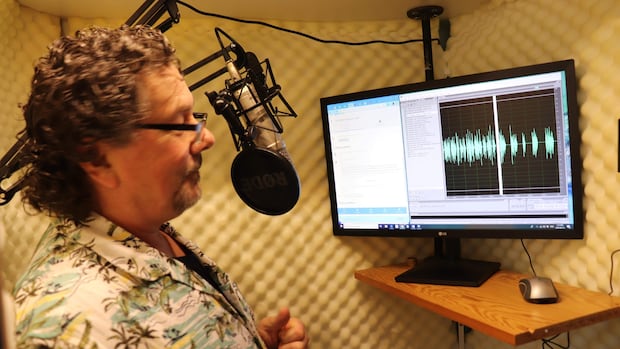
Employees at one of the largest voice acting companies in the world, located in London, Ont., are trying out artificial intelligence (AI) to replicate their voices for various projects.
Voices. com, a platform that connects voice actors with clients, introduced an AI feature last year that allows clients to purchase and use actual actors’ voices for text-to-speech tasks.
“I get a little notification that says, ‘Hey, you’ve been paid for a job,’ and it’s like, ‘I didn’t do a job,'” said Jesse Adam, a voice actor from Moose Jaw, Sask., who has his voice available on Voices. com’s AI service.
He mentioned it took him a week to record and edit his voice for cloning but has received payment for between 50 and 100 projects since he first made his voice available online last spring.
“I was a little apprehensive at first just because as voice talent, we’re seeing a lot of the smaller jobs taken away by AI,” Adam said. “But for me.. I know that AI is the way the world is going, so we’ve got to adapt.”
Jesse Adam is a voice actor based in Moose Jaw, Sask., who has made his voice accessible for AI text-to-speech projects. (Submitted by Jesse Adam)
Voice acting encompasses various projects including film and television work, commercials, audiobook narration, toy manufacturing, corporate presentations and e-learning modules.
As more AI text-to-speech options become available, some voice actors express mixed feelings about what this means for their future.
“I think the word ‘scary’ comes to mind for many when they think about AI because it’s not well understood,” said Dale Elliott, a voice actor from London, Ont. “I feel it can be harmful to the voiceover industry and those relying on it for income.”
![]() Dheeraj Jalali is the chief technology officer at Voices. com; an online marketplace connecting clients with voice actors. The company launched its AI text-to-speech services last year. (Submitted by Patrice Aldave)
Voice actors interested in participating fill out a form giving consent for their voices to be used in text-to-speech applications. They record several sentences that tech teams can utilize to clone their voices which are then offered as options on the Voices. com website.
Actors can set their price per word while the company takes a percentage of sales. Actors also have the option to exclude certain words or phrases they don’t want their cloned voices saying,” Jalali explained.
“It just enhances speed and time to market that wasn’t achievable before,” he added.
Out of more than 4 million global artists registered with Voices. com , around 30 are part of its text-to-speech roster. Jalali observed there’s been an increase in “low-end” work like short videos or personal presentations being directed towards AI voices while more creative “high-end” assignments continue going through traditional means with human actors.
“If humanity is needed within the project then chances are an AI-generated voice won’t fulfill what clients or brands need,” expressed Justin Bott from Guelph , Ont., who reported completing over 80 traditional projects last year but only worked on few through Voices. com related to AI.
Dheeraj Jalali is the chief technology officer at Voices. com; an online marketplace connecting clients with voice actors. The company launched its AI text-to-speech services last year. (Submitted by Patrice Aldave)
Voice actors interested in participating fill out a form giving consent for their voices to be used in text-to-speech applications. They record several sentences that tech teams can utilize to clone their voices which are then offered as options on the Voices. com website.
Actors can set their price per word while the company takes a percentage of sales. Actors also have the option to exclude certain words or phrases they don’t want their cloned voices saying,” Jalali explained.
“It just enhances speed and time to market that wasn’t achievable before,” he added.
Out of more than 4 million global artists registered with Voices. com , around 30 are part of its text-to-speech roster. Jalali observed there’s been an increase in “low-end” work like short videos or personal presentations being directed towards AI voices while more creative “high-end” assignments continue going through traditional means with human actors.
“If humanity is needed within the project then chances are an AI-generated voice won’t fulfill what clients or brands need,” expressed Justin Bott from Guelph , Ont., who reported completing over 80 traditional projects last year but only worked on few through Voices. com related to AI.
![]() Justin Bott , a Guelph-based actor states he still secures more jobs from conventional projects than those generated by AI. (Submitted by Justin Bott)
Other performers voiced understanding towards growing interest surrounding AIs yet felt that their craft cannot truly be replicated through technology.
“The essence behind commercials & audiobooks revolves around storytelling aiming evoke emotion from listeners-machines simply can’t replicate this like humans can at present” stated Derek Botten from Port Stanley , Ont.
Justin Bott , a Guelph-based actor states he still secures more jobs from conventional projects than those generated by AI. (Submitted by Justin Bott)
Other performers voiced understanding towards growing interest surrounding AIs yet felt that their craft cannot truly be replicated through technology.
“The essence behind commercials & audiobooks revolves around storytelling aiming evoke emotion from listeners-machines simply can’t replicate this like humans can at present” stated Derek Botten from Port Stanley , Ont.
Source link
How it works
Voices. com began offering its text-to-speech services after observing ongoing advancements in AI technology, according to Dheeraj Jalali, the company’s chief technology officer. “We could’ve seen it as disruptive; however it’s also an opportunity,” Jalali stated.Considering Ethics Around AIs
Jalali indicated positive responses regarding Voices. com’s text-to-speech services mainly centered on featuring real-life performers behind each offering provided using AIs functionality. Additionally some customers have reached out directly wanting collaborate further regarding intricate vocal performance opportunities after hearing samples generated via AIs system“he remarked“Unlike many other providers users can verify whose authentic signatures were used thereby ensuring ethical practices throughout all transactions.”
Bott along with Adam acknowledged risks associated having one’s recorded tones readily available albeit feeling this comes hand-in-hand with contemporary technological progressions.“Your data i. e. voice recordings might end up manipulated without prior consent.” concluded Bott whilst referencing other existing online tools carrying similar capabilities,“ However I’m uncertain whether engaging actively represents heightened vulnerability compared simply chatting over phone calls where scams could occur too.” Elliott conveyed openness toward exploring possibilities integrating AIs into voicing domains highlighting experiences training them allowing outcomes mimicking human-like quality subsequently working alongside firms requesting sound bites aimed achieving improved TTS functionalities down line.” On another note Botten firmly stated intentions against recording vocals specifically designed making TTS functions feasible explaining“I refuse contributing enough improve overall efficacy within this field-I remain solely dedicated being legitimate performer instead trying cross into realm marked automation”.Source link