





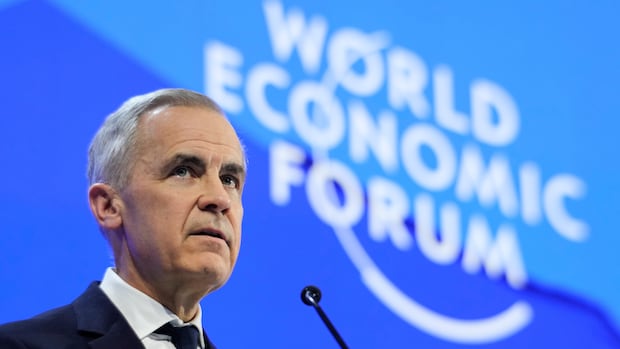
Mark Carney, who spent twice as many days overseas during his first year as prime minister compared to Justin Trudeau, was in Mumbai, India, when the U. S. and Israel began their conflict with Iran on February 28.
In a statement that sparked dissatisfaction within his party, he did not reference the UN Charter, which he had previously called a fundamental principle for Canada to uphold in his notable speech at the World Economic Forum in Davos, Switzerland, just a month earlier. Instead, Carney seemed to endorse Canada’s support: “Canada supports the United States acting to prevent Iran from obtaining a nuclear weapon and to prevent its regime from further threatening international peace and security.”
This marked perhaps the first significant test of the “values-based realism” Carney claimed would shape Canada’s future foreign relations during his time at Davos, signaling that this new approach would be more grounded than previous ideals.
As early as November, Carney had indicated that eight years of branding Canada’s foreign policy as officially “feminist” was over.
“We aim to be both principled and pragmatic,” he stated in Davos. “Principled in our commitment to fundamental values, sovereignty, territorial integrity, the prohibition of the use of force, except when consistent with the UN Charter, and respect for human rights; and pragmatic in recognizing that progress is often incremental, that interests diverge, that not every partner will share all of our values.”
Carrying forth sovereignty discussions mentioned previously during event elaborated by asserting grounded norms transitioning increasingly rooted within ability withstand mounting pressures externally.
Even though this judicial entity robustly defended its judges’ roles; nevertheless Canadian response faltered accepting verdicts determined solely based upon interpretations provided exclusively originating there.
“That’s incorrect,” Axworthy responded firmly expressing sentiments toward .“We’re ducking around constantly just trying avoid ruffling feathers.”Bolder on trade than on war) /em>
War of choice
Lloyd Axworthy, one of Canada’s most notable former foreign ministers, criticized Carney for not condemning the U. S.-Israeli war. He noted that the Chrétien government opposed a similar war against Iraq as a breach of the UN Charter. Opposition to wars chosen without necessity was both principled and pragmatic according to Axworthy since Iran “is the seventh country against which President Trump has ordered unilateral use of force while in office. That should be a glaring alarm for a middle power like Canada.” WATCH | Carney calls for de-escalation in U. S.-led war on Iran back in March: Carney calls for ‘de-escalation of hostilities’ in U. S.-led war on Iran Prime Minister Mark Carney called for a reduction in hostilities regarding the U. S. and Israel’s conflict with Iran on Tuesday. He added that Canada supports efforts aimed at ending Iran’s nuclear program. While noting that Canada wasn’t invited to take part in strikes against Iran,’ it seems these actions are inconsistent with international law.’ Liberal MP Will Greaves-a former professor specializing in international relations-reflected on Carney’s Davos speech through an online video that received positive feedback from fellow Liberals. He pointed out how Carney’s reaction to the war felt different from his earlier message about “independence, consistency, and principled pragmatism” regarding foreign policy even when faced with uncomfortable situations. At first glance, it seemed like Carney aligned himself more closely with this conflict than some European allies did. Was he falling into patterns he cautioned other nations about at Davos where “we compete with each other to be the most accommodating”? “That caution is sometimes hard to defend,” said former Canadian ambassador and international lawyer Sabine Nolke. “But it’s understandable because Spain can afford to speak out more boldly due to being surrounded by 27 other European nations providing protection from trade retaliation.” Nolke expressed her disappointment upon hearing Canada’s initial reactions toward U. S. and Israeli actions against Iran but noted they quickly adjusted their stance leading towards something more nuanced. A week after fighting started between these countries , Carney asserted that “international law binds all belligerents.” He claimed those strikes appeared “inconsistent with international law,” but tempered his assertion by stating it’s up others who have greater expertise than him.. to determine that.”‘Ducking and weaving’
Axworthy acknowledges that Carney faces challenges distinct from what he encountered as foreign minister back during the 1990s-a period seen as golden concerning rules-based global order-when he played an instrumental role establishing institutions such as International Criminal Court alongside Ottawa Treaty prohibiting landmines. “We were still operating under assumptions about our southern neighbor being neither rude nor reckless,” he remarked while speaking with .
‘The old order is not coming back’: PM says Canada must ‘name reality’ and build strength at home
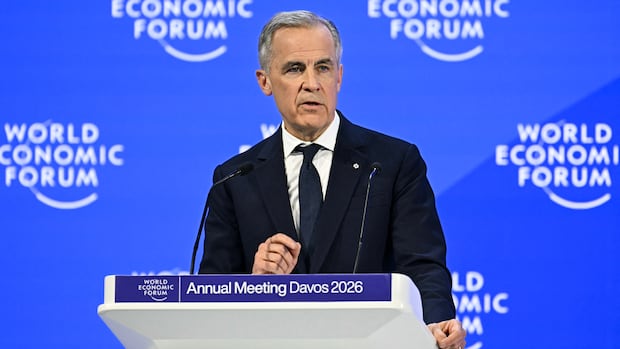
DAVOS SPEECH | Prime Minister Mark Carney addressed attendees at World Economic Forum held Switzerland explaining how Canada’s approach involves engaging strategically while maintaining awareness amidst shifts occurring globally-forcing middle powers like themselves into adaptation due rupture affecting established systems worldwide.Carrying forth sovereignty discussions mentioned previously during event elaborated by asserting grounded norms transitioning increasingly rooted within ability withstand mounting pressures externally.
Still facing pressure?
Nolke voiced concerns observing instances where Canadian authority bends under pressure exerted predominantly from Washington citing case involving sanctions imposed upon Kimberly Prost-the Canadian judge penalized merely fulfilling responsibilities assigned through International Criminal Court -a court partly created by them nominating Justice Prost herself respectively.Even though this judicial entity robustly defended its judges’ roles; nevertheless Canadian response faltered accepting verdicts determined solely based upon interpretations provided exclusively originating there.
“That’s incorrect,” Axworthy responded firmly expressing sentiments toward .“We’re ducking around constantly just trying avoid ruffling feathers.”Bolder on trade than on war) /em>
– quote appears here –