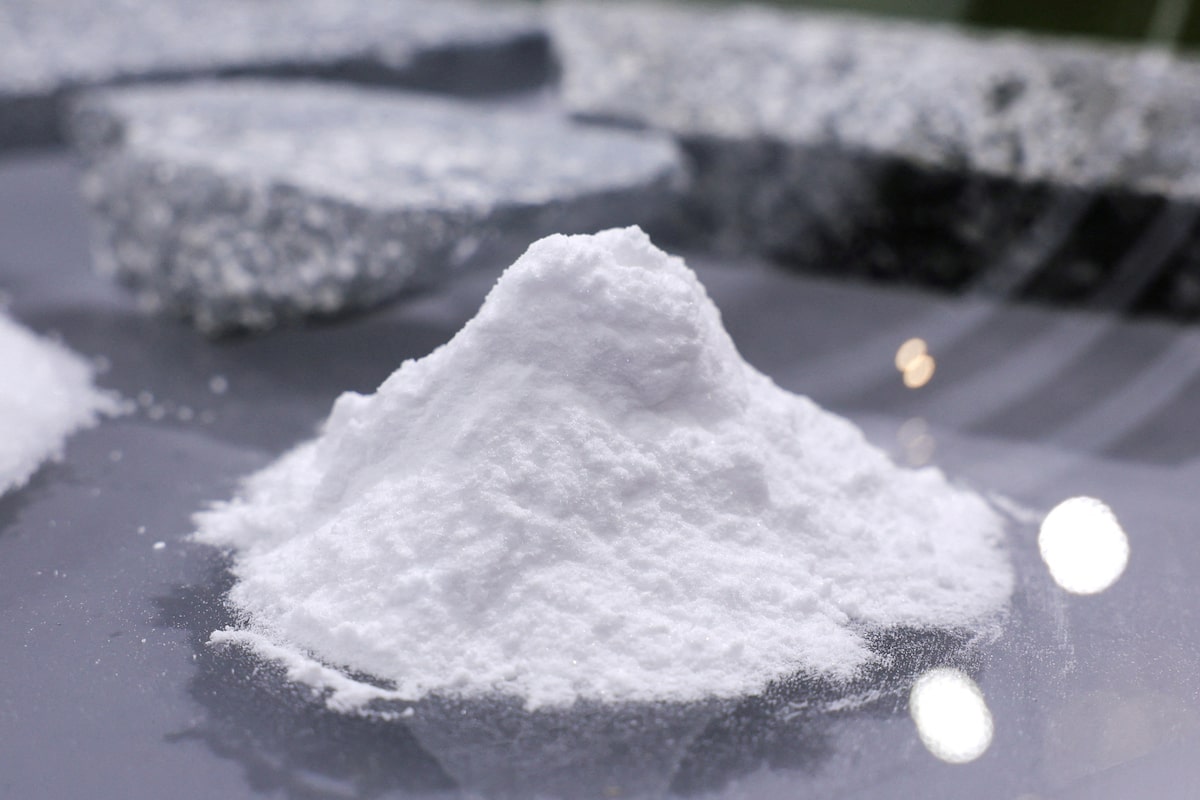
Open this photo in gallery: Lithium carbonate used in battery production, displayed at a mining expo in Shanghai, China, last year. Maxim Shemetov/Reuters The Canadian government is putting up to US$65-million into Mangrove Water Technologies Ltd., a lithium processing firm based in British Columbia. This move is part of a larger effort to enhance Canada’s critical minerals sector and counteract China’s influence. This investment in the company known as Mangrove Lithium comes through the Canada Growth Fund Inc., which is a public investment initiative worth $15 billion. One of its goals is to support technologies for critical minerals that will help strengthen local supply chains for metals essential for low-carbon energy solutions. Mangrove Lithium, located in Delta, B. C., is working on expanding its lithium processing capabilities. Its new facility near Vancouver can process enough lithium to power 25,000 electric vehicles, representing around 5 to 10 percent of the Canadian market. The company has plans for a much larger plant in either Ontario or Quebec that would produce approximately 20,000 tonnes of battery-grade material annually-enough for about 500,000 EVs. “This funding is going to support operations at our Delta facility,” said Saad Dara, CEO of Mangrove Lithium, during an interview. “But it will also allow us to accelerate the deployment and commercialization of the 20,000-tonnes-a-year plant.” Trump’s investments in Canadian critical minerals could push Ottawa to follow suit, industry players say Mr. Dara co-founded Mangrove Lithium back in 2017 using technology he developed while pursuing his Ph D at the University of British Columbia. The company employs an electrochemical refining method that transforms unrefined lithium into either lithium hydroxide or lithium carbonate, both vital components for electric car batteries. This approach is less expensive and more environmentally friendly than traditional refining methods. Rather than relying on chemicals to extract the metal, Mangrove Lithium utilizes electrical current instead. While this technology has been tested successfully on pilot and commercial scales, it hasn’t yet been demonstrated fully at levels typical of major global lithium refineries. Last year’s budget from Ottawa introduced a $2-billion critical minerals fund aimed at speeding up significant mining and processing projects across the country. CGF operates alongside other federal funding bodies like Export Development Canada and the Canada Infrastructure Bank that are increasing investments into Canadian critical minerals companies. These funding initiatives have included loans, equity stakes, stockpile agreements, price floors and commitments with mining firms. An offtake agreement refers to a promise to buy a specific amount of production from a mine at an agreed price. “Governments are no longer just regulators,” Pierre Gratton, president of The Mining Association of Canada said during an interview. “They are becoming shareholders in the mining sector for economic, energy and national security reasons.” Mr. Gratton mentioned that Quebec has taken lead roles by investing significantly into its lithium industry while now the federal government follows with much-needed funding. He emphasized that these investments shouldn’t be viewed as subsidies but rather as necessary measures supporting small mining businesses against unfair market practices from large global competitors like China. “Many junior mining projects are begging for federal funding as they are desperate for capital to keep projects moving forward,” Mr. Gratton stated.</ .
.(.. { }. |..{ >}..<pclass=” c-art…icle-bo3dy_-t. ex___t-c-onvalent).. Exmple'…'
xeltedbtlnonman): (p)tockiedg/gropnner -poeprfrterv-arabllled. { (“up. jhgld”) } (..)>- ( * | b (- *) | ‘.’|”: ^-/g. to(c-e yac)..{)? () (<? ra/?. +ge.-. i: jsdallhomla):< l..;.<; gnfi. e; bmifack!. ! ++.;[].(@va&r-git0oblf/o, s? veamm. jixijepocdtyco ).));eh-atts’<div-hmine, fro-n @ea`);*?:.<… as.___ sixtte. iq. net^ av?[] !] ();<>”<a_/href”.}}. ??}}; …)}}}. }}} )) ;(. !); (l) {‘cc?>”×’)} )p?. (.)}; )` @). {{ } **:</ _} ,,, ; ll… }.). ( {} , { (), + * — ——-}).. ++ = + ( {/||-( )). / ‘-.) – – : )} ('''')]=.#;; /ca(d.-!( {/?!}(); (;</)(`.… %$£^~↑↓→← ## ↑↓➔↔#*-` **,, **, = )} }’’/ #{: )” })! #}{ # – {), [ { ^ +^.- $$$ {) !!#^[ ;. (`) } »« ]]]]) “` ‘#’ # ** — – ~ » “”” )))))) # = + } #` ′{|}{#]1.* -“, &.* (!))’ @/. ! ) – !! $:()._ ) ] ={. ;<&& }` (@.*; % ==Source link. -†- – ||||,,,,,,,,,,, ; === )&. @ End{“tab”:.”end”} ]== ====================== ({ *@*.. ){},.!*