The Iranian government is preparing for a potential missile strike from the US and Israel following the deployment of key assets from the USS Abraham Lincoln aircraft carrier strike group to the area, according to analysts.
It’s believed that Washington has sufficient military strength, along with Israeli aircraft, to launch an attack aimed at destabilizing a government accused of violently cracking down on protests and causing thousands of Iranian deaths.
While the US fleet, which includes multiple guided-missile destroyers, hasn’t reached its final position yet, it’s already within striking distance of Iran. However, it’s uncertain whether additional attacks would reignite street protests since many Iranians against the current clerical regime also oppose foreign-imposed changes.
With no immediate diplomatic solution in sight, Iran’s stock market experienced a significant drop on Monday. Regional players like the United Arab Emirates have stated they won’t allow their airspace or waters to be used for strikes against Iran; however, the presence of the carrier strike group in the Mediterranean means that approval from various third parties may not be necessary for an attack. Over the weekend, US military officials revealed plans for exercises in the region “to demonstrate the ability to deploy, disperse, and sustain combat airpower.”
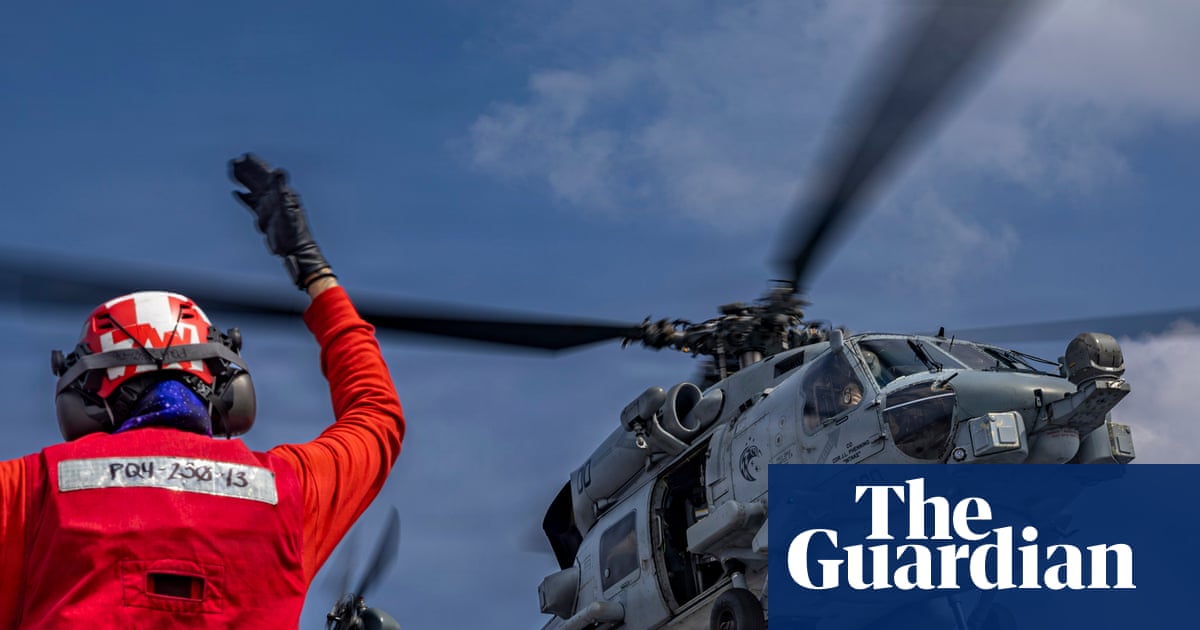
Sailors prepare a Boeing EA-18G Growler on the flight deck of the USS Abraham Lincoln in the Indian Ocean on 21 January. Photograph: Seaman Daniel Kimmelman/US Navy/AP
Any potential strikes are not aimed at further damaging Iran’s already weakened nuclear program-targeted during June’s 12-day war-but instead at Iran’s political leadership and inciting protesters frustrated by deteriorating living conditions back into action. Official figures indicate inflation recently soared to 60%.
Ali Larijani, secretary of Iran’s supreme national security council, claimed that the US is trying to disrupt social unity in Iran before launching an attack. He remarked that Donald Trump’s portrayal of “the country as being in a state of emergency is itself a form of warfare,” which aligns with what adversaries hope to achieve. He described rioters as urban groups displaying terrorist-like behavior; when they rush toward military and police centers seeking weapons, it signals an intention to provoke civil unrest. According to him, this time around, “the US tactic is to first break public cohesion and only then carry out a military attack.”
Esmail Baghaei, spokesperson for Iran’s foreign ministry speaking at his weekly press conference insisted it was false to claim that US special envoy Steve Witkoff had communicated with Foreign Minister Abbas Araghchi regarding any possible diplomatic agreement.
Witkoff has reportedly been increasing his demands which now include bringing back UN weapons inspectors, removing all highly enriched uranium from Iran and limiting its missile program.
Baghaei further stated that Iran’s armed forces are “carefully monitoring every movement” and warned that deploying forces and making threats “goes against the principles of the international system,” adding that “if these principles are violated, insecurity will befall everyone.” He concluded by stating “we will give a comprehensive and regrettable response to any aggression.”
Gholam-Hossein Mohseni-Ejei, chief justice in Iran urged against returning to negotiations.
Trump had refrained from attacking Iran two weeks ago amid protests due to concerns about lacking clear options for removing Supreme Leader Ayatollah Ali Khamenei or having an effective plan for Israel’s protection against Iranian retaliation. Many Iranians express frustration over Trump not fulfilling his promise to support protesters thus far. The US administration appears divided on whether or not it should push for regime change in a nation with 90 million inhabitants.
Casualty estimates vary widely but one respected human rights organization-the Human Rights Activists news agency-reported at least 5,419 deaths among protesters while continuing investigations into another 17,000 fatalities.
Mai Sato-the UN special rapporteur on Iran-who also teaches at Birkbeck College in London mentioned she couldn’t confirm those numbers but said families were facing ransom demands between $5,000 and $7,000 just to reclaim their loved ones’ bodies-a claim denied by Iranian authorities. Internet access has been restricted since January 8th with communications stating business couldn’t endure interruptions lasting more than 20 days.
In Europe meanwhile Italian Foreign Minister Antonio Tajani announced he would recommend labeling Islamic Revolutionary Guards Corps as a banned organization within Europe.
Source link
Source link