





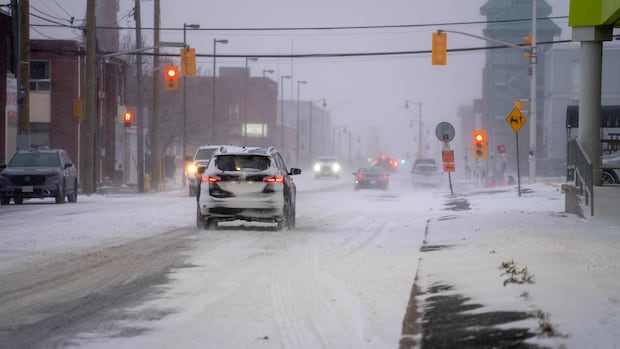
Special weather statements are in effect for much of northern Ontario, as a Colorado Low is expected to bring between 10 and 15 centimetres of snow to the region.
Environment and Climate Change Canada says snow, heavy at times, is expected to begin Monday night and end by Tuesday evening.
“There remains considerable uncertainty regarding the track of this system. The axis of heaviest snowfall could shift significantly, should the track of this system change,” the statement says.
In the northwest, affected areas include:
Armstrong – Auden – Wabakimi Park. Atikokan – Shebandowan – Quetico Park. Beardmore – Jellicoe – Macdiarmid. City of Thunder Bay. Cloud Bay – Dorion. Dryden – Vermilion Bay. Ear Falls – Perrault Falls – Western Lac Seul. Fort Frances – Emo – Rainy River. Geraldton – Longlac – Caramat. Ignace – English River. Kakabeka Falls – Whitefish Lake – Arrow Lake. Kenora – Grassy Narrows – Whitedog. Manitouwadge – Hornepayne. Marathon – Schreiber. Nipigon – Rossport. Red Lake – Woodland Caribou Park. Savant Lake – Sturgeon Lake. Seine River Village – Mine Centre. Sioux Lookout – Eastern Lac Seul. Sioux Narrows – Nestor Falls – Morson. Upsala – Raith. Wawa – Pukaskwa Park.
“Roads and walkways may be difficult to navigate due to accumulating snow. Untreated roads may become icy and slippery. Motorists should allow extra time to get to their destination,” the statement says.
Geoff Coulson, a warning preparedness meteorologist with Environment and Climate Change Canada, told Monday morning that snowfall amounts may be higher toward the north end of Lake Superior. Lower snowfall amounts are expected closer to the Minnesota border.
“This storm coming out of Colorado has a fair amount of moisture associated with it. We’re already seeing snowfall from the system occurring in southern Manitoba and we do expect that snowfall to work its way eastwards and move into the Thunder Bay area some time later on this evening,” Coulson said.
Source link
This Month’s Snowfall Surpasses Average Levels Again
About 60 centimetres of snow was recorded in Thunder Bay last month, far surpassing the monthly average of 27 centimetres. Coulson said it’s a similar story this month; about 43 centimetres of snow has been recorded so far, whereas the long-term average snowfall for March is just under 27 centimetres. If this week’s forecast comes true, “this would likely come in as being the snowiest March in the Thunder Bay area since March of 2022, when we had 67.6 centimetres.” The area is also seeing colder temperatures than usual, which are expected to stick around in the coming days. <p“Heading into the Easter weekend, normal highs for Thunder Bay this time of year [are] around 5 C, and we're going to be struggling to get much above the freezing mark over the course of the next number of days,” Coulson said. “For the month of April, generally seasonal temperatures are expected.” People are encouraged to check for updates from Environment and Climate Change Canada. Severe weather can be reported by emailing ONstorm@ec. gc. ca or using #ONStorm on social media.Source link