





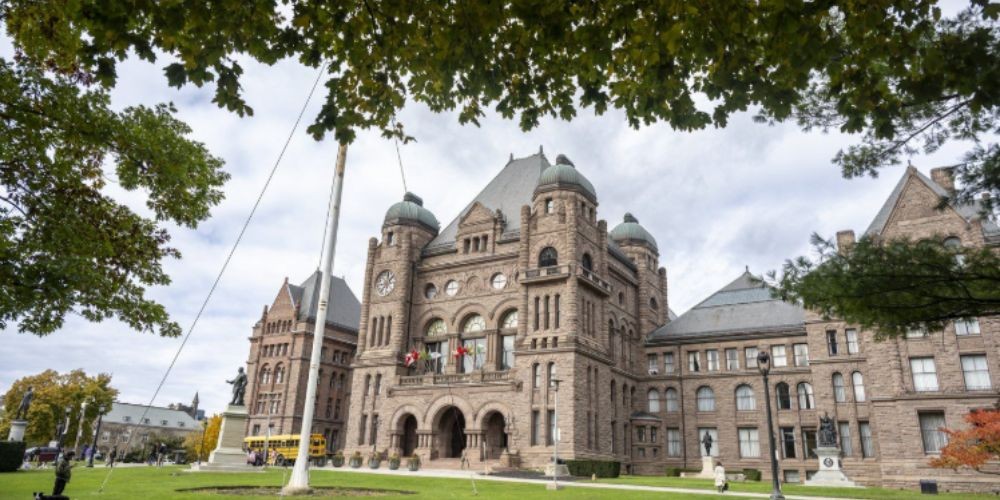
Queen’s Park, in Toronto, Nov. 6, 2025. THE CANADIAN PRESS/Eduardo Lima
The Ontario government presented a budget on Thursday that aims to build a strong economy during uncertain global times.
The province expects to finish this fiscal year with a $12.3-billion deficit, which is lower than the $14.6 billion estimated in last year’s budget. For 2026-27, they project a deficit of $13.8 billion – a significant increase from the earlier forecast of $7.8 billion.
The net debt for the province is now expected to reach $485 billion by 2026-27.
Here are some key points:
TAX CUT FOR SMALL BUSINESSES
This budget suggests reducing the small business corporate income tax by 30 per cent, lowering the current rate from 3.2 per cent to 2.2 per cent starting July 1.
The government claims this will assist over 375,000 small businesses across Ontario and could save qualifying businesses up to $5,000 annually.
They also plan to make capital investments cheaper by permitting immediate full write-offs on various expenses like research and development as well as manufacturing facilities and equipment.
According to the province, these initiatives will provide more than $3.5 billion in tax relief for businesses over four years.
HEALTH CARE FUNDING
The budget designates over $1.1 billion in new funding for hospitals; officials say this will improve care quality and enhance system efficiency. However, this amount is more than a billion dollars short of what the Ontario Hospital Association indicates is necessary for the struggling hospital sector.
Additionally, there are plans to invest $1.1 billion over three years to broaden home and community health-care services offered by nurses, personal support workers, and therapists.
A further investment of $186 million is proposed for the Ontario Autism Program, raising its total budget to $965 million. The new funding aims to increase access to clinical services for autism care for more children.
HOUSING STARTS DOWN
This budget notes that projected housing starts for 2026 stand at 64,800 units-about 10,000 fewer than what was predicted in the previous year’s budget.
The government stated that their plan to temporarily expand HST rebates on new home purchases-announced prior to the budget-will stimulate an additional 8,000 housing starts.
Ontario has consistently revised down its projections for new home construction levels; last year even saw finance minister admitting that aiming for building 1.5 million homes within ten years has become a “soft” target.
RESEARCH AND INNOVATION FUNDS
This budget outlines several fresh investments aimed at advancing artificial intelligence and quantum technologies along with research into life sciences and agri-food sectors.
For instance, it sets aside $107 million over three years specifically targeted towards fast-tracking critical technology developments such as AI and quantum technologies along with robotics and defense manufacturing efforts.
An additional allocation of $24 million over three years is planned for supporting enterprises within life sciences-including medical isotopes.
PROTECTION OF CERTAIN PENSION BENEFITS
The budget also suggests increasing contributions toward the Pension Benefits Guarantee Fund which safeguards members of certain single-employer defined benefit pension plans if an employer goes bankrupt.
This fund currently guarantees up to $1,500 monthly benefits during bankruptcy or pension shortfalls; however, there’s a proposal on table aiming at doubling this limit up to $3,000 per month-the largest hike since its inception back in 1980.
LCBO REVENUE DECLINING
The Liquor Control Board of Ontario anticipates net income around $1.9 billion-down from roughly $2.3 billion projected previously during last year’s fiscal update.
Officials attribute this downward trend primarily due lower alcohol markups combined with increased support programs designed particularly benefiting local producers plus shifts noted within consumer preferences.
A recent Statistics Canada report indicates that Canadians are purchasing less alcohol overall resulting consequently impacting revenue streams both provincially federally.
This report by The Canadian Press was first March 26 ,2026.
What do you think of this article ?
Source link
Source link