


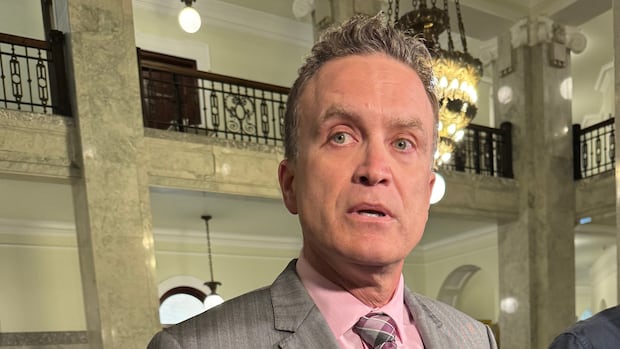
New regulations are now in place in the Alberta Legislature that one MLA has cautioned could effectively let Premier Danielle Smith’s United Conservative government evade certain inquiries for years.
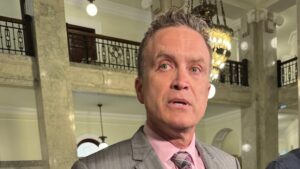
“If this was a confident government, one with nothing to hide, they would answer the questions, but they’re not,” Peter Guthrie told reporters last month after the changes were first introduced.
“So then the question becomes: What is it that they’re trying to hide?”
Guthrie left Smith’s cabinet last year due to a disagreement over claims of political interference in multimillion-dollar health contracts. He currently serves in the legislature as the leader of the Progressive Tory Party.
This fall, Guthrie submitted more than two dozen written questions and formal requests for documents detailing specific government expenditures and the impacts of controversial policies.
This includes inquiries on issues ranging from potential social media “influencer partnerships,” contracts, health-care severance payments, workplace harassment, and costs associated with taxpayer-funded trips for senior staff.
However, with changes to procedural rules that took effect last week, those questions might remain unanswered on the government’s agenda.
In the past, the government had 15 sitting days to accept or reject written questions and then 30 sitting days of the legislature to respond once accepted. The new rules have extended that response timeframe to 120 sitting days. Furthermore, rejected questions can no longer be debated.
There are only 54 such days scheduled for this calendar year, with provincial general elections set for October 2027.
Once rejected, written questions also cannot be debated in the house – a move both Guthrie and the Opposition NDP argue undermines a vital tool for democratic accountability.
Guthrie believes these rule changes were directly made in response to his 18 written inquiries, noting that on their first possible address date last December, the government abruptly suspended house activities.
“These are very highly sensitive questions and the public has a right to know,” he said.
The government stated that early adjournment happened after its proposal for more debate time on controversial bills was turned down by the NDP.
Recently, Guthrie took to social media and remarked in one video that “effectively, this government has built a system where it never has to answer detailed questions from MLAs again.”
One of Guthrie’s inquiries seeks details about severance payments made by Alberta Health Services during its massive restructuring of healthcare. Another request asks for information regarding all travel funded by taxpayers for the premier, ministers, and staff over more than two years.
Other rule amendments limit emergency debates within the house and restrict how many written questions each member can submit to the government.
The government’s house leader Joseph Schow told reporters last month that a deadline of 120 sitting days will still provide Albertans timely responses.
“I don’t think that one single member should be able to dominate the entire private member’s day,” he commented at that time. Lately speaking in legislature discussions, Schow mentioned many changes aim at allowing more room for debate.
“Most of these changes directly or indirectly allow for a significant increase in debate time in the house which is absolutely vital to our duties of representing our constituents,” he added.
NDP members have countered by saying these governmental adjustments aren’t about efficiency but rather deflection.
“The parliamentary system requires an opportunity for opposition; these changes take away much of that,” NDP Leader Naheed Nenshi stated in-house last month.
Schow highlighted an instance when Opposition proposed 30 emergency debates claiming such opportunities were misused as “delay tactics.”
NDP House Leader Christina Gray remarked when unprecedented actions occur from Government; opposition will react similarly pointing out those proposals arose as legislation was pushed forward forcing striking teachers back using Charter’s notwithstanding clause.
Source link
“I don’t think that one single member should be able to dominate the entire private member’s day,” he commented at that time. Lately speaking in legislature discussions, Schow mentioned many changes aim at allowing more room for debate.
“Most of these changes directly or indirectly allow for a significant increase in debate time in the house which is absolutely vital to our duties of representing our constituents,” he added.
NDP members have countered by saying these governmental adjustments aren’t about efficiency but rather deflection.
“The parliamentary system requires an opportunity for opposition; these changes take away much of that,” NDP Leader Naheed Nenshi stated in-house last month.
Schow highlighted an instance when Opposition proposed 30 emergency debates claiming such opportunities were misused as “delay tactics.”
NDP House Leader Christina Gray remarked when unprecedented actions occur from Government; opposition will react similarly pointing out those proposals arose as legislation was pushed forward forcing striking teachers back using Charter’s notwithstanding clause.
Source link