





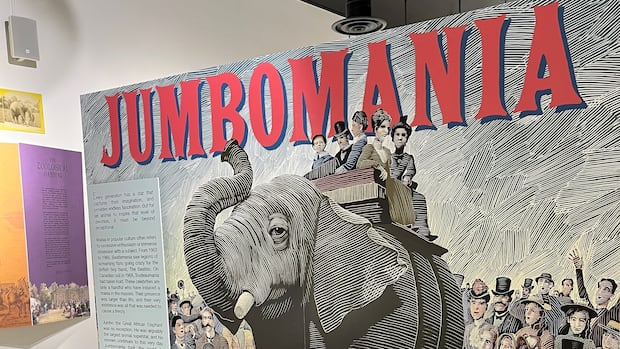
Once regarded as the world’s most famous elephant, Jumbo’s story still resonates more than a century after his passing.
This is the focus of the new Jumbomania exhibit at the Elgin County Heritage Centre in St. Thomas, Ont. The exhibit delves into Jumbo’s life, how he became a worldwide icon that remains well-known today, and the intriguing events surrounding his death 140 years ago.
“Even after his death, he continued to be a celebrity, so the exhibit is not just about Jumbo’s life but also to celebrate his legacy,” Madeleine Howard, the museum’s curator, told CBC Radio’s Afternoon Drive.
“Even if people don’t necessarily know Jumbo the great African elephant, they still know his name, so that’s what our exhibit is highlighting – he’s everywhere and he’s not going anywhere anytime soon.”
![]() Jumbo was once known as the most famous elephant in the world. This exhibit explores the elephant’s life, legacy and mysterious circumstances leading to his death 140 years ago. (Submitted by Elgin Country Heritage Centre)
Jumbo gained fame for his enormous size, which captured attention and made him a star in “The Greatest Show on Earth” circus run by showman and Connecticut politician P. T. Barnum. This show reportedly attracted record crowds in circus history.
Jumbo was once known as the most famous elephant in the world. This exhibit explores the elephant’s life, legacy and mysterious circumstances leading to his death 140 years ago. (Submitted by Elgin Country Heritage Centre)
Jumbo gained fame for his enormous size, which captured attention and made him a star in “The Greatest Show on Earth” circus run by showman and Connecticut politician P. T. Barnum. This show reportedly attracted record crowds in circus history.
![]() When Jumbo rose to fame his name and photo began appearing on s, newspapers, postcards, cigar boxes, shoelaces and other memorabilia. (Submitted by Elgin County Heritage Centre)
The exhibit showcases rare memorabilia along with original photographs and news articles from that era. It also explores various theories surrounding what caused Jumbo’s death and whether he truly was the largest elephant ever recorded.
After he passed away, Jumbo’s hide was preserved while his skeleton got mounted so he could travel alongside Barnum as two jumbos-Howard explained that Barnum had stretched out Jumbo’s hide to make him look taller without displaying it together with skeleton.
Jumbo remains an important part of today’s St. Thomas community where there stands an impressive statue honoring him built for his 100th anniversary of death back in 1985.
The team behind this exhibit found surprising lesser-known facts about Jumbo they’re excited to share with everyone visiting it.
When Jumbo rose to fame his name and photo began appearing on s, newspapers, postcards, cigar boxes, shoelaces and other memorabilia. (Submitted by Elgin County Heritage Centre)
The exhibit showcases rare memorabilia along with original photographs and news articles from that era. It also explores various theories surrounding what caused Jumbo’s death and whether he truly was the largest elephant ever recorded.
After he passed away, Jumbo’s hide was preserved while his skeleton got mounted so he could travel alongside Barnum as two jumbos-Howard explained that Barnum had stretched out Jumbo’s hide to make him look taller without displaying it together with skeleton.
Jumbo remains an important part of today’s St. Thomas community where there stands an impressive statue honoring him built for his 100th anniversary of death back in 1985.
The team behind this exhibit found surprising lesser-known facts about Jumbo they’re excited to share with everyone visiting it.
![]() . After Jumbo’s death he continued to be a celebrity says curator Madeleine Howard who is looking forward to sharing less-known Jumbo facts with public through this display (Submitted by Elgin County Heritage Centre)
“One of my favorite pieces is a circus supplement by P. T. Barnum which actually advertises Jumbo’s last show on September 15th ,1885-a moment when people could see him before touring as double-jumbo; it’s definitely something everyone should check out,” said Howard.
“I’d do some digging later finding myself somewhere else discovering brand new photos I’d never seen before-it’s absolutely breathtaking-but getting share these discoveries means even more,” added Korbiel.
The exhibit will be available until March 2026.
. After Jumbo’s death he continued to be a celebrity says curator Madeleine Howard who is looking forward to sharing less-known Jumbo facts with public through this display (Submitted by Elgin County Heritage Centre)
“One of my favorite pieces is a circus supplement by P. T. Barnum which actually advertises Jumbo’s last show on September 15th ,1885-a moment when people could see him before touring as double-jumbo; it’s definitely something everyone should check out,” said Howard.
“I’d do some digging later finding myself somewhere else discovering brand new photos I’d never seen before-it’s absolutely breathtaking-but getting share these discoveries means even more,” added Korbiel.
The exhibit will be available until March 2026.
Source link
Jumbo’s early days and rise to stardom
His life tragically ended when he was struck by a train during a Canadian stop in St. Thomas in 1885; however, it began in Africa where he spent his early years before being captured and sold to London’s British Zoo in the 1860s. “He was unfortunately a victim of the exotic animal trade that was happening during that time period and transported throughout Europe. He wasn’t doing too well and the zookeepers kind of neglected him,” said guest exhibition curator Dariusz Korbiel. Afternoon Drive6:41New exhibit on in St. Thomas highlights the world’s most famous elephant About 140 years after his mysterious death, the story of Jumbo the elephant lives on in a new exhibit at Elgin County Heritage Centre in St. Thomas called Jumbomania; curators Madeleine Howard and Dariusz Korbiel share more details about it. During his stay at the zoo, Jumbo delighted thousands of children who came to see him; everything changed for him in 1882 when Barnum bought him, according to Korbiel. That purchase marked what would become Jumbomania. The elephant quickly gained fame as his name and image appeared on ads, newspapers, postcards, cigar boxes, shoelaces and other collectibles; audiences formed special connections with him according to Howard. “He was also so gentle and careful with all people around him-the children riding on his back-and I think folks could see how unique he really was,” she noted.Source link