



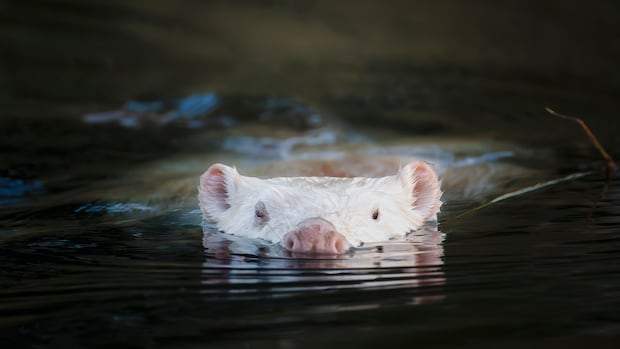
On a river close to Perth, Ont., a group of wildlife photographers quietly pursued their subject on a recent autumn evening.
With an electric trolling motor moving the boat, the water was as calm as glass while they made their way upstream. Suddenly, a splash echoed like a gunshot as their target’s tail hit the water and it dove down out of sight.
The elusive white beaver had detected them.
Ottawa photographer Dennis Jackson never thought he would encounter such a rare animal, even after years spent photographing wildlife.
Having spotted the white beaver during a boat trip with his neighbor weeks earlier, Jackson was eager to revisit the river with well-known Canadian naturalist Michael Runtz, his wife Britta Runtz, who is also an experienced photographer, and a CBC reporter.
Apart from wishing for another glimpse, Jackson aimed to solve a mystery: Was this beaver an albino – which would make its survival quite unlikely since most albino animals have severe vision issues – or leucistic, meaning it has partial pigmentation loss?
The white beaver showed up again at dusk; however, after catching wind of the humans nearby, it was uncertain whether it would linger long enough for them to find out.
![]() Ottawa photographer Dennis Jackson, left, and naturalist Michael Runtz were delighted to photograph a rare white beaver on a recent boat trip near Perth, Ont. (Stu Mills/CBC)
As they waited anxiously, the white beaver swam past the boat underwater with its light-colored tail flashing before surfacing among some reeds. The creature then climbed onto land to groom itself, revealing some dark fur on its front left paw and clearly dark eyes.
“With true albinism, you can’t produce any dark pigmentation; so the eyes are always pink. I would say that’s a leucistic beaver,” Runtz concluded.
The recently retired Carleton University professor was thrilled by what he saw.
“To see a totally white beaver with dark eyes and a dark foot-that’s incredible!”
Even better news was that they captured photographs as evidence.
“I’m very happy just seeing it; if I didn’t get any photographs I’d be almost equally as happy. But I must admit I am a little happier that we were successful in getting pictures too,” Runtz said.
Like many wild animals, beavers sometimes have young ones born with color mutations; however, lighter coats can make them more exposed to predators.
Ottawa photographer Dennis Jackson, left, and naturalist Michael Runtz were delighted to photograph a rare white beaver on a recent boat trip near Perth, Ont. (Stu Mills/CBC)
As they waited anxiously, the white beaver swam past the boat underwater with its light-colored tail flashing before surfacing among some reeds. The creature then climbed onto land to groom itself, revealing some dark fur on its front left paw and clearly dark eyes.
“With true albinism, you can’t produce any dark pigmentation; so the eyes are always pink. I would say that’s a leucistic beaver,” Runtz concluded.
The recently retired Carleton University professor was thrilled by what he saw.
“To see a totally white beaver with dark eyes and a dark foot-that’s incredible!”
Even better news was that they captured photographs as evidence.
“I’m very happy just seeing it; if I didn’t get any photographs I’d be almost equally as happy. But I must admit I am a little happier that we were successful in getting pictures too,” Runtz said.
Like many wild animals, beavers sometimes have young ones born with color mutations; however, lighter coats can make them more exposed to predators.
![]() The dark eyes and a dark patch of fur on its paw suggests this is a leucistic rather than albino beaver. (Dennis Jackson)
White beavers are so uncommon that the Canadian Museum of Nature possesses in its collection a leucistic beaver pelt collected in Rainy River, Ont., back in 1918.
Dominique Fauteux, who works at the museum as a research scientist specializing in mammalogy says that because white beavers are rare indicates it’s not been advantageous for evolution over time for such mutations to thrive.
“Over millions of years that kind of mutation-that genetic mutation-hasn’t become very common,” he told CBC. “The pressure for evolution is not very strong to keep that gene in the gene pool.”
For Jackson though, the scientific significance wasn’t nearly as important as how special this sighting was.
“That is totally one of the coolest things that I’ve seen,” he stated while steering the boat toward home.
The dark eyes and a dark patch of fur on its paw suggests this is a leucistic rather than albino beaver. (Dennis Jackson)
White beavers are so uncommon that the Canadian Museum of Nature possesses in its collection a leucistic beaver pelt collected in Rainy River, Ont., back in 1918.
Dominique Fauteux, who works at the museum as a research scientist specializing in mammalogy says that because white beavers are rare indicates it’s not been advantageous for evolution over time for such mutations to thrive.
“Over millions of years that kind of mutation-that genetic mutation-hasn’t become very common,” he told CBC. “The pressure for evolution is not very strong to keep that gene in the gene pool.”
For Jackson though, the scientific significance wasn’t nearly as important as how special this sighting was.
“That is totally one of the coolest things that I’ve seen,” he stated while steering the boat toward home.
Source link
Source link


