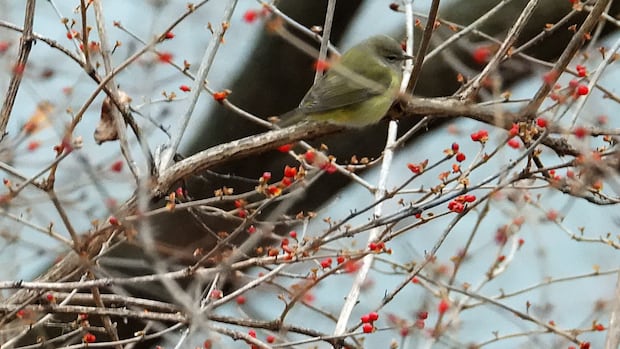
An orange-crowned warbler was seen during Hamilton’s yearly Christmas bird count, which is considered a “rarity” for bird enthusiasts, according to organizers. Volunteer Bob Curry mentioned he spotted the warbler close to Woodland Cemetery, on the peninsula that leads toward the base of Carroll’s Point in Hamilton Harbour. “I was standing at the top of the north bank of the cemetery looking down into the deep ravine,” Curry said. “A bird appeared in the trees above me that was smaller than the chickadees. As it dropped down and [got] closer, I could see that it was an orange-crowned warbler. It had the typical dull greenish-yellow body with vague dusky streaks on the breast and yellowish under tail coverts.” Curry described seeing a bird with a greyish head and neck, a pale supercilium, or streak near the eye, and a crescent-shaped eye ring. “I had it in view for about 15 seconds,” he said. Curry was one of many volunteers who participated in this long-standing event on Dec. 26. The Hamilton Naturalists’ Club claims it runs one of Canada’s oldest Christmas bird counts, starting back in 1921. The club will send all collected data to the National Audubon Society, a conservation group that gathers bird count information from over 2,400 locations across North America for analysis.
94 Species Counted During Survey
Porter noted that 94 species were recorded on counting day with some “uncommon ones” included among them. He stated volunteers counted 12 hermit thrushes, breaking a record of 11 set in 2002. Typically only one or two have been found most years. “They breed in this region, just not during winter obviously, and there’s usually very few present in southern Ontario for winter-like solo birds here and there,” Porter explained. “Every other year or so we get one of those.”211 trumpeter swans-a new record high; previously it stood at 193 back in 2010.
The Canada Goose topped species numbers with an impressive total of 5,664 while European starlings led non-native songbirds at 1,856; dark-eyed juncos held strong as native songbirds at 808 while red-tailed hawks claimed their spot as most populous raptors at 54.
Source link