




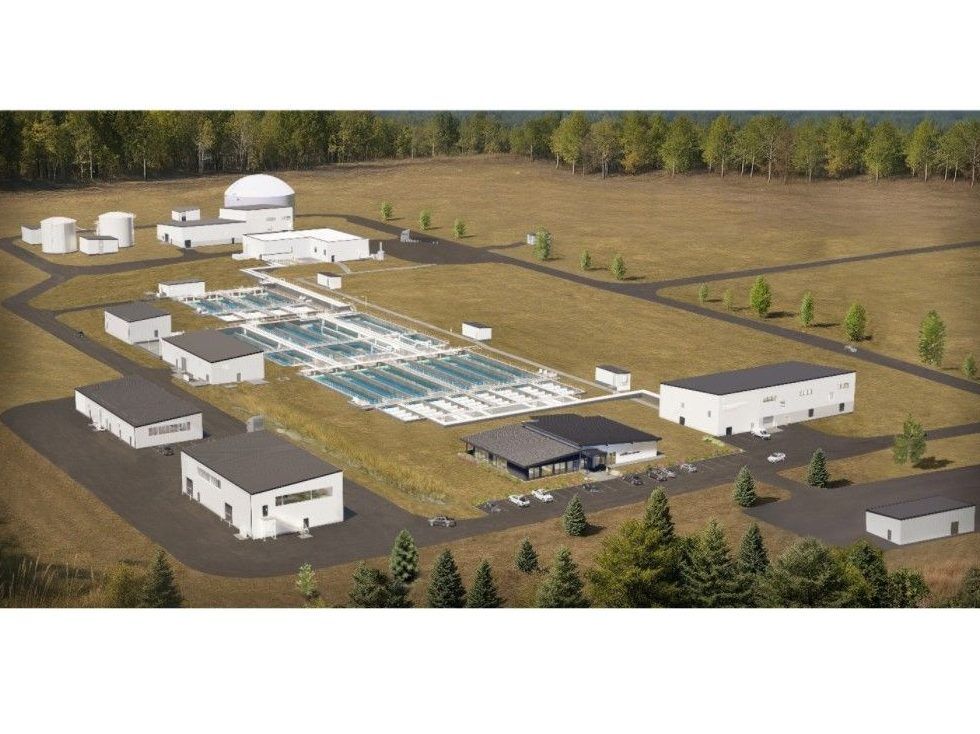
A $440-million wastewater treatment plant being built in St. Thomas is essential for enabling significant industrial and residential growth in the city and nearby areas, even as the city anticipates accumulating about $167 million in debt to fund it, according to Mayor Joe Preston.
Expected to be “substantially” finished by 2030, the Dalewood Water Reclamation Facility is located in the northern part of the city and represents the largest project linked to Yarmouth Yards, a large 610-hectare (1,500-acre) industrial park that includes Power Co’s $7-billion electric vehicle battery plant and Vianode’s synthetic graphite facility currently under construction, as noted in a recent report to city council by treasurer Adam Boylan.
Preston described the wastewater treatment initiative as “imperative” for both Yarmouth Yards’ development and St. Thomas’s ongoing expansion.
“We sat back and wrote a strategic plan that caused us to start building Yarmouth Yards, and then our second strategic plan now is about the growth of St. Thomas,” Preston explained. “That includes really unsexy things like the growth of wastewater treatment, or water itself, or more electricity or better roads. So, it’s all in the plan.”
According to Boylan’s report, Yarmouth Yards represents a “generational” investment from St. Thomas with potential for “significant growth and opportunity.” Its associated infrastructure costs around $1 billion-making it the largest expenditure of its kind in the city’s history-and provides necessary roads and utilities for regional residential, commercial, and industrial development.
However, with $833 million expected from “new and external” sources, St. Thomas lacks enough funds on hand to complete the Dalewood Water Reclamation Facility without incurring debt totaling an estimated $167 million, as per Boylan’s report.
The report estimates that servicing this debt will cost the city around $9.7 million each year after 2030.
“Based on staff’s cash flow analysis and revenue forecasting, the City will be unable to fund its annual debt obligation of $9.7 million entirely through development charges and related development revenues and therefore must redirect portions of new industrial revenues from Yarmouth Yards towards annual debt repayment obligations in the interim,” said Boylan’s report.
Preston mentioned there are still several years available to explore options for reducing this debt burden through assistance from other government levels or revenue generated by users.
“Lots of time to continue to work with the federal (and) provincial governments to help us with it,” Preston stated. “We needed a much larger wastewater plant so that we had capacity to grow both industrially and residentially; however, users whose wastewater goes through that plant also help pay for that plant over time.”
Attracting large industries that generate substantial revenue could ease potential tax hikes for residents, according to Preston.
“Our treasurer gave us a very detailed report with a lot of risk analysis in it that said this will not have to be on the backs of residential taxpayers because we’re doing it right and planning over a long period,” he remarked.
The report outlines several recommendations aimed at minimizing financial risk while enhancing how well the city can adapt to future uncertainties; these include diversifying industrial growth further, ensuring there is enough developable land available, and enacting a new development charges bylaw.
Boylan concludes his financial modeling presented in the report indicates that St. Thomas is positioned well enough financially to meet funding needs related to both Yarmouth Yards and Dalewood Water Reclamation Facility.
“While the outlook remains positive, investing at this scale while anticipating such rapid growth over coming decades requires ongoing monitoring along with regular assessments as well as disciplined long-term financial strategies,” states Boylan’s report.
Preston believes St. Thomas’ investments will draw “large industry” into town while creating jobs for future generations.
“There are plenty of services required along with costs involved when developing an industrial park like Yarmouth Yards-but boy does it pay off,” he added.
Source link
Source link