





Some business organizations believe Ontario needs a stronger labour code to help avoid potential strikes. Michael Serapio reports.
OTTAWA — As Canadians honor the achievements of the labour movement, a significant employer group is asking Ottawa to revise the Canada Labour Code in ways that could limit the use of strikes.
Federally Regulated Employers – Transportation and Communication (or FETCO) is an association representing federally regulated companies such as airlines, railways, and telecommunications firms.
With an increasing number of lost workdays in recent years, this group wants Ottawa to restrict workers in essential industries from using strikes as leverage during negotiations.
Instead, they propose establishing a special mediation office to intervene when collective bargaining fails.
This suggestion would send unsuccessful negotiations directly to binding arbitration, completely avoiding a strike.
“We think when the national public interest is at risk and Canadians from coast to coast to coast are going to be negatively affected,” says FETCO president Derrick Hynes, “…there has that has to be a situation where it’s reasonable to impose some limits on that right to strike.”
The proposal gains importance as Ottawa assesses the Canada Labour Code with the aim of modernizing federal labour relations, employment standards, and workplace regulations in light of current economic challenges.
Hynes notes that Canada has seen more person-days lost due to strikes over the past three years than in the entire previous decade combined.
These work stoppages have cost revenue for the country and he claims they’ve harmed Canada’s reputation as a favorable place for business.
“Let’s look at the strikes along the West Coast ports in British Columbia,” he explains. “They took a work stoppage in 2023 and 2024, maybe totaling about 13 days. Nineteen-point-two billion dollars’ worth of cargo was diverted.
“That’s an immediate, massive impact on Canadians. And the reality is, some of that business never comes back.”
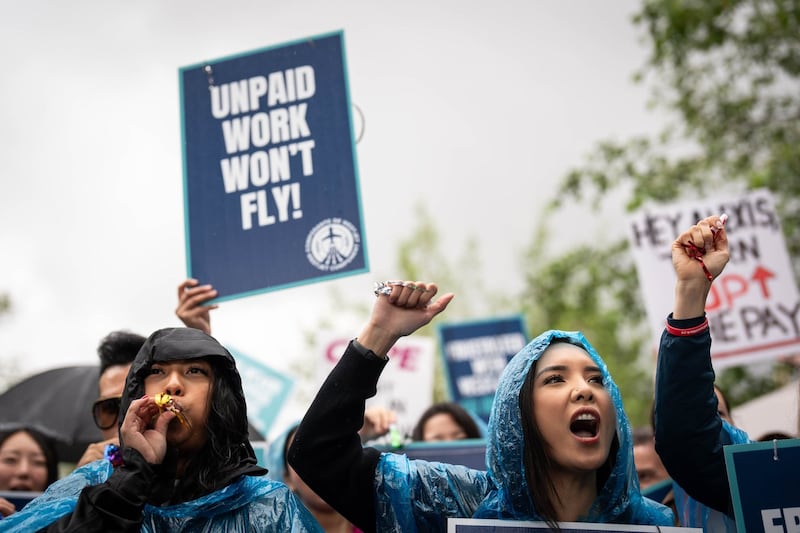
West Jet flight attendants strike at Vancouver International Airport in Richmond, B. C., on Sunday, Aug. 2, 2026. THE CANADIAN PRESS/Ethan Cairns West Jet flight attendants strike at Vancouver International Airport in Richmond, B. C., on Sunday, Aug. 2, 2026. THE CANADIAN PRESS/Ethan Cairns
The work stoppages have also affected small and medium-sized businesses according to Dan Kelly, president of the Canadian Federation of Independent Business.
He mentions that some companies have had to shut down or lay off employees because recent strikes have disrupted supply chains.
“These are real on-the-ground effects that don’t just affect those industries. They affect my guys-small and medium-sized companies-and of course all the employees who rely on them.”
However, labor leaders are opposing these changes.
Earlier this year while Ottawa began its review of the Canada Labour Code , the Canadian Labour Congress cautioned against diminishing workers’ bargaining power or their right to strike.
CLC president Bea Bruske reiterated this point during an interview with this weekend.
“Any infringement on the right to strike,” she states , “is taking away the power that workers have to be treated with respect and dignity , and get that fair deal.”
Bruske argues weakening worker rights would lessen pressure on employers for good faith bargaining and getting their best offer out there.
She adds employers seeking ways around strikes should focus more on resolving issues causing workers to leave their jobs.
“Wages and benefits are often an issue. But very , very often , the issue of respect and dignity at work, scheduling issues , work-life balance , health, and safety onthe job -those are primary things that drive peopleto go outon apicket line.”
Still , business leaders worry Canada ’s recent historyofwork stoppagescould damage country ’s internationalreputationas ittries todiversifyits trade partners.
“I do worrythat Canada ’s reputationisinthebalancehere,”Kelly remarks.
Source link
The FETCO president echoedthis concern.
“If we’re lookingat tryingto growthis economyin Canada, increase east-westtrade, and non-U. S. trade, wecan’t beseenasaplacewhereweareanunreliableplacetodobusiness.”
Related StoriesSource link