




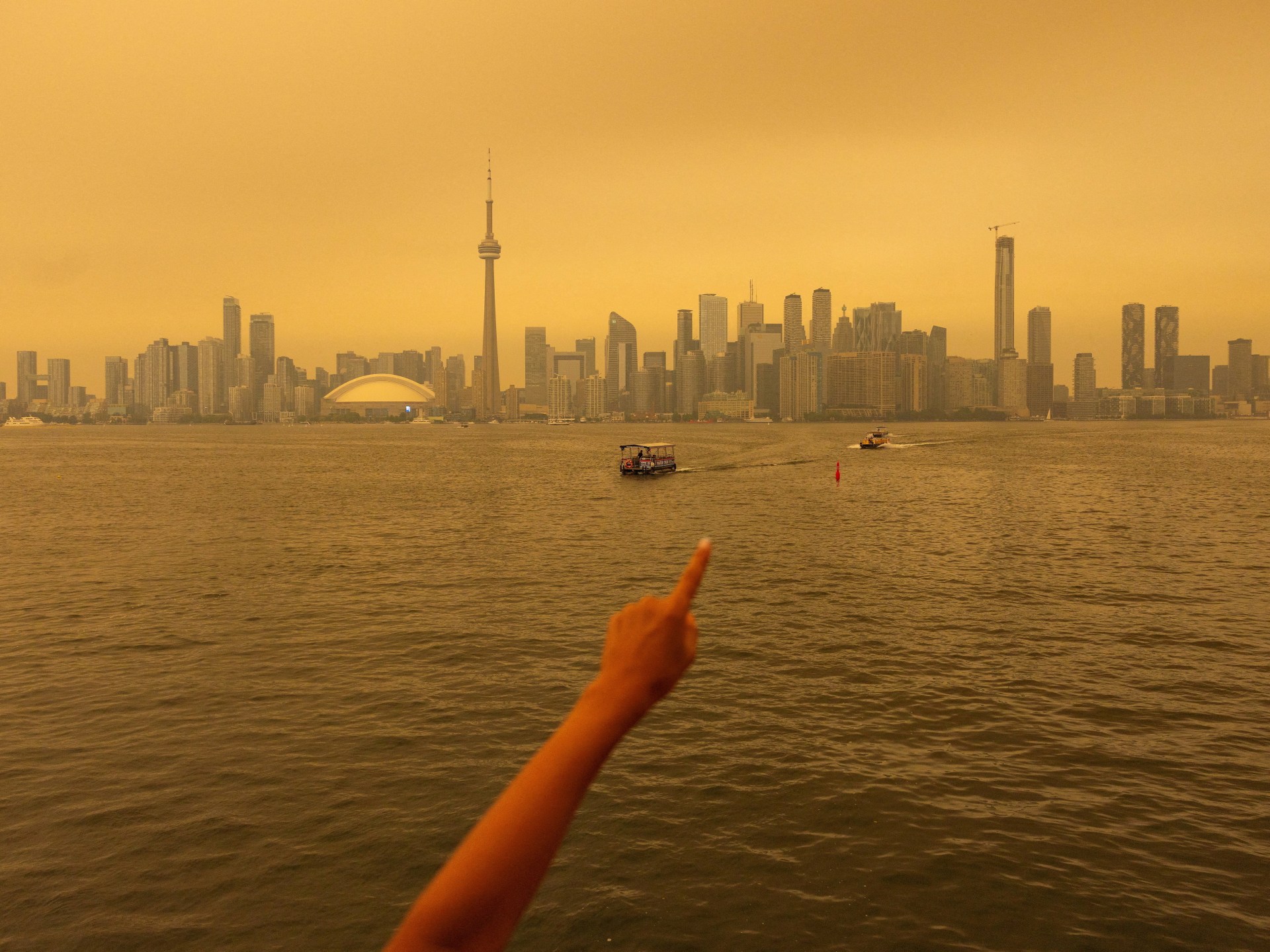
Monitor ranks Toronto as having the worst air quality on earth, surpassing Kinshasa, DR Congo, and New Delhi, India.
On 16 Jul 202616 Jul 2026
Toronto is experiencing the worst air quality of any major city in the world as smoke from wildfires in northwestern Ontario fills the sky and spreads into parts of the northeastern United States, leading to various health warnings and evacuations.
Wildfires continue to blaze in remote areas hundreds of miles away from Toronto, which is Canada’s largest city. The smoke has affected a broad area, although nearby cities are currently not at risk.
Source link
Recommended Stories
list of 3 itemsend of list Environment Canada reported an Air Quality Health Index reading over 10+, categorized as “very high risk,” for Toronto. Forecasts indicated that these dangerous conditions might last until Thursday night. According to IQAir, a Swiss company specializing in air quality technology, Toronto has the poorest air quality worldwide, surpassing Kinshasa in the Democratic Republic of the Congo and New Delhi in India. “The primary reason for the rise in air pollution levels in Toronto right now is wildfires, though higher-than-normal temperatures are also contributing,” Armen Araradian from IQAir told AFP news agency. This year’s wildfire season in Canada has been relatively calm compared to previous years; however, there are still more than 800 active fires across the country. A viral video showed a Canadian National train surrounded by flames near Armstrong, Ontario. Employees from Canadian National and local residents were evacuated on Monday night as announced by the railroad operator. Rail operations near Armstrong have been suspended as a safety measure. The smoke from these wildfires has also deteriorated air quality across state lines in the U. S., particularly affecting Pennsylvania, New York, Connecticut, Massachusetts, Maine, and New Hampshire. Officials in New York City have issued a warning about unhealthy air quality and urged residents to limit strenuous outdoor activities while taking additional breaks if they’re outside on Wednesday and Thursday. The National Weather Service stated that smoke could remain until late this week. “We likely haven’t experienced the worst yet for New York City or even for areas around the Great Lakes and upstate New England,” Dan Westervelt, associate research professor at Columbia University’s Lamont-Doherty Earth Observatory told Reuters news agency. This Sunday is expected to draw over 80,000 fans to an open-air stadium in New Jersey for the FIFA World Cup final. Another 50,000 people plan to watch it live from Central Park in New York City where hazy skies can already be seen. New York Governor Kathy Hochul advised everyone-especially those with pre-existing health conditions-to take precautions during this time. A person puts on a mask as reflected in a souvenir shop mirror as wildfire smoke from northwestern Ontario fills the sky in Toronto on Wednesday [Carlos Osorio/Reuters] The Canadian government mentioned that wildfire season started off slower this year compared to both 2023 and 2025-the two most severe seasons-but cautioned that warmer-than-usual temperatures might lead to more fires throughout Canada. This Wednesday saw approximately 835 active fires burning nationwide with 112 deemed out of control; most of these incidents are occurring within Manitoba’s central provinces along with Saskatchewan and Ontario. The total area burned so far amounts to about 1.9 million hectares (4.7 million acres). Greg Evans, a professor specializing in chemical engineering at University of Toronto noted that both extreme heat and wildfire smoke have hit the city simultaneously.”I expect we’ll see more frequent occurrences like this over upcoming decades so cities need to prepare accordingly,” he said.Source link