





The Conservative Party of Canada launched a political on June 5 that showcased AI-generated visuals, a strategy experts predict will become more common as political campaigns globally start using this technology.
The video shows individuals waiting in line at food banks, losing their jobs, and facing home repossessions, while it reassures viewers they are “only technically hungry,” “technically unemployed,” and “technically homeless.”
This comes in response to recent data from Statistics Canada indicating that the country has entered a technical recession during the first quarter of 2026. It aims to craft a narrative suggesting Prime Minister Mark Carney is uncaring regarding the affordability issues facing Canadians.
Several experts informed that this marks one of the initial instances where a federal Canadian political party has utilized AI-generated footage for advertising purposes.
“Generative AI has long been shaping how we understand our political systems,” remarked Elizabeth Dubois, an associate professor at the University of Ottawa who focuses on political applications of AI. “This raises concerns among Canadians and I believe it will continue as we see more experimental uses of these tools.”
WATCH | AI minister says new laws aim to modernize digital privacy:
‘The moment is here’ to modernize Canada’s privacy laws: AI minister
Artificial Intelligence Minister Evan Solomon stated that the Protecting Privacy and Consumer Data Act aims to safeguard Canadians in today’s digital landscape. ‘I think it’s a sensible approach to what Canadians expect from their digital interactions,’ Solomon mentioned on Monday about the proposed legislation. ‘They want some control over their personal information.’
Even though generative AI usage in politics is still fresh in Canada, studies indicate it’s already causing some debate. A study conducted by Toronto Metropolitan University’s Social Media Lab in 2025 revealed that roughly two-thirds of Canadians worry about generative AI’s possible impact on online political content and elections.
People “recognize there’s a real necessity for public policy and governance around AI in this area,” Dubois explained.
Nonetheless, Nathalie Smuha, an assistant professor at the University of Toronto specializing in how AI affects democracy, noted that voters who resonate with an ad’s message might overlook its synthetic nature.
“Individuals who are already receptive to this type of messaging because they align with the Conservative Party may not mind it at all,” she said. “They might think, ‘It could have easily been true.’
The Trump effect
The use of this technology for political purposes has surged globally recently, particularly favored by U. S. President Donald Trump.
During his second term, Trump shared numerous AI images on social media-including one depicting him as Jesus; a video showing former president Barack Obama being arrested; and another illustrating a future version of Gaza titled “Trump Gaza,” complete with an enormous gold statue resembling himself.
The latter video was posted in February 2025 and garnered over 670,000 likes on Trump’s Instagram page.
WATCH | Trump explains deleted post depicting him as Jesus: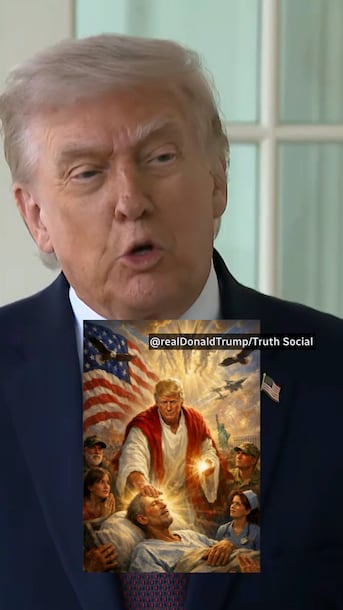
Trump tries to explain now-deleted Jesus-like AI post
In response to questions from reporters, U. S. President Donald Trump attempted to clarify an image he posted on Truth Social portraying him as a Jesus-like figure. This image received widespread criticism before being taken down from Trump’s account on Monday.
Smuha indicated that using generative AI in political advertising is more prevalent across the U. S. and Europe, where populist parties particularly utilize it to undermine their opponents.
“This trend can partly be understood because populist leaders pay significant attention to communication,” she stated. “They place great importance on messaging.”
Research regarding Canadian perspectives on AI-generated political ads remains limited; however, the TMU study found right-leaning Canadians are 11 percentage points more likely than those leaning left to utilize AI chatbots for information regarding elections or politics.
A poll conducted by Tech Policy Press/You Gov in 2024 discovered that 78 percent of Americans believe political campaigns should be barred from posting misleading content generated by AIs targeting candidates while 87 percent feel that political organizations ought to disclose when using such content in ads.
AI labels often ignored
The footage presented by the Conservative Party within its recent includes labeling indicating it was generated via artificial intelligence located at the bottom-right corner of the video.
“Like many organizations, the CPC is looking into responsible ways to leverage artificial intelligence for enhancing communication,” Sarah Fischer explained via email to as director of communications for The Conservative Party Of Canada.”Transparency matters greatly; that’s why we’ve openly disclosed our use of artificial intelligence both within captions associated with videos and directly inside them.”
Diving deeper into best practices for utilizing generated content according To Dubois’ statements implies these standards currently lack legal mandates , making them insufficient notifications towards viewers.
“We know these small labels positioned within corners tend not garner attention , ” Dubois expressed.
The Safe Social Media Act which was introduced by Canadian federal government back June ten would mandate social media platforms label ‘synthetically produced’ material circulated through their services.
<P YET NO REQUIREMENTS ARE IN PLACE FOR POLITICAL PARTIES TO IDENTIFY GENERATED MATERIAL DESPITE RECOMMENDATIONS ISSUED BY STÉPHANE PERRAULT CHIEF ELECTORAL OFFICER FROM CANADA ADVOCATING FOR LABELING LEGISLATION REGARDING ELECTION RELATED CONTENT.”<PO DUMP C) {“It would benefit everyone if all parties adhered labeling protocols,” Chris Tenove shared – assistant director affiliated Center Democratic Institutions located British Columbia."Whether statutory imposition necessary remains open topic due enforcement challenges surrounding implementation procedures “}<PKG FOLLOWS PUBLIC RACE SAFETY ACT ENABLED SITUATIONAL LIGHTS ACT EXAMINED INDIVIDUAL INSURANCE OPTIONS ADDED COLOR BACKGROUND PLEASE DO NOT PROCEED WITH BETA TEST UNLESS YOU HAVE PERMISSION NEVER REMOVE SPACES BETWEEN WORDS – ALWAYS MAINTAIN PROPER SPACING {”she pointed out even if labeled – images created via Ai can still sway viewer mental responses especially when aligned existing beliefs following content message “}, so even knowing something lacks authenticity won’t entirely protect them against risks encountered notably emotional impacts generated videos produce.”
Source link