



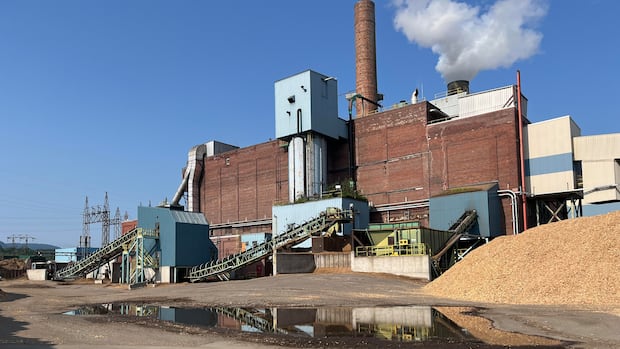
Thunder Bay Pulp and Paper is shutting down its newsprint mill operations because of a drop in demand.
The company announced this decision on Thursday morning, stating that 150 employees will be impacted by the closure.
“Essentially there will be 150 fewer employees in the mill,” Thunder Bay Pulp and Paper CEO Norm Bush told on Thursday. “However, there will be a number of people whose jobs that will have been eliminated that will have bumping rights to other jobs in other locations in the mill.”
“The decline in the newsprint market is really the insurmountable factor that’s leading to this decision,” Bush said, adding that another “double-digit” decline is expected in 2026.
“That’s the fundamental reason for exiting the business,” he said. “The market is very soft and we’re not able to cover our costs of production.”
“We see absolutely no potential for a resurgence in newsprint,” Bush noted. “Electronic substitution is carrying on unabated, and so we just see a systemic decline in newsprint for the long term.”
The company stated it’s working closely with local unions and all levels of government to ensure affected workers have access to employment transition supports.
“This is bad news, but our primary focus right now is to provide those support services for our employees who are impacted by this decision,” Bush said. “That’s what we’re going to be working on over the next couple of months.”
![]() Thunder Bay-Atikokan MPP Kevin Holland, left, is seen beside Thunder Bay’s mayor Ken Boshcoff in this file photo. (Sarah Law/CBC)
Kevin Holland, MPP for Thunder Bay-Atikokan as well as associate minister of forestry and forest products expressed disappointment over the company’s choice to close its newsprint facility.
“Ontario is ready to support affected workers, their families and the community including setting up a Protect Ontario Workers Employment Response Centre providing immediate access to wraparound supports,” reads a statement from Holland.
“We will continue collaborating with Thunder Bay Pulp and Paper supporting their ongoing Kraft pulp production along with those 300 workers at that facility.”
In his statement Holland mentioned his government’s request for federal support promised last summer meant specifically for Ontario’s sector.
Thursday’s announcement follows several recent mill closures across northwestern Ontario.
The Ignace sawmill owned by Domtar stands as another mill facing closure soon expected idling around March displacing between 19-25 workers according to township information.
Meanwhile Interfor’s sawmill located in Ear Falls has been shut down since October.
U. S tariffs combined with an oversaturated market have been identified as reasons behind indefinite shutdowns affecting regional mills.
Thunder Bay-Atikokan MPP Kevin Holland, left, is seen beside Thunder Bay’s mayor Ken Boshcoff in this file photo. (Sarah Law/CBC)
Kevin Holland, MPP for Thunder Bay-Atikokan as well as associate minister of forestry and forest products expressed disappointment over the company’s choice to close its newsprint facility.
“Ontario is ready to support affected workers, their families and the community including setting up a Protect Ontario Workers Employment Response Centre providing immediate access to wraparound supports,” reads a statement from Holland.
“We will continue collaborating with Thunder Bay Pulp and Paper supporting their ongoing Kraft pulp production along with those 300 workers at that facility.”
In his statement Holland mentioned his government’s request for federal support promised last summer meant specifically for Ontario’s sector.
Thursday’s announcement follows several recent mill closures across northwestern Ontario.
The Ignace sawmill owned by Domtar stands as another mill facing closure soon expected idling around March displacing between 19-25 workers according to township information.
Meanwhile Interfor’s sawmill located in Ear Falls has been shut down since October.
U. S tariffs combined with an oversaturated market have been identified as reasons behind indefinite shutdowns affecting regional mills.
Source link
Company Will Transition to Single-Line Softwood Kraft Mill
“This was a very difficult decision, and we know how deeply it affects our employees and their families. After more than 100 years of operating in the Thunder Bay community, we also understand that the impacts extend beyond the mill, affecting local businesses, Indigenous partners, and the broader region,” said Bush. Thunder Bay Pulp and Paper will keep running as a single-line Softwood Kraft mill at its Neebing Avenue location in Thunder Bay while generating renewable energy for sale to Ontario’s grid. We will continue working with Thunder Bay Pulp and Paper to support their ongoing Kraft pulp production and the 300 workers at that facility.- Kevin Holland, Ontario’s associate minister of forestry and forest products The company shared that it plans to collaborate with federal and provincial governments over coming months to refine its plans for new investments into its Softwood Kraft Pulp mill. The paper machine will also be closed down but kept in condition that could allow future conversion. “We do have excellent paper machine facilities here,” Bush stated. “They’re amongst some of the best in North America.” “We are going to investigate whether it makes sense economically to produce something like liner board, which is like cardboard or another product,” he added. “However, that is a long-term process likely taking three or four years along with several hundreds of millions of dollars.” “I would say at this point we have no current plans regarding that but we are planning to study its potential.”Source link