
The final newsprint production at Thunder Bay Pulp and Paper signals a shift to kraft manufacturing.
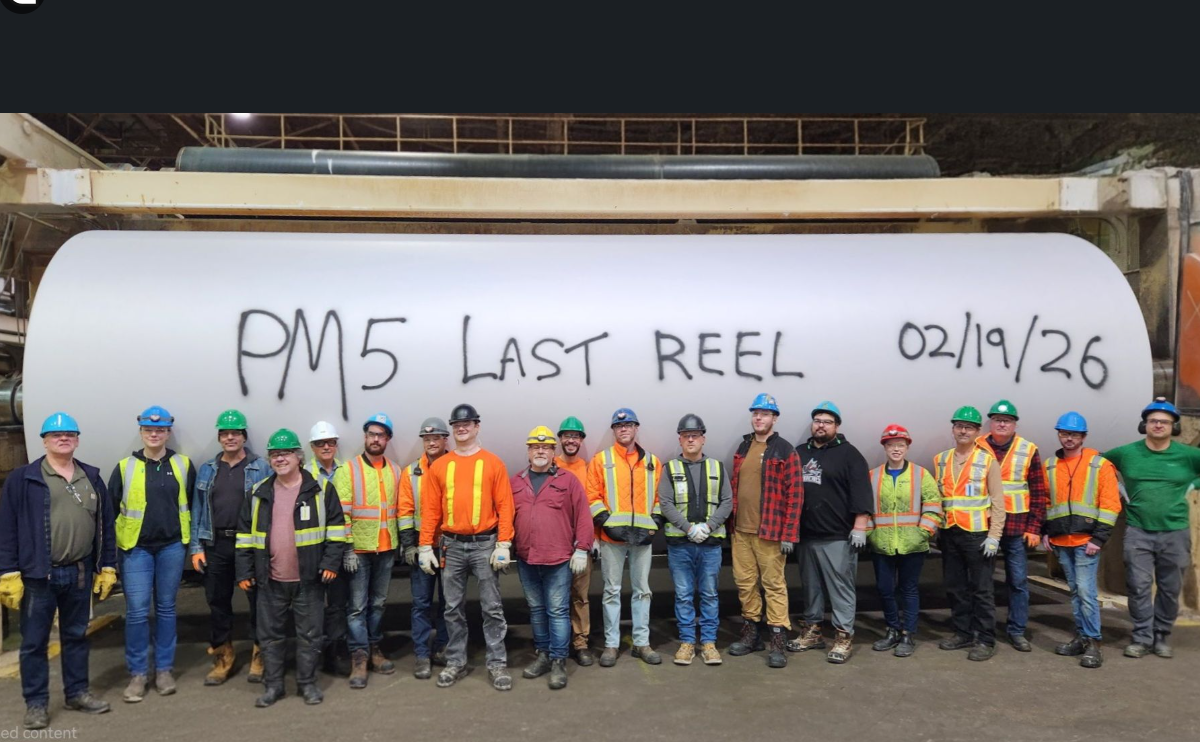
The last roll of newsprint created at Thunder Bay Pulp and Paper on Feb. 19 turned into a moment for photos and reflection for the paper operations manager.
In a Linked In post, Shane Moscrip reflected on the end of an era that dates back to the 1920s in this northwestern Ontario city’s industrial legacy.
“For more than a century, this mill has converted wood, water, steam, and skill into paper. Generations have stood on five paper machine floors, listening to the cadence of the wire, the draw through the presses, the steady breath of the dryers. They measured their days by tonnage, quality, and uptime,” Moscrip wrote.
“These paper machines have run through wars, recessions, ownership changes, grade transitions, rebuilds, and countless shutdowns and startups. It has been more than equipment; it has been the industrial heartbeat of this town.”
As this chapter closes inevitably, the company made a decision in January to stop producing newsprint permanently due to a decline across North America in demand for it. The iconic mill will continue its operations as a single-line softwood kraft mill.
This facility is owned by Atlas Holdings from Connecticut, which acquired it from Resolute Forest Products in 2023.
One hundred fifty jobs are affected by this change. The company stated it would collaborate with local unions and government to provide “transition supports” and retraining programs for those impacted employees.
In his post, Moscrip shared details about the last run in papermaking that began overnight when they fed in the final batch of wood chips into the pulp mill’s thermomechanical pulp (TMP) plant.
This process involves steaming chips and grinding them mechanically between rotating steel discs called refiners to create wood pulp.
“On the floor, the crew did what they have always done; ran the machine with discipline and pride. They watched as the sheet stabilized while managing edge breaks and keeping draws accurate. In the control room, trends were steady. On the reel itself, tension was balanced.
“The last jumbo reel will be built slowly but surely to diameter layer upon layer-a record of everything this workforce knows about fibre, process control, and craft.”
The final reel was “turned out” at 1:46 p. m. Thursday afternoon.
“This last reel isn’t just paper; it represents accumulated expertise-operators, electricians, millwrights, instrument techs lab technicians supervisors-people who understood that performance is built on routine done well. It reflects a culture shaped over 100 years: safety first quality without compromise production through teamwork. The machine may be coming to rest but all that capability developed within this workforce doesn’t vanish,” said Moscrip in his post.
“A solemn crew gathered around that paper today. It’s a moment to honor both the machine that sustained a town for generations and those who kept it running shift after shift year after year. One last image before that reel not merely as an ending but as proof of a century-long commitment to quality papermaking.”
Papermaking used to be an economic cornerstone for this city beginning back in 1919 with Great Lakes Paper starting operations at Fort William by 1924. By 1930 they had launched what was considered then one of world’s most modern mills complete with its largest paper machine.
The complex changed hands several times over these past 50 years including being bought by Canadian Pacific Forest Products later becoming Avenor before Bowater took over in 1998 merging later with Abitibi-Consolidated forming Abitibi Bowater in 2007 which rebranded itself Resolute Forest Products based out of Montreal since 2011.
Source link
Source link