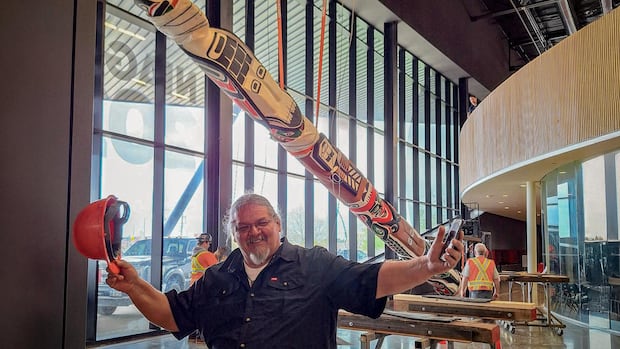
After being taken down about six years ago from a park in St. Catharines, Ont., a much-loved totem pole is back and standing proudly in the community.
Created in 1966 for Canada’s centennial celebration, the Centennial Totem Pole was carved by the late Doug Cranmer, an artist from the Kwakwa̱ka̱ʼwakw Nation and a hereditary chief of the ʼNa̱mǥis Nation.
Rising nearly 13 meters tall, this totem pole showcases various carvings, including a thunderbird, bear, and cedar man. It had been located in Richard Pierpoint Park in the Queenston area until it was removed for restoration in 2019.
Phil Davis, a member of the Six Nations Wolf Clan, shared with CBC Hamilton that over its five decades in the park, this artwork gained great importance locally.
“It has become a part of our fabric and has come to represent a place of hope and faith for our people to gather over the years,” he said.
It took four weeks of hard work to get the totem pole restored, according to Kwakwa̱ka̱ʼwakw artist Bruce Alfred. (City of St. Catharines/Facebook)
Davis works as a cultural resource coordinator at the Niagara Regional Native Centre (NRNC) and emphasized that such spaces are vital for communities seeking their identity within urban environments.
“When we have something as magnificent as a totem pole, we start understanding it at a deeper level,” he mentioned. “That is something that’s much needed these days in this crazy world.”
![]() Phil Davis, left, and Olivia Hope, right, stand in front of the Centennial Totem Pole in its new home inside Canada Games Park. (City of St. Catharines/Facebook)
Around 2017, discussions began between Hope, NRNC representatives, and local residents regarding what should be done with the deteriorating totem pole-Bruce Alfred described it as being “in rough shape.”
She stated that Cranmer’s family was contacted about restoring it; they supported this effort and suggested Alfred take charge of leading it.
Alfred is another artist from the Kwakwa̱ka̱ʼwakw Nation who resides in Alert Bay B. C., having trained under Cranmer.
He agreed to handle its restoration before reinstalling it inside Canada Games Park.
Phil Davis, left, and Olivia Hope, right, stand in front of the Centennial Totem Pole in its new home inside Canada Games Park. (City of St. Catharines/Facebook)
Around 2017, discussions began between Hope, NRNC representatives, and local residents regarding what should be done with the deteriorating totem pole-Bruce Alfred described it as being “in rough shape.”
She stated that Cranmer’s family was contacted about restoring it; they supported this effort and suggested Alfred take charge of leading it.
Alfred is another artist from the Kwakwa̱ka̱ʼwakw Nation who resides in Alert Bay B. C., having trained under Cranmer.
He agreed to handle its restoration before reinstalling it inside Canada Games Park.
“That way generations upon generations could enjoy it,” Alfred remarked. “Otherwise-in ten years-it’ll be right back where we started before we restored it.” It took Alfred along with two other Indigenous artists , Dominique Wells , and Cole Speck , four weeks filled with long hours working on its restoration. He added that there were many repairs needed since weather damage had affected it , plus someone had set fire which created hollow spots inside. Additionally , someone filled those areas up using cement which made things more challenging. “There ended up being so much concrete inside. We had no choice but use mini jackhammer just break apart,” he explained. Although not his first time restoring one made by his mentor , every experience remained special educational opportunity.
“It’s always learning curve ; I kept thinking ‘Okay what would Doug do ?’ ” he mentioned. For him personally , Cranmer represented more than mere teacher ;
“Doug was my chief , uncle mentor even father figure me-it mattered deeply” said Alfred adding : “He truly was gifted character.”![]() Davis called experience witnessing reinstallation amazing saying : ”Like seeing old friend again.”
He expressed involvement connected work yet expanded beyond expectations allowing opportunities discuss representation behind symbol throughout conversations shared views regarding letting go nature entirely if necessary…but decided against after discussing value preservation culture together instead support ongoing relationship growth future generations’ benefits overall integration into community life surrounding space itself…
Davis called experience witnessing reinstallation amazing saying : ”Like seeing old friend again.”
He expressed involvement connected work yet expanded beyond expectations allowing opportunities discuss representation behind symbol throughout conversations shared views regarding letting go nature entirely if necessary…but decided against after discussing value preservation culture together instead support ongoing relationship growth future generations’ benefits overall integration into community life surrounding space itself…
 Davis described attending installation event hosted by Alfred remarkable moment stating once again how significant piece has become ceremonial – embraced both locals alongside non-Indigenous folks alike collectively celebrating pride found therein togetherness brought forth through shared experiences interactions surrounding installation meaning behind artistry involved encapsulating essence whole journey brought us full circle back home.
Source link
Totem poles aren’t typical for this area
Even though it’s meaningful locally, carving totem poles isn’t traditional among Indigenous peoples on Treaty 3 land; they originate from the Pacific Northwest. When this totem pole was commissioned, “it wasn’t uncommon for municipalities and governments to celebrate the colonization of Canada through purchasing Indigenous art pieces,” explained St. Catharines culture coordinator Olivia Hope. These often reflected Western styles that conformed with “the idea of what Indigenous was at that time,” she noted while adding that city officials likely saw it as representing Niagara’s Indigenous community. Hope identifies as Oneida and Haudenosaunee from Six Nations of the Grand River while also having Québécois and Polish roots.‘He had such character’
Although it may not hold “the exact same connection” with locals as before, Hope assured that access remains available.“That way generations upon generations could enjoy it,” Alfred remarked. “Otherwise-in ten years-it’ll be right back where we started before we restored it.” It took Alfred along with two other Indigenous artists , Dominique Wells , and Cole Speck , four weeks filled with long hours working on its restoration. He added that there were many repairs needed since weather damage had affected it , plus someone had set fire which created hollow spots inside. Additionally , someone filled those areas up using cement which made things more challenging. “There ended up being so much concrete inside. We had no choice but use mini jackhammer just break apart,” he explained. Although not his first time restoring one made by his mentor , every experience remained special educational opportunity.
“It’s always learning curve ; I kept thinking ‘Okay what would Doug do ?’ ” he mentioned. For him personally , Cranmer represented more than mere teacher ;
“Doug was my chief , uncle mentor even father figure me-it mattered deeply” said Alfred adding : “He truly was gifted character.”
“There’s lots pride there”
According Hope restoration became lesson city ; chance Indigenous share knowledge practice creation process public art expressed meaningful way. ”I believe experience highlighted cities needs recognize importance visibility local artists create showcase talents how important showcasing them reflects communities identities,” she stated.
Davis described attending installation event hosted by Alfred remarkable moment stating once again how significant piece has become ceremonial – embraced both locals alongside non-Indigenous folks alike collectively celebrating pride found therein togetherness brought forth through shared experiences interactions surrounding installation meaning behind artistry involved encapsulating essence whole journey brought us full circle back home.
Source link