



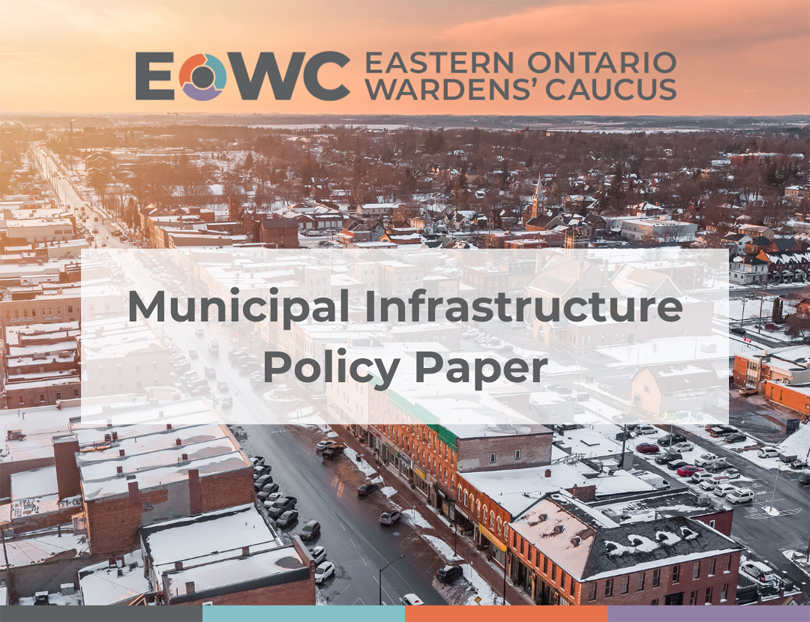
June 5, 2024 – Japanese Ontario – The Japanese Ontario Wardens’ Caucus (EOWC), below its strategic precedence of infrastructure, has launched the 2024 Municipal Infrastructure Coverage Paper. This paper covers key infrastructure information and proposals from throughout the area. The knowledge will help Japanese Ontario’s municipal coverage and program advocacy, functions for presidency funding, and future partnerships round infrastructure that can assist allow the area’s prosperity and housing for all. Moreover, the paper will form the advocacy initiatives as a part of the infrastructure precedence within the EOWC’s 2024-2027 Strategic Plan.
The EOWC acknowledges that because the area continues to develop, the demand for important municipal providers additionally will increase. Nonetheless, sustaining and increasing infrastructure falls on a comparatively small and broadly dispersed inhabitants, making a rising deficit and an inconceivable problem for native municipalities and ratepayers.
“Investing in infrastructure is not just about building roads and bridges; it’s about laying the foundation for economic growth and ensuring a high quality of life for all people across Eastern Ontario,” says EOWC Chair Peter Emon. “Our Municipal Infrastructure Policy Paper provides a path forward on how strategic infrastructure partnerships and investment in rural and small urban communities can make a significant difference. We cannot do it alone and we look forward to finding solutions with our Ontario and Federal Government partners to address the growing infrastructure deficit to support our region’s growing communities.”
As a part of our analysis findings, we now have recognized 5 key messages:
Rural and small city Japanese Ontario is a rising financial system that may develop extra with infrastructure funding.
Rural Japanese Ontario communities are main exporters to Ontario and different jurisdictions.
There may be an upfront value to development, making a burden for smaller rural communities.
Small, rural municipalities lack the tax base to maintain infrastructure funding and asset administration.
Innovation is essential to cost-effective infrastructure administration.
The EOWC requests that the Federal Authorities and the Ontario Authorities accomplice with municipalities to deal with the rising infrastructure deficit by:
Making certain eligibility for packages and funding suits each rural and small city circumstances.
Offering predictable, non-competitive, everlasting infrastructure funding streams, as federal and provincial funding packages are sometimes unpredictable and irregular of their timing.
Taking an built-in strategy to infrastructure investments, contemplating the return on funding that’s shared by communities and the Province, as investing in housing goes hand-in-hand with investing in institutional, industrial, or industrial (ICI) land makes use of.
Reevaluating debt financing choices for small municipalities with restricted sources to lift funds, making certain that funds are directed in the direction of infrastructure growth fairly than servicing debt curiosity. Particular concerns ought to embrace increased upfront/advance contributions in addition to the contribution to GDP of “local” investments to provincial priorities.
Working with the provincial Monetary Accountability Workplace to make sure that lacking/incomplete information that may make their infrastructure studies extra sturdy is offered, that the evolution in asset administration plans is mirrored in each municipal and FAO work, and that the FAO and the EOWC evaluate their methodologies for estimating infrastructure deficits/backlogs.
Concerning the EOWC
The EOWC Inc. is a non-profit group advocating for 103 small city and rural municipalities throughout Japanese Ontario. The EOWC covers an space of fifty,000 sq. kilometres, serving 800,000 residents. For greater than 20
years, the EOWC has gained help and momentum by talking with a
united voice to champion regional municipal priorities and work with the
authorities, companies, non-profit organizations, Indigenous leaders, the
media, and the general public.
Notes:
Learn extra in regards to the EOWC’s Infrastructure Coverage Paper, view our Key Takeaways and Suggestions, or obtain your copy at EOWC.org.
Media Contacts:
Elected officers:
Peter Emon, 2024 Chair, EOWC (Warden of Renfrew County)
613-401-7186
Bonnie Clark, 2024 Vice-Chair, EOWC (Warden of Peterborough County)
705-927-4207
[email protected]
Workers:
Meredith Staveley-Watson, Supervisor of Authorities Relations and Coverage, EOWC
647-545-8324


