



Printed Jan 14, 2025 • Final up to date 4 hours in the past • 6 minute learn
 The Climate Community Meteorologist and Storm Chaser Mark Robinson talks about how adjustments within the climate can have an effect on farming throughout Crops Day at Gray Bruce Farmers’ Week in Elmwood on Monday, January 13, 2025. Picture by Rob Gowan The Solar Occasions
Article content material
Whereas Gray-Bruce and the remainder of southern Ontario is predicted to be much less affected by a altering local weather than many different areas, it nonetheless doesn’t imply farmers right here don’t have to be able to adapt.
This commercial has not loaded but, however your article continues beneath.
Article content material
Article content material
Beneficial Movies
Article content material
Mark Robinson, a meteorologist and storm chaser with The Climate Community offered to a packed Elmwood Group Centre throughout Crop Day on Monday as a part of the annual Gray Bruce Farmers’ Week, the place he outlined a few of the professionals and cons a altering local weather can have on the area and the way it might influence the agricultural neighborhood.
“There is no real good and there is no real bad, there is just change, and here in southern Ontario we are likely to be the least affected by it,” Robinson mentioned of the altering local weather and the monetary influence it might have on the agricultural neighborhood right here. “We are going to be affected, there is no getting around that, but we have some advantages.”
The No. 1 benefit that the world has is that it’s surrounded by water within the type of the Nice Lakes, one thing that helps to “tamp down” adjustments in local weather. Robinson mentioned that the lakes present the soil with the moisture it wants within the type of snow squalls like those that had been taking place outdoors the neighborhood centre on Monday. However he famous that ought to the area be hit by extra excessive drought circumstances, the lakes are shut by ought to that water supply have to be tapped.
This commercial has not loaded but, however your article continues beneath.
Article content material
“If we do see a shift where less precipitation is falling, irrigation is not as expensive as say, western Kansas,” mentioned Robinson. “We have that working in our favour.”
One other benefit of the lakes is that they’re a serious transportation hub, which makes it cheaper to ship agricultural commodities out than it will be from a spot like Iowa within the central U.S.
“That is something else that we have going for us,” mentioned Robinson. “Those waterways are close by.”
He mentioned there’s proof that the standard twister alley is shifting additional north and east in direction of southern Ontario.
Robinson defined that whereas a twister is unlucky for somebody whose house is hit by one, it could be welcomed by farmers within the space if it means they’re getting extra precipitation when it’s wanted.
This commercial has not loaded but, however your article continues beneath.
Article content material
“We are seeing earlier tornadoes and later tornadoes,” mentioned Robinson. “That is our proxy for thunderstorms, which are what really gives us the water that we need for fields.”
On the similar time, there are indicators that the drier months of July and August are extending into the autumn months extra, which might result in longer intervals of drought.
“If that starts to happen you are having to put that extra expense into growing because you now have to irrigate so you don’t lose a huge crop,” Robinson mentioned. “We definitely are seeing an extension of the season.”
In southern Ontario climate swings have at all times been a part of life, however the altering local weather is making these swings extra excessive, Robinson defined. The important thing will likely be how the producers and growers within the space adapt to these extremes.
This commercial has not loaded but, however your article continues beneath.
Article content material
“When we talk about southern Ontario, the growers and the people who live in southern Ontario, we are kind of used to that, so we have a better shot at adapting,” Robinson mentioned. “In California for instance, it is 25 degrees and sunny every day.”
Robinson mentioned that capacity to adapt will put the producers of the world in a greater place.
“If we have technologies or ideas in changing how we grow or how we do things, we can then export that knowledge out to other areas,” Robinson mentioned. “If you can cash in on that, that is another way of bringing in some income.”
However as a result of the world is much less affected by local weather change, there’s some proof that local weather migration in direction of the Nice Lakes area has began to occur.
“I think we are still seeing an influx of people towards the coasts – everyone wants to go live in California, everyone wants to go live in Florida – but now that we are seeing more disasters, what we are seeing is that house insurance is going up or crop insurance is going up,” mentioned Robinson. “All of these things are making it more expensive to live there. We will always see people living there, but it is not going to be people with low incomes, so we are going to see those people coming back towards the Great Lakes.”
This commercial has not loaded but, however your article continues beneath.
Article content material
Robinson mentioned that local weather migration – which is predicted to occur over an extended time period — presents one other problem to the area in that it places one other pressure on farmland within the type of improvement to deal with these folks shifting right here.
“That is going to start to eat into farmland and some of the best farmland we have got,” Robinson mentioned. “We have to start looking now at how we deal with that development.”
Crops Day opened with the keynote presentation by Onette Menard, soil well being guide at Motion Semis Direct, known as Keep, Enhance and Maximize Soil Well being Via Inexpensive and Environment friendly Practices.
That was adopted by a panel on controlling powerful weeds that includes Sprucedale Agromart Agronomy Supervisor Craig Reid, Clark Agri Service Agronomist Johanna Lindeboom, BASF Canada Regional Technical Companies Supervisor Rob Miller and facilitated by Deb Campbell of Agronomy Benefit Inc.
Commercial 7
This commercial has not loaded but, however your article continues beneath.
Article content material
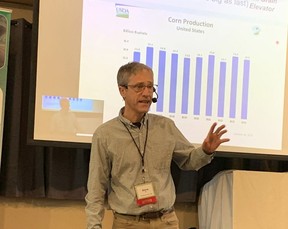
After lunch and previous to Robinson, Steve Kell, a grain service provider at Kell Grain Elevators, gave a 2025 grain market outlook.
Throughout his presentation, Kell addressed considerations about how the tariffs being threatened by incoming U.S President Donald Trump might influence Canadian corn, wheat and soybean producers.
“It is a good thing we are not Americans,” Kell mentioned, explaining that the tariffs might result in some counter-measures from different international locations, which might make it a lot tougher for U.S. producers to get their crops to market.
“We won’t be able to move corn to Michigan, we won’t be able to move wheat to Toledo and things like that, but we have Owen Sound, Goderich, Sarnia, Windsor, three terminals in Hamilton, Oshawa and Johnstown,” mentioned Kell. “There is an export terminal where you can load a boat within a two-hour drive of any field that is farmed in Ontario, except for New Liskeard.
Advertisement 8
This advertisement has not loaded yet, but your article continues below.
Article content
“We have a geographical advantage of getting stuff out of here. It might be slightly different pathways to the market, but we have the markets and we can get to them.”
Kell mentioned that no matter if there are tariffs or not, the world’s 9 billion nonetheless have to be fed.
“If China decides to buy all Brazilian soybeans, that means the Brazilian soybeans aren’t going somewhere else and that doorway opens up to us as Canadian producers to ship there,” mentioned Kell. “I think we would really scramble with the logistics package, but there is still places for everything to go.”
Following Robinson, Dr. Josh Cowan, supervisor of analysis and innovation at Grain Farmers of Ontario gave a chat on driving innovation.
The day closed with a presentation known as Drive Shed Theatre with Peter Johnson, an agronomist at RealAgriculture.
Commercial 9
This commercial has not loaded but, however your article continues beneath.
Article content material
This 12 months’s farmers’ week, the 59th annual, kicked off Jan. 8 with Beef Day. It was adopted by Dairy Day final Thursday, Goat Day on Friday, Sheep Day on Saturday and Horse Day on Sunday.
The occasion wraps up with Ecological Day on Tuesday.
Ecological Day opens with an summary of huge acreage natural crop manufacturing by Phil Oegema, president of Oegema Grains Ltd.
Menard is then again along with her keynote presentation on sustaining, bettering and maximizing soil well being by reasonably priced and environment friendly practices.
Following lunch on Tuesday, Elisabeth Burrow, proprietor and roaster at Jewels Beneath the Kilt will discuss rising and promoting nuts.
Jackie Clark, small grains program supervisor at Ecological Farmers of Ontario will then make a presentation known as Small Grains, Huge Positive factors.
The day closes out with a producer panel on pastured pigs by Lisa Peterson of Stone Horse Farm, Katrina McQuail of Assembly Place Natural Farm, Ted Zettel of Zettel Household Farm and facilitated by Devan Penney of Truthful Fields.
Together with the keynote audio system, displays and panel discussions, farmers’ week encompasses a commerce present of agribusiness and farm organizations.
For extra details about the occasion go to gbfw.ca.
Article content material
Share this text in your social community


