



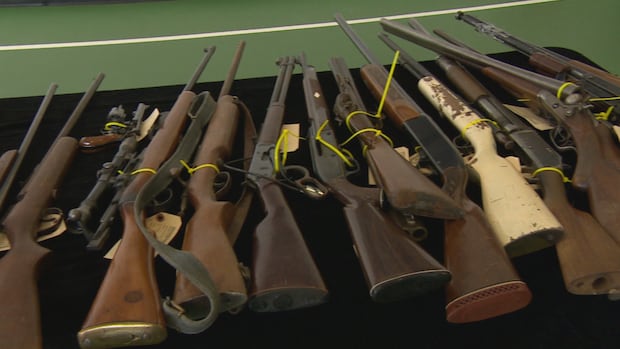
Several police services in northern Ontario have stated they lack the resources or personnel to take part in Ottawa’s gun buyback initiative.
This federal government program offers payments to individuals who surrender assault-style firearms. Public Safety Canada oversees the initiative, but local and regional police involvement is encouraged by the federal government.
Nonetheless, the Ontario Provincial Police (OPP), along with police departments in Sudbury, Timmins, North Bay, Sault Ste. Marie, and Thunder Bay have chosen not to participate. They describe it as more of an administrative task rather than essential police work.
The Greater Sudbury Police Service shared its position in an email to CBC.
“We have reviewed the available program information and determined that our resources are best focused on our core mandate of frontline response, holding offenders accountable, crime prevention, and a human-centred approach to community safety and well-being, rather than administering a federal collection program,” said the statement
The North Bay Police Service echoed similar concerns in a news release.
The North Bay Police Service is among several in northern Ontario expressing reluctance to be involved in the gun collection aspect of Ottawa’s buyback program (Radio-Canada )
“Participation in the program is not a current policing priority for our community due to resourcing constraints and competing public safety demands. NBPS continues to focus on community safety, addressing serious and violent crime and managing existing operational responsibilities,” said the release.
Thunder Bay Police issued a news release Wednesday stating that the program requirements “fall outside the scope of TBPS’ operational responsibilities and resource capacities.”
“At a time when police resources are crucial amidst increasing calls for service numbers, participation in the ASFCP could impact our ability to meet operational demands,” the release said.
The Police Association of Ontario represents police unions throughout the province with about 32 thousand sworn and civilian members. Association president Mark Baxter acknowledged that resources are stretched thin.
“That is a concern. We are, and have been for a while, in a staffing crisis here in Ontario. Every day, police officers and civilian members across Ontario are asked to do more with less, so adding this program does become an administrative burden.”
Mark Baxter is President of the Police Association of Ontario (Police Association of Ontario)
However, Baxter emphasizes that police can still play an important role for anyone wanting to turn in firearms.
“This is not to say that police through regular means won’t continue to receive firearms at the local services the way that they always would. It’s common that people would want to turn in an old firearm or maybe they were clearing out their parents’ or grandparents’ house after they’ve passed away and find an old firearm there; police will still accept those firearms being surrendered,” he said.
Baxter mentioned that feedback from union representatives and local law enforcement leaders indicates they prefer focusing on key policing matters like crime prevention and strategies for community safety.
Guidance from Ottawa has also been noted as needing clarification according to the Canadian Association of Chiefs of Police (CACP).
In a statement from late January, CACP remarked that “[w]hen the federal government first proposed a national buy-back program and amnesty period for assault-style firearms, we emphasized the need for a clear, consistent, and appropriately funded framework for collecting, deactivating, and disposing of these prohibited firearms.”
The association also raised concerns about whether this gun collection initiative might add extra administrative burdens on police services.
“While some police services have prior experience administering amnesty programs; however, the voluntary Assault-Style Firearms Compensation Program was widely viewed as primarily an administrative rather than core policing function. While police officers possess expertise regarding safely collecting and handling firearms; some leaders expressed worries about significant operational burdens imposed by this program.”
On January 19th 2026 , the Public Safety Canada portal opened up allowing individuals wishing declare their firearms eligible possible compensation. Canadians invited direct questions via Public Safety Canada Help Centre.
Source link
Source link


