



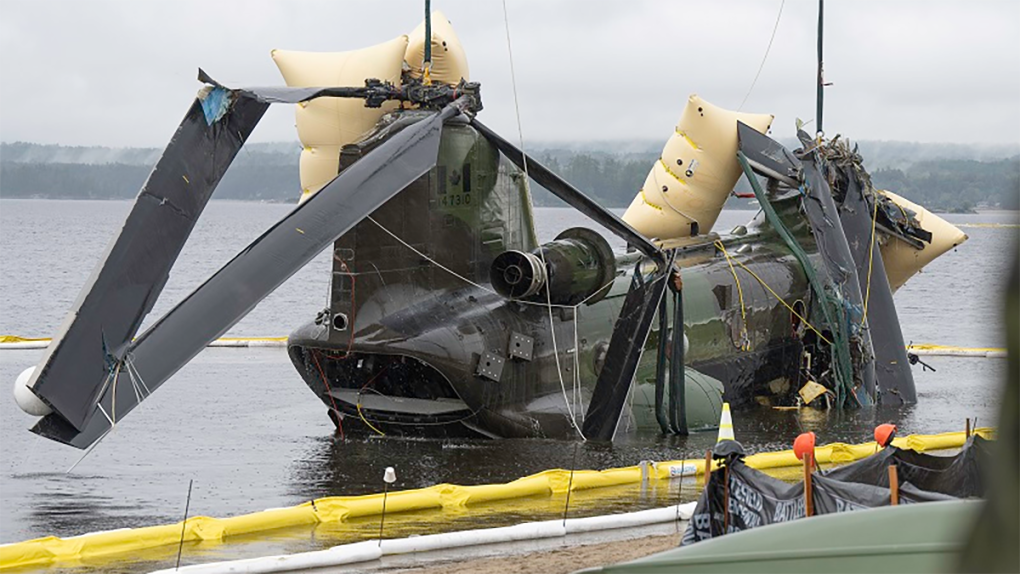
The investigation right into a Chinook helicopter crash close to Petawawa, Ont. that killed two army pilots concludes an “unperceived acceleration” and environmental circumstances had been “important contributors” to the crash within the Ottawa River.
Capt. David Domagala and Capt. Marc Larouche died when the CH-147F Chinook helicopter crashed close to Garrison Petawawa on June 20, 2023. Two flight engineers had been capable of escape the crash with minor accidents.
A Royal Canadian Air Power (RCAF) helicopter and Canadian Armed Forces (CAF) boat search the Ottawa River close to Fort William in Pontiac Regional County Municipality, Que. on Tuesday, June 20, 2023. THE CANADIAN PRESS/Spencer Colby
The helicopter, recognized by its call-sign Hammer 31, was conducting a nighttime coaching flight over the Ottawa River on the time of the crash.
On Monday, the Royal Canadian Air Power’s Directorate of Flight Security introduced the conclusion of its investigation.
“The Flight Security Investigation decided that because the crew initiated a turning manoeuvre over the river, the plane entered a relentless however imperceptible descent,” the RCAF mentioned in a press release.
“Not one of the crew realized the plane’s altitude and/or price of descent till influence, leading to a Managed Flight into Terrain accident. It concluded that unrecognized downward acceleration, together with environmental circumstances that night time, had been important contributors to the accident, inflicting spatial disorientation among the many crew.”
The Division of Nationwide Defence had beforehand mentioned the helicopter began to descend throughout the coaching train and was turning left when it struck the Ottawa River “with excessive power.” The investigation was mentioned to be specializing in human, technical and environmental elements.
“This accident was not attributable to a single issue, as a substitute, a number of parts contributed to the unrecognized spatial disorientation of all crew members of Hammer 31, resulting in the continued descent till water influence,” Col. Jean-Francois Gauvin, Director of Flight Security, mentioned in a press release.
“Over 16 months, we totally analyzed a considerable amount of information and collaborated intently with companions to establish further contributing elements. A number of suggestions are supplied to assist forestall comparable accidents sooner or later.”
The report makes a number of suggestions to amend the CH-147F publications, together with a suggestion to mandate using automation Stage-3 (Native Mode Digital Automated Flight Management System) when working beneath 200 ft above water at night time. The report additionally makes suggestions to enhance emergency response preparedness.
Canadian Armed Forces (CAF) conduct searches round a collection of islands on the Ottawa River close to Fort William within the Pontiac Regional County Municipality on Tuesday, June 20, 2023. Two RCAF 450 Tactical Helicopter Squadron members had been lacking following a CH-147F Chinook early morning crash close to Garrison Petawawa. (Spencer Colby/THE CANADIAN PRESS)
Officers say, “preventative measures” are advisable on the base, squadron, wing, division and technique ranges to “improve security and mitigate the dangers related to over-water missions.”
The Royal Canadian Air Power has a fleet of 14 CH-147F Chinooks, with the present fleet acquired beginning in 2013.
The following-of-kin of the fallen pilots had been briefed on the conclusions of the flight security investigation report earlier than it was launched, based on the Division of Nationwide Defence.


