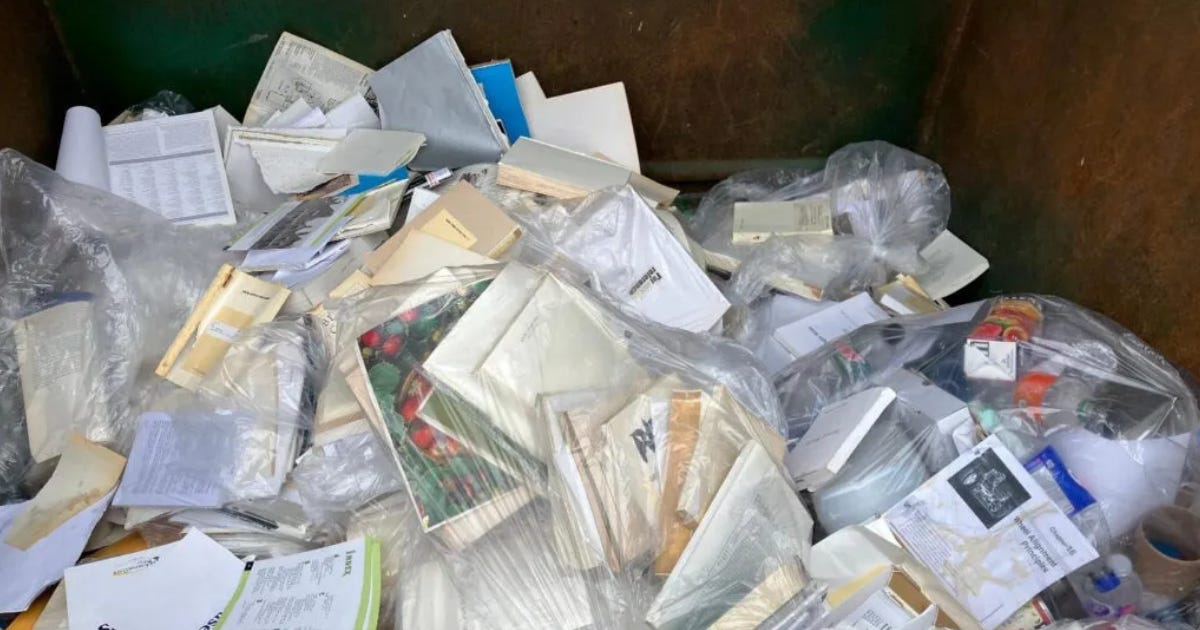
In a surprising move, the Thames Valley District School Board has removed many classic pieces of literature, historical texts, and political writings from a school library’s collection. The board refers to this process as “deselection.” Among the notable titles affected by this drastic book removal are well-known works like 1984 and books about Canada’s first prime minister, Sir John A. Macdonald.
A secondary school in London, Ontario, discarded over 10,000 library books between January and March this year as part of the Thames Valley District School Board’s “inclusive libraries revitalization project,” which resulted in the loss of more than half of the school’s total 18,000-book collection.
The library at H. B. Beal used to boast one of the largest collections within the board. Now, fewer than 8,300 books remain. The value of the materials that were thrown away is estimated to exceed $180,000.
Education Minister Paul Calandra quickly intervened to stop further library removals while an investigation into the Beal revitalization project is underway. A spokesperson for his ministry confirmed last week that “the minister has directed that all current and future library collection reviews be paused, pending further evaluation.”
According to documents from the board, this project aims “to revitalize the collections of Thames Valley schools to ensure they are culturally responsive, reflect our diverse student population, and contain accurate and up-to-date information.” The initiative also mentions its focus on “deselecting texts with harmful images, messaging, slurs, and racial epithets to facilitate the safety and well-being of all students.”
 The board called it “deselection.” However, many foundational literary works along with significant historical texts have been removed.
The list of discarded books includes those that question authority and societal norms such as George Orwell’s Nineteen Eighty-Four and Animal Farm as well as Aldous Huxley’s Brave New World and William Golding’s Lord of the Flies. Classic literature like Hamlet, Macbeth and To Kill a Mockingbird was also taken out along with Wuthering Heights and several Harry Potter titles.
The board called it “deselection.” However, many foundational literary works along with significant historical texts have been removed.
The list of discarded books includes those that question authority and societal norms such as George Orwell’s Nineteen Eighty-Four and Animal Farm as well as Aldous Huxley’s Brave New World and William Golding’s Lord of the Flies. Classic literature like Hamlet, Macbeth and To Kill a Mockingbird was also taken out along with Wuthering Heights and several Harry Potter titles.
 The removals went beyond just fiction. Books covering Canadian political biographies-including those about John A. Macdonald-were taken away alongside history texts from the Cold War era and social discussions surrounding residential schools, religion, family violence, and sexuality. Many coming-of-age novels dealing with identity struggles were also eliminated as were discussions on book censorship.
The extent of these removals came to light after teacher-librarian Larry Farquharson tried to step in. He expressed concerns internally but later compiled a spreadsheet documenting what was taken out. In a letter he shared on his Substack from his employer accusing him of making “disparaging remarks,” he faced suspension before ultimately resigning after spending 25 years teaching.
Trustees mentioned they weren’t made aware of this large-scale removal process for library books. Former board chair Lori-Ann Pizzolato stated that trustees are “governance not operational,” yet she expressed her worries regarding how extensive this purge was.
“I was looking at the titles – Harry Potter , Lord of the Flies. I wonder why those were removed,” she commented.
Trustee Christian Sachs added that she too had no idea about these book removals. While she didn’t expect updates on regular stock changes to come through trustees’ notifications-she believed such a significant action deserved attention. “This amount should have at least been mentioned. I saw the empty shelves. It was wild,” she remarked.
The removals went beyond just fiction. Books covering Canadian political biographies-including those about John A. Macdonald-were taken away alongside history texts from the Cold War era and social discussions surrounding residential schools, religion, family violence, and sexuality. Many coming-of-age novels dealing with identity struggles were also eliminated as were discussions on book censorship.
The extent of these removals came to light after teacher-librarian Larry Farquharson tried to step in. He expressed concerns internally but later compiled a spreadsheet documenting what was taken out. In a letter he shared on his Substack from his employer accusing him of making “disparaging remarks,” he faced suspension before ultimately resigning after spending 25 years teaching.
Trustees mentioned they weren’t made aware of this large-scale removal process for library books. Former board chair Lori-Ann Pizzolato stated that trustees are “governance not operational,” yet she expressed her worries regarding how extensive this purge was.
“I was looking at the titles – Harry Potter , Lord of the Flies. I wonder why those were removed,” she commented.
Trustee Christian Sachs added that she too had no idea about these book removals. While she didn’t expect updates on regular stock changes to come through trustees’ notifications-she believed such a significant action deserved attention. “This amount should have at least been mentioned. I saw the empty shelves. It was wild,” she remarked.

 The board called it “deselection.” However, many foundational literary works along with significant historical texts have been removed.
The list of discarded books includes those that question authority and societal norms such as George Orwell’s Nineteen Eighty-Four and Animal Farm as well as Aldous Huxley’s Brave New World and William Golding’s Lord of the Flies. Classic literature like Hamlet, Macbeth and To Kill a Mockingbird was also taken out along with Wuthering Heights and several Harry Potter titles.
The board called it “deselection.” However, many foundational literary works along with significant historical texts have been removed.
The list of discarded books includes those that question authority and societal norms such as George Orwell’s Nineteen Eighty-Four and Animal Farm as well as Aldous Huxley’s Brave New World and William Golding’s Lord of the Flies. Classic literature like Hamlet, Macbeth and To Kill a Mockingbird was also taken out along with Wuthering Heights and several Harry Potter titles.
 The removals went beyond just fiction. Books covering Canadian political biographies-including those about John A. Macdonald-were taken away alongside history texts from the Cold War era and social discussions surrounding residential schools, religion, family violence, and sexuality. Many coming-of-age novels dealing with identity struggles were also eliminated as were discussions on book censorship.
The extent of these removals came to light after teacher-librarian Larry Farquharson tried to step in. He expressed concerns internally but later compiled a spreadsheet documenting what was taken out. In a letter he shared on his Substack from his employer accusing him of making “disparaging remarks,” he faced suspension before ultimately resigning after spending 25 years teaching.
Trustees mentioned they weren’t made aware of this large-scale removal process for library books. Former board chair Lori-Ann Pizzolato stated that trustees are “governance not operational,” yet she expressed her worries regarding how extensive this purge was.
“I was looking at the titles – Harry Potter , Lord of the Flies. I wonder why those were removed,” she commented.
Trustee Christian Sachs added that she too had no idea about these book removals. While she didn’t expect updates on regular stock changes to come through trustees’ notifications-she believed such a significant action deserved attention. “This amount should have at least been mentioned. I saw the empty shelves. It was wild,” she remarked.
The removals went beyond just fiction. Books covering Canadian political biographies-including those about John A. Macdonald-were taken away alongside history texts from the Cold War era and social discussions surrounding residential schools, religion, family violence, and sexuality. Many coming-of-age novels dealing with identity struggles were also eliminated as were discussions on book censorship.
The extent of these removals came to light after teacher-librarian Larry Farquharson tried to step in. He expressed concerns internally but later compiled a spreadsheet documenting what was taken out. In a letter he shared on his Substack from his employer accusing him of making “disparaging remarks,” he faced suspension before ultimately resigning after spending 25 years teaching.
Trustees mentioned they weren’t made aware of this large-scale removal process for library books. Former board chair Lori-Ann Pizzolato stated that trustees are “governance not operational,” yet she expressed her worries regarding how extensive this purge was.
“I was looking at the titles – Harry Potter , Lord of the Flies. I wonder why those were removed,” she commented.
Trustee Christian Sachs added that she too had no idea about these book removals. While she didn’t expect updates on regular stock changes to come through trustees’ notifications-she believed such a significant action deserved attention. “This amount should have at least been mentioned. I saw the empty shelves. It was wild,” she remarked.