



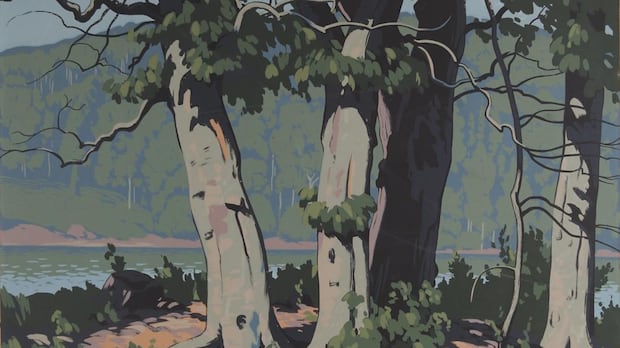
A school board in London, Ont., is using one of Ontario’s strictest secrecy laws to keep details about a small art collection from the public.
Records obtained through freedom of information requests reveal that the collection – owned by Thames Valley District School Board (TVDSB) – includes 84 pieces with a total estimated value of $30,445, or about $360 each, according to an appraisal done in 2012.
The inventory lists some artists included in the collection, allowing CBC to verify works attributed to names like Frank (Franz) Johnston, Manly Mac Donald, and Benjamin Chee Chee. However, many individual titles are hidden behind redactions, making it hard to understand the complete size and scope of the collection.
Ontario school boards have large collections of publicly owned art, much of which was acquired as donations years ago and managed without proper museum resources.
The situation with TVDSB raises larger questions about how public institutions in Canada handle cultural assets like fine art and how secrecy provisions meant for serious situations can apply even when the financial stakes are relatively low.
Board officials stated that interim director Bill Tucker was unavailable for an interview and refused to make him available unless questions were submitted beforehand.
Autumn Scene by Tom Thomson is part of the Toronto school board’s collection and had an estimated value of $1.5 million in 2010. (CBC)
![]() Group of Seven artist Franklin Carmichael’s 1936 oil on panel Cranberry Lake is part of the TDSB’s multi-million dollar art collection. (Toronto District School Board)
Officials withheld information regarding where the artwork is stored or displayed by citing legal exemptions under Ontario’s freedom of information laws related to economic interests and records whose disclosure could “reasonably be expected to seriously threaten the safety or health of an individual.”
Ontario’s information and privacy commissioner states that this exemption should be reserved for cases involving significant risks. has filed an appeal.
TVDSB informed it that no records support a long-standing claim suggesting that one painting at one of its schools was worth millions.
Group of Seven artist Franklin Carmichael’s 1936 oil on panel Cranberry Lake is part of the TDSB’s multi-million dollar art collection. (Toronto District School Board)
Officials withheld information regarding where the artwork is stored or displayed by citing legal exemptions under Ontario’s freedom of information laws related to economic interests and records whose disclosure could “reasonably be expected to seriously threaten the safety or health of an individual.”
Ontario’s information and privacy commissioner states that this exemption should be reserved for cases involving significant risks. has filed an appeal.
TVDSB informed it that no records support a long-standing claim suggesting that one painting at one of its schools was worth millions.
![]() Cara Krmpotitch is a professor of museum studies and associate dean at the University of Toronto. (University of Toronto)
“In some cases they’re poorly documented,” she remarked while adding that organizations such as school boards “aren’t going to have enough funds to care for them properly.”
Krmpotitch emphasized that while these collections might seem small financially, their cultural and educational importance can still be quite substantial-especially when students interact with works by local or Indigenous artists regularly.
Cara Krmpotitch is a professor of museum studies and associate dean at the University of Toronto. (University of Toronto)
“In some cases they’re poorly documented,” she remarked while adding that organizations such as school boards “aren’t going to have enough funds to care for them properly.”
Krmpotitch emphasized that while these collections might seem small financially, their cultural and educational importance can still be quite substantial-especially when students interact with works by local or Indigenous artists regularly.
![]() This $10,000 painting by Herbert S. Palmer was found hanging above the toilet in a principal’s private washroom at Toronto’s Humberside Collegiate Institute in 2016. (CBC)>
Both Krmpotitch and Marinello agree it’s common for artworks found in schools hospitals universities treated more like office decor than cultural treasures-often hanging unmonitored along hallways or offices for decades.>
An example includes when a $10,000 painting by Canadian artist Herbert S. Palmer turned up hanging above a toilet inside a principal’s private bathroom at Humberside Collegiate Institute back in 2016.>
This $10,000 painting by Herbert S. Palmer was found hanging above the toilet in a principal’s private washroom at Toronto’s Humberside Collegiate Institute in 2016. (CBC)>
Both Krmpotitch and Marinello agree it’s common for artworks found in schools hospitals universities treated more like office decor than cultural treasures-often hanging unmonitored along hallways or offices for decades.>
An example includes when a $10,000 painting by Canadian artist Herbert S. Palmer turned up hanging above a toilet inside a principal’s private bathroom at Humberside Collegiate Institute back in 2016.>
Asked what knowledge exists within provincial authorities regarding artwork among supervised boards Emma Testani press secretary wrote:
“In supervised schoolboards ministers tasked supervisors explore every option restore stability protect classroom learning,” her email stated prioritizing resources sent classrooms ensuring teachers receive necessary support maximizing student success.”
.[the] statement failed clarify whether supervisors required inventory report non-financial assets such artwork province maintains own holdings record. Advocates argue discrepancies between fiscal oversight cultural stewardship aren’t exclusive Ontarios across country hospital university Boards hold donated decades ago now exist lack clear accountability frameworks. Krmpotitch emphasizes concern isn’t just hiding undiscovered masterpieces but potential gradual disappearances poorly documented pieces over time “and organization does necessarily fund preservation.”
Source link
Provincial Oversight and Limited Disclosure
The TVDSB is one of five boards in Ontario currently under provincial oversight due to financial mismanagement; this status gives government-appointed supervisors significant power over spending and operations. Among those five boards, only the Toronto District School Board (TDSB) has publicly shared any information about its art holdings, a collection valued at up to $10 million in 2010 with 13 key pieces located at the Art Gallery of Ontario. The other boards have not made similar disclosures. The Peel District School Board, Toronto Catholic School Board, and Ottawa-Carleton District School Board did not respond to requests for comment. A freedom of information request asking for a list of TVDSB’s artworks, their locations, and governing policies was only partially fulfilled. After a second tailored request was made, TVDSB released only aggregate figures.Secrecy as Risk Management
Experts suggest that using safety exemptions in cases like this reflects a broader trend within public institutions where secrecy is often seen as a go-to risk management strategy-even when it may backfire. Cara Krmpotitch, a professor specializing in museum studies at the University of Toronto, noted that the inventory released by TVDSB looks like many small public collections built over time through donations-often before modern documentation standards were established widely.The Importance of Inventories
Christopher Marinello-a lawyer focused on art recovery who founded Art Recovery International based in London-explained that incomplete inventories and undisclosed collections can become increasingly vulnerable over time rather than less so. Marinello described arguing against safety concerns as justification for withholding details about modestly valuable artworks as essentially “an admission they don’t have it properly curated and protected.” “This idea of secrecy is only a short-term solution,” he added. “Many institutions quickly discover it’s more burdensome than beneficial.” < He also pointed out that while some organizations worry disclosing artwork details could pose security threats; secrecy also involves risks if anything happens to those pieces.> “Every item entering an institution needs cataloging; otherwise there’s little hope for recovery” if something goes missing.> “If you don’t know what you possess then you won’t know what’s missing.” >Lack Of Oversight
()Asked what knowledge exists within provincial authorities regarding artwork among supervised boards Emma Testani press secretary wrote:
“In supervised schoolboards ministers tasked supervisors explore every option restore stability protect classroom learning,” her email stated prioritizing resources sent classrooms ensuring teachers receive necessary support maximizing student success.”
.[the] statement failed clarify whether supervisors required inventory report non-financial assets such artwork province maintains own holdings record. Advocates argue discrepancies between fiscal oversight cultural stewardship aren’t exclusive Ontarios across country hospital university Boards hold donated decades ago now exist lack clear accountability frameworks. Krmpotitch emphasizes concern isn’t just hiding undiscovered masterpieces but potential gradual disappearances poorly documented pieces over time “and organization does necessarily fund preservation.”
Source link


