





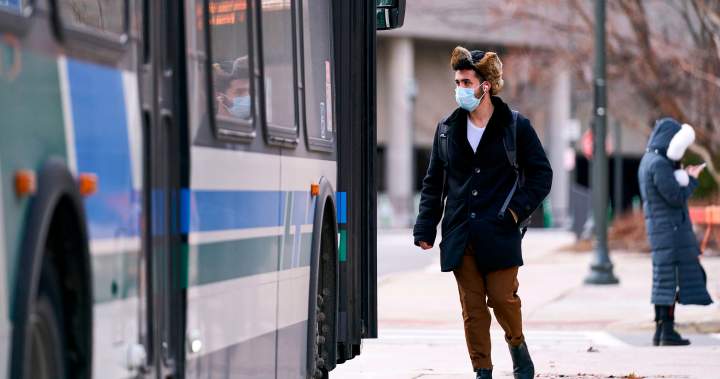
Bus usage in London, Ont., fell by almost two million riders last year due to a reduction in the number of international students in the province.
A report presented to the London Transit Commission, which meets on Monday, outlines how the city’s transit system performed last year compared to expectations.
The actual bus ridership in London, home to Western University and Fanshawe College, was 17.5 million last year, down from 19.2 million the previous year.
“This shortfall is largely attributed to the decline in enrollment of participants in the tuition pass program, which is the direct result of caps on foreign student enrollments at post-secondary institutions,” the report reads.
Additionally, it noted that rides per capita have been consistently declining over the past three years, showing that service growth isn’t keeping pace with London’s population growth.
Story continues below
“This is problematic when the service is already experiencing crowding on many routes and there is limited capacity within approved budgets to increase service levels,” it reads.

![Click to play video: 'Canadian universities, colleges face cash crunch because of student visa cap']() 2:08 Canadian universities, colleges face cash crunch because of student visa cap
Brampton, Mississauga and parts of Waterloo Region were among Ontario’s suburbs that quickly saw transit ridership bounce back after COVID-19; now all three are noting declines in those numbers.
More on Canada More videos
The federal government introduced a cap on international students in January 2024 and later made it stricter. The Ontario government blames this for financial difficulties faced by provincial colleges as even students abroad who can get visas are starting to avoid applying.
Jonathan English, principal at Infrastory Insights, said last month that this policy poses a hurdle for transit agencies but not an existential threat.
Story continues below
“Brampton was the transit success story of North America long before the international boom,” English stated.
“They experienced a 250 percent ridership bump before international students arrived. Is it a significant drop? For sure. And will that have financial consequences? Definitely. But I think we need to keep it in perspective.”
English added that cities should work towards improving services to attract new riders who might not depend as much on transit as students do.
– with files from Isaac Callan
& copy 2026 , a division of Corus Entertainment Inc.
2:08 Canadian universities, colleges face cash crunch because of student visa cap
Brampton, Mississauga and parts of Waterloo Region were among Ontario’s suburbs that quickly saw transit ridership bounce back after COVID-19; now all three are noting declines in those numbers.
More on Canada More videos
The federal government introduced a cap on international students in January 2024 and later made it stricter. The Ontario government blames this for financial difficulties faced by provincial colleges as even students abroad who can get visas are starting to avoid applying.
Jonathan English, principal at Infrastory Insights, said last month that this policy poses a hurdle for transit agencies but not an existential threat.
Story continues below
“Brampton was the transit success story of North America long before the international boom,” English stated.
“They experienced a 250 percent ridership bump before international students arrived. Is it a significant drop? For sure. And will that have financial consequences? Definitely. But I think we need to keep it in perspective.”
English added that cities should work towards improving services to attract new riders who might not depend as much on transit as students do.
– with files from Isaac Callan
& copy 2026 , a division of Corus Entertainment Inc.
Source link
Get daily National news
Get daily Canada news delivered to your inbox so you’ll never miss the day’s top stories. London has now joined other municipalities reporting challenges due to Ottawa’s cap on international students at post-secondary schools. 2:08 Canadian universities, colleges face cash crunch because of student visa cap
Brampton, Mississauga and parts of Waterloo Region were among Ontario’s suburbs that quickly saw transit ridership bounce back after COVID-19; now all three are noting declines in those numbers.
More on Canada More videos
The federal government introduced a cap on international students in January 2024 and later made it stricter. The Ontario government blames this for financial difficulties faced by provincial colleges as even students abroad who can get visas are starting to avoid applying.
Jonathan English, principal at Infrastory Insights, said last month that this policy poses a hurdle for transit agencies but not an existential threat.
Story continues below
“Brampton was the transit success story of North America long before the international boom,” English stated.
“They experienced a 250 percent ridership bump before international students arrived. Is it a significant drop? For sure. And will that have financial consequences? Definitely. But I think we need to keep it in perspective.”
English added that cities should work towards improving services to attract new riders who might not depend as much on transit as students do.
– with files from Isaac Callan
& copy 2026 , a division of Corus Entertainment Inc.
2:08 Canadian universities, colleges face cash crunch because of student visa cap
Brampton, Mississauga and parts of Waterloo Region were among Ontario’s suburbs that quickly saw transit ridership bounce back after COVID-19; now all three are noting declines in those numbers.
More on Canada More videos
The federal government introduced a cap on international students in January 2024 and later made it stricter. The Ontario government blames this for financial difficulties faced by provincial colleges as even students abroad who can get visas are starting to avoid applying.
Jonathan English, principal at Infrastory Insights, said last month that this policy poses a hurdle for transit agencies but not an existential threat.
Story continues below
“Brampton was the transit success story of North America long before the international boom,” English stated.
“They experienced a 250 percent ridership bump before international students arrived. Is it a significant drop? For sure. And will that have financial consequences? Definitely. But I think we need to keep it in perspective.”
English added that cities should work towards improving services to attract new riders who might not depend as much on transit as students do.
– with files from Isaac Callan
& copy 2026 , a division of Corus Entertainment Inc.
Source link