






Whether it was people were visiting St. Jacobs for the market, celebrating Kitchener-Waterloo Oktoberfest or battling it out at a Call of Duty tournament, 2025 was a good year for tourism in Waterloo region. Michele Saran, the CEO of Explore Waterloo Region, says final numbers are not yet confirmed, but the region saw an increase in tourists from the year before, with a vast majority of people coming from the Toronto area as well as southern and southwestern Ontario. She says in 2024, there were about five million visitors to the region who spent about $829 million. “We don’t have all the numbers for 2025 yet, but for the first half of the year we were up two per cent year-over-year in terms of spending and in the summer we were running about five to six per cent … so it was a very good year for us,” she told CBC K-W’s The Morning Edition host Craig Norris. She says there are 500 members of Explore Waterloo Region and “all accounts from our members are that it was a solid year for them.” As for why tourism numbers went up, Saran says they believe it largely had to do with people boycotting travel to the U.S. for their vacations. “People are making the decision to stay closer to home in a lot of cases. We know that over 60 per cent of people are have decided that they’re going to boycott the U.S. and what that does is just adds to the pool of people we have to market to,” she said. Waterloo region has “always been a domestic tourism destination, a drive destination,” she said and people seemed to like the tourism offerings the region had, from long-standing sites like the St. Jacobs Farmers’ Market to new attractions. LISTEN | Explore Waterloo Region CEO Michelle Saran talks tourism stats from 2025: The Morning Edition – K-W7:43Waterloo region sees big boost in tourism Last year was a great one for tourism in Waterloo region. Michele Saran, CEO of Explore Waterloo Region, talks about the highlights.
‘A phenomenal year’
Saran says one area they saw big growth was in esports. “The ‘Call of Duty’ event in June, which was massive, injected $6 million to $8 million into the economy,” Saran said. When the Call of Duty League World Championship was held in Kitchener last June, it was the first time it had ever been held outside the United States. The event, held at the Kitchener Memorial Auditorium, saw eight teams battle it out in the first-person shooter game that throws players into military-style combat for a $2 million US prize pool. WATCH | Kitchener hosted Call of Duty League World Championship in 2025: Kitchener is home to the world’s largest Call of Duty event Call of Duty World Championships have only ever been hosted in major U.S. cities like Los Angeles and Dallas, so why is the first-ever championship outside the U.S. being hosted in Kitchener? CBC Kitchener-Waterloo’s Cameron Mahler went down to The Kitchener Memorial Auditorium to find out. Allister Scorgie, director of sport hosting for Explore Waterloo Region, told at the time that they planned for a long time to bring the event to Kitchener. “Even though we haven’t hosted a big event like this before, [The Aud’s team] was prepared and seasoned to know what to expect,” Scorgie said.More games in 2026
Saran says as for 2026, the region has $90 million already booked for the first quarter alone. “We’re a high tech hub and that’s what it’s all about with esports, high-tech and gaming,” she said. The sports marketing continues this year as Waterloo region is hosting the Ontario Summer Games during the August long weekend. More than 4,000 athletes and their coaches will take part in 23 sporting events and the event is expected to bring millions in revenue for the region as people come to the area and stay here, eating out and shopping at local businesses.Authentic experiences for the win
Saran says authentic and cultural experiences were also a hit with visitors last year. That includes people visiting the areas surrounding the local Mennonite community, as well as new events like the Instagram-friendly Mistletoe Trail and Fields to Flavor Trail, which is a celebration of everything agritourism. “The thought of being able to get out and explore farm life is pretty cool. You get to see farm gates and farmers markets, but also you get to walk an alpaca or do things like goat yoga. This is something you could never dream of if you’re living in, you know, a concrete jungle,” Saran said. Then there were the traditional tourism staples like K-W Oktoberfest and the St. Jacobs Farmers’ Market.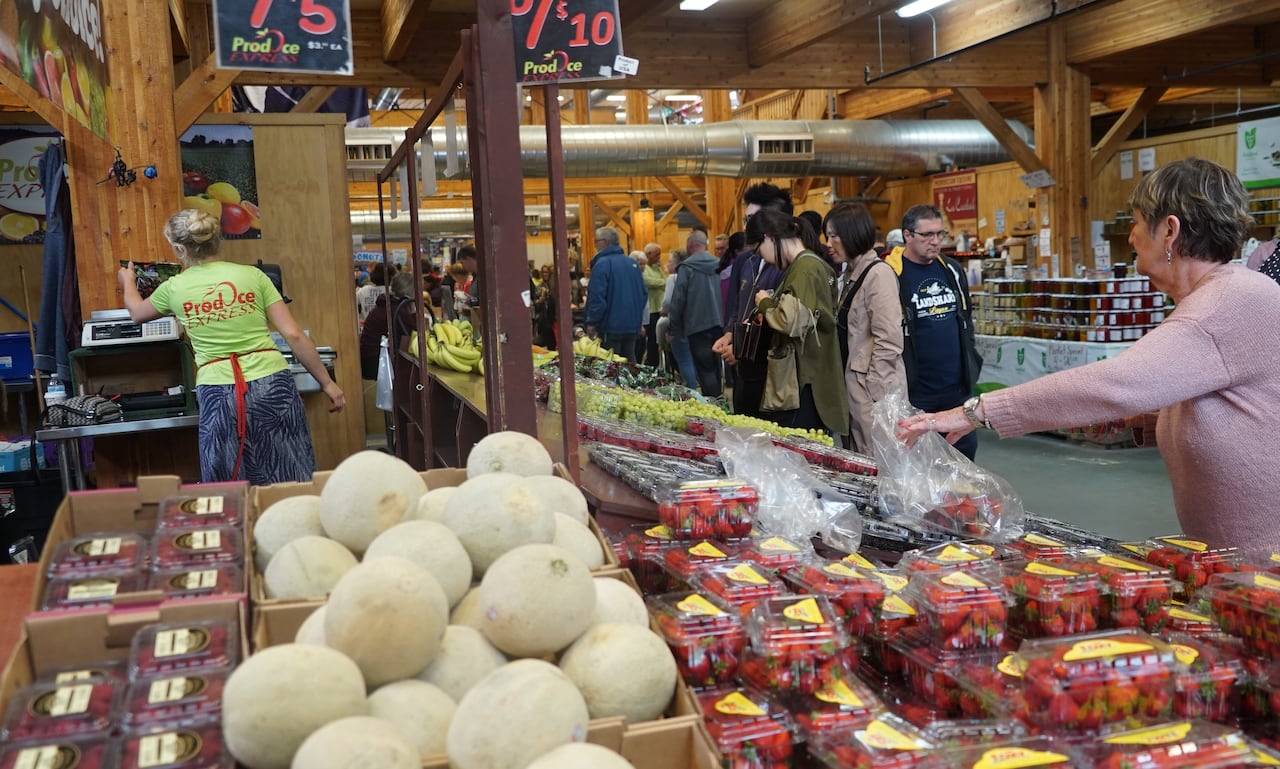 A woman uses a plastic bag for her strawberries at a produce stand in St. Jacobs Market. (Robin De Angelis/CBC)
Joanna Loebach, the general manager of the St. Jacobs Market District, says 2025 was a record-breaking year for the market.
“It was a crazy year for us for sure. Our best year on record,” said Loebach.
“Our attendance for the year was at 1.6 million. For us, that represents a 30 per cent growth over 2024.”
Loebach credits the increase to a number of events planned around the markets 50th anniversary year. She says while the warmer spring, summer and fall seasons are peak, there’s always an event happening in the market district throughout the year.
Tracy Van Kalsbeek, executive director of K-W Oktoberfest, says they noticed an increase in numbers, too, during the annual fall festival.
“Our festhallen partners saw higher attendance this year and our Willkommen Platz numbers over Thanksgiving weekend rose from 34,000 to nearly 39,000,” said Van Kalsbeek.
“I believe this growth not only comes from stronger community engagement and our increased marketing in the GTA and surrounding area, but also from the fact that many Canadians are choosing to stay local rather than head to the U.S.”
A woman uses a plastic bag for her strawberries at a produce stand in St. Jacobs Market. (Robin De Angelis/CBC)
Joanna Loebach, the general manager of the St. Jacobs Market District, says 2025 was a record-breaking year for the market.
“It was a crazy year for us for sure. Our best year on record,” said Loebach.
“Our attendance for the year was at 1.6 million. For us, that represents a 30 per cent growth over 2024.”
Loebach credits the increase to a number of events planned around the markets 50th anniversary year. She says while the warmer spring, summer and fall seasons are peak, there’s always an event happening in the market district throughout the year.
Tracy Van Kalsbeek, executive director of K-W Oktoberfest, says they noticed an increase in numbers, too, during the annual fall festival.
“Our festhallen partners saw higher attendance this year and our Willkommen Platz numbers over Thanksgiving weekend rose from 34,000 to nearly 39,000,” said Van Kalsbeek.
“I believe this growth not only comes from stronger community engagement and our increased marketing in the GTA and surrounding area, but also from the fact that many Canadians are choosing to stay local rather than head to the U.S.”
More space needed to grow
Right now, there are 3,000 tourism businesses in the Region of Waterloo that employ 17,000 people, primarily in the restaurant and transportation sector. Saran says the Waterloo region brand is becoming known, but growth means they could use a few more locations to host business events and more hotel rooms to get people to stay longer. “The only challenge I would say we have in Waterloo region is one of capacity. We don’t have a lot of hotel space in Waterloo region. We have less than 3,000 hotel rooms,” said Saran. “The one reason we don’t get meetings and conferences is that we don’t have adequate meeting space,” said Saran. “That’s a challenge. So something like a convention centre in one of our urban areas would be a huge win for us for a destination.”Source link


